

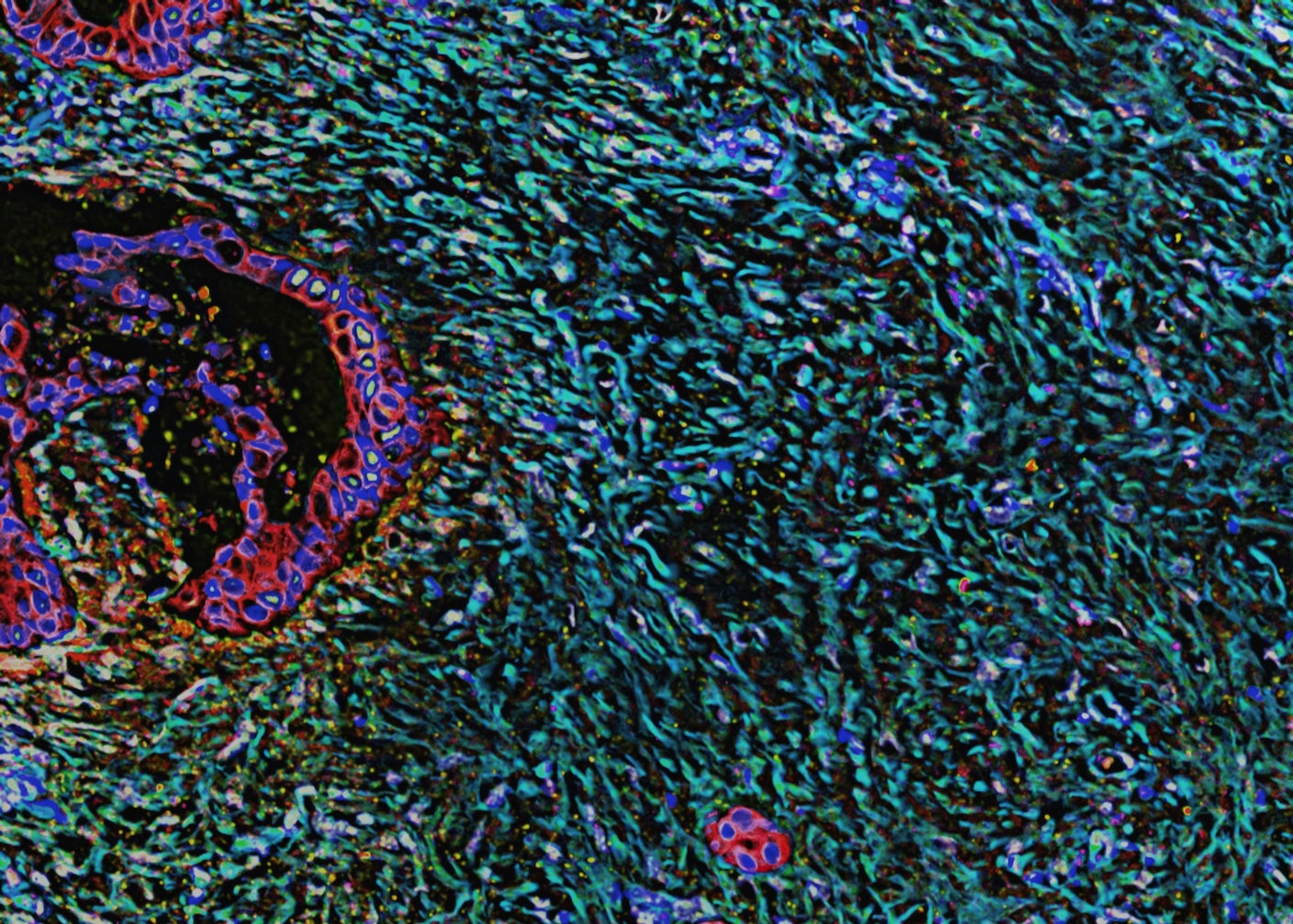

For decades, a handful of molecular switches has haunted the nightmares of cancer researchers. The switches trigger runaway tumor growth and cause the disease to spread across the body in multiple cancers. In theory, this makes them perfect treatment targets. Blocking even one could lead to drugs that are effective against a variety of cancers.
But despite considerable efforts, these switches—all of which are proteins—have escaped our most advanced cancer treatments, earning them the term “undruggable.” This is largely due to a shared trait: They all have smooth surfaces, making it difficult for drugs to interact with them.
But maybe not for much longer.

Researchers recently reported promising results for a new medication targeting a family of undruggable proteins in a clinical trial for advanced pancreatic cancer. The drug, daraxonrasib, nearly doubled survival time compared to chemotherapy, with fewer side effects. It’s not a total cure. But the treatment gives patients precious time, adding roughly 13 months after diagnosis. Patients also reported less pain and better quality of life.
Daraxonrasib is the latest in a new generation of drugs aimed at undruggable proteins. And AI-based tools are now poised to further accelerate progress in the field.
RAS Attack
The RAS family was the first group of oncogenes—or genes that drive cancer—ever discovered. The genes became a major focus in 1982 when several teams independently showed the mutation of a single DNA letter could transform RAS genes into a potent cancer trigger.
The proteins RAS genes encode are like spring-loaded molecular switches that relay signals from a cell’s surroundings. When proteins called growth factors latch onto a cell, RAS switches flip on to promote cell growth and survival, while built-in safeguards quickly turn them off again.
Cancerous mutations break this cycle. The switches get stuck in the “on” position, continuously instructing cells to grow and divide. This is, of course, a hallmark of cancer.
An ideal drug would simply switch RAS off. But most drugs are like rock climbers. They need grooves, pockets, or bumps on a protein to grab onto. Similar to a smooth rock face, RAS offers few such features. Making matters worse, different mutations subtly reshape the protein, so it’s tough to build a one-size-fits-all inhibitor.
The first RAS drug wasn’t approved in the US until 2021, nearly four decades after discovering the genes’ role in cancer. Even then, the drug targeted just one family member of three, limiting its reach to a relatively small group of patients. Many eventually developed resistance.
That’s why daraxonrasib turned heads. Developed by Revolution Medicines in Redwood City, California, the drugs switches off all three RAS family members. Rather than trying to grip the slippery proteins directly, it binds to a partner molecule that helps RAS proteins fold into their final 3D shapes. In this way, the drug hitches a ride on active RAS and shuts the proteins down.
The workaround paid off. The new study enrolled 500 people worldwide with advanced pancreatic cancer. All participants had already tried cancer therapies with limited success. On average, patients receiving daraxonrasib lived 13.2 months and spent most of that time with limited pain. The most common discomfort was a rash. Those receiving chemotherapy fared worse, living roughly 6.6 months and experienced more severe side effects.
The results don’t rival the dramatic success of CAR T cell therapies in blood cancer. In CAR T, caregivers engineer a patient’s own immune cells to recognize and attack tumors, sometimes producing long-lasting remission after a single infusion.
But the findings have energized the field. If approved, a daily daraxonrasib pill would likely be far more affordable and easier to administer than a personalized cell therapy. And because RAS mutations fuel many solid cancers—which CAR T still struggles to control—the drug could offer a new defense against deadly cancers that are largely beyond cell therapy’s reach. Combining daraxonrasib with earlier-generation RAS inhibitors may further boost its effects.
The Genome Guardian
Daraxonrasib didn’t appear overnight. Scientists used a crystallized snapshot of its target protein as a molecular blueprint. Years of medicinal chemistry followed, with scientists repeatedly tweaking candidate compounds to boost potency, improve selectivity, and minimize toxicity.
AI could dramatically accelerate similar efforts against other undruggable cancer targets. Among the most coveted is p53, often called the “guardian of the genome” for its dizzying array of roles. The protein orchestrates the activity of over 300 genes involved in DNA repair, metabolism, cell death, and inflammation, making it one of the cell’s most important defense systems.
Since its discovery in 1979, p53 has been both a holy grail and a headache for cancer researchers. Mutations in the gene are common in multiple cancers. But like RAS, the protein is flat and smooth. Some mutations destabilize its structure; others turn it into misfolded clumps. A universal p53 drug has remained elusive.
Some researchers are trying to restore the protein. In a small trial earlier this year, they tested a drug that restabilizes a common mutant form of p53. Within 21 days, tumors shrank roughly 20 percent in patients with ovarian, breast, and several other solid cancers.
Other researchers aim to selectively kill cells carrying the mutation. Using AI, a team at Baylor College of Medicine screened nearly 10 million compounds that cause mutated p53 cells to self-destruct, while sparing healthy cells. The search uncovered 83 chemically distinct candidates. One called H3 dramatically suppressed tumor growth in mice.
“These results highlight the potential use of AI-powered drug screening to investigate individual p53 mutants in the future,” they wrote. Although the approach is early-stage and only focused on one mutation, the team is hopeful it can be extended to other cancerous mutations.
Most Wanted
MYC is another formerly undruggable protein that could now be vulnerable. Roughly 70 percent of cancers have abnormal MYC activity. Normally, the protein is a master regulator of growth, directing cells to manufacture proteins, replicate DNA, absorb nutrients, and divide when needed.
Cancer finds many ways to hijack the system and keep cells in a state of runaway growth. MYC gene mutations aren’t just single-letter swaps. Sometimes the gene duplicates or is rearranged across the genome, churning out excessive amounts of the protein it encodes. This genetic diversity makes approaches using gene therapy difficult. And again, like RAS, the MYC protein’s smooth, featureless surface lacks stable anchors for drugs.
An emerging strategy is to disrupt MYC’s interaction with other proteins that it needs to function. A designer protein blocking MYC activity, for example, recently showed promise in a small trial against solid cancers. Other teams are using AI to identify drugs that limit MYC’s ability to fix damaged DNA in tumors, kneecapping their ability to divide. Meanwhile, biotechnology companies are deploying AI to map out MYC’s structure and molecular interactions in search of new ways to shut the protein down.
Daraxonrasib’s success shows that undruggable proteins aren’t untouchable. There’s a lot more work ahead to prove other similar drugs can work too. But scientists are increasingly leaning into AI during all stages of drug development to speed up the process. Maybe, one day, “undruggable” will disappear from our vocabulary altogether.
