


Why you can trust TechRadar
We spend hours testing every product or service we review, so you can be sure you’re buying the best. Find out more about how we test.
Bluesound Pulse Cinema Mini: Two minute review
I came to this Bluesound Pulse Cinema Mini with admitted baggage. I’m not gonna sugarcoat it; I did not like Bluesound’s original Pulse Soundbar. It had an awkward design, it sounded cold and clinical, and it was very expensive when compared to alternative products.
The Bluesound Pulse Cinema Mini is company’s latest model, and is still on the pricey side, but where its predecessor disappointed, the Cinema Mini impresses. There’s powerful, rich, and detailed sound, an elegant design that will complement most rooms, and a wealth of features you won’t find from brands like Sonos and Bose.
Like any Dolby Atmos soundbar that tries to do immersive, 3D sound with only two channels, the Pulse Cinema Mini can’t quite deliver on the promise of overhead height channel effects, but it makes up for it with a surprisingly wide soundstage that brings Atmos and 5.1 movies to life, and does wonders for stereo.

Though physically wider than most “mini” soundbars, that’s clearly enabling its biggest strength: it gives the speaker room to house a set of woofers that deliver much bolder low-end bass than the compact category is known for.
This puts the Pulse Cinema Mini in a tricky spot for buyers. It’s priced higher than many full-sized soundbars, yet it can’t quite match the performance of those larger speakers. It’s highly versatile, yet it may be too big for truly small setups.
These contradictions mean the Bluesound Pulse Cinema Mini isn’t a no-brainer-just-buy-it product, but there’s also no doubt in my mind that if you put a high value on the things it well, you’ll be thrilled with it in your home.
Bluesound Pulse Cinema Mini review: Price and release date
- Release date: August 27, 2025
- Price: $999 / £799
Bluesound sells the Pulse Cinema Mini in many international markets, including the US, UK, and Canada. However, it hasn’t yet released the soundbar in Australia.
At $999 / £799, the Pulse Cinema Mini is considerably more expensive than its closest direct competitors, like the Bose Smart Soundbar at $499 / £499.95, and Sonos Beam Gen 2 at $499 / £499.
However, it boasts better performance and has several features that set it apart. The Pulse Cinema Mini includes a wall-mount bracket; it’s larger and more powerful than the Bose and Sonos models, and it includes an analog input, wired subwoofer output, USB storage access, and two-way Bluetooth with aptX Adaptive, all of which are absent on the Smart Soundbar and Beam Gen 2.

Bluesound Pulse Cinema Mini review: Specs
|
Dimensions (W x H x D) |
(W x H x D): 33.34 x 2.91 x 5.51 inches |
|
Speaker channels |
2.0 (2.1 with planned update) |
|
Connections: |
1x HDMI out (with eARC), optical in, RCA stereo in, USB-A, Gigabit Ethernet, RCA subwoofer-out, Wi-Fi (802.11ac), Bluetooth 5.2 (two-way, with aptX Adaptive support) |
|
Dolby Atmos/DTS:X |
Yes/No |
|
Sub included |
No |
|
Rear speakers included |
No |
|
Features |
AirPlay 2, Tidal Connect, Spotify Connect, Qobuz Connect, Roon Ready, multiroom audio, expandable channel layout, hi-res audio |
|
File formats |
MP3, AAC, WMA, WMA-L, OGG, OPUS, FLAC, MQA, ALAC, WAV, AIFF, MPEG-4 SLS, DSD256 |
Bluesound Pulse Cinema Mini review: Features

- Analog, USB, subwoofer, and two-way Bluetooth connections
- Expandable and multiroom compatible
- Hi-res Audio and Dolby Atmos support
As is the case for a lot of small-footprint soundbars, the Bluesound Pulse Cinema Mini doesn’t has only one HDMI port, so you won’t be able to connect devices like streaming video players, Blu-ray players, or game consoles and pass through their video to your TV.
However, it also offers connections that are rarely found in this class of speaker, such as dedicated analog inputs (as well as optical digital), a wired subwoofer output, and a USB port that provides access to music stored on a hard drive.
Even its Bluetooth capability exceeds standard soundbar fare, with its support for Qualcomm’s high-quality aptX Adaptive codec and the ability to stream in two directions: from a phone or computer to the soundbar, or from the soundbar to a set of wireless headphones or a Bluetooth speaker.
Bluesound gets compared to Sonos a lot. Bluesound’s BluOS apps for phones and computers perform many of the same multi-room and music management functions as Sonos’ software.
Like Sonos, Bluesound makes a range of wireless audio devices from speakers to subwoofers to streamers that can all work seamlessly together in one household. The Cinema Mini can be bonded with various combinations of these speakers for a true surround sound experience, or it can simply play the same music at the same time for a synchronized house party.
Thanks to its compatibility with multiple hi-res audio formats and sample rates, many audiophiles feel that Bluesound is superior to Sonos.
Still, there are a few things Bluesound can’t do. You can stream Apple Music via AirPlay or Bluetooth, but neither of these gives you lossless quality, and the BluOS app doesn’t have native support for Apple Music, YouTube Music, or Spotify. Unlike Sonos, there’s no easy in-app room correction here.
It also doesn’t support support DTS, it doesn’t support Google Cast, it’s not compatible with Google Home — but Sonos also lacks these.
Currently, despite its Dolby Atmos certification, native support of Amazon Music, and Tidal Connect compatibility, there’s no way to stream Dolby Atmos Music to the Pulse Cinema Mini without the help of an HDMI-connected third-party device, such as an Apple TV 4K. Since the Mini only has one HDMI eARC port, that device will need to use your TV as a go-between.
Bluesound Pulse Cinema Mini review: Sound quality

- Impressive low end and virtual surround
- No dialogue mode or Low Frequency Effects (LFE) channel
- Great for music, but no EQ, tone control, or Dolby Atmos Music
Before we get into sound quality, a quick note on the Bluesound Pulse Cinema Mini’s stated specifications. Bluesound says it’s a 2.1-channel system, but this isn’t entirely accurate.
According to the company, the soundbar will be capable of processing low-frequency effects (or LFE — the subwoofer part of a soundtrack) without any help from a standalone subwoofer; it’s just that, as of the time of reviewing, it doesn’t actually do so.
For now, if you want true, 2.1 sound from the Cinema Mini, you’ll need to connect a powered sub via the soundbar’s sub output, or buy the Bluesound Plus Sub+ wireless subwoofer.
Having said that, even with only two discrete channels, this is a very capable soundbar for both multichannel and stereo sound. Thanks to a pair of dedicated woofers and passive bass radiators, it pumps out surprisingly deep and resonant bass, which leads me to believe that it will have no problem with LFE channel content when and if Bluesound adds it.
For music, the Cinema Mini’s bass is powerful enough to get by without a subwoofer in smaller rooms.
My experience with two-channel soundbars, even those that can process Dolby Atmos, has been less than stellar. So I have to give Bluesound a lot of credit for the Cinema Mini’s acoustic design and digital signal processing (DSP). With an angled tweeter and midrange driver located at each end of the bar, it projects sound both outward and to the sides, creating a soundstage with remarkable width and detail.
It reminds me a lot of Sennheiser’s Ambeo Soundbar Mini, which also uses just six powered drivers to achieve its virtualized surround sound. Unlike the Ambeo Soundbar Mini, which suffers from a lack of low-end, the Pulse Cinema Mini has a full-range sound that won’t disappoint.
Still, when it comes to Dolby Atmos, you’ll need to temper your expectations. The Cinema Mini’s DSP has to do a lot of heavy lifting to get its two discrete channels to virtualize surround and height content. It does a decent job with the surrounds, but height effects aren’t especially distinct.
During the Aston Martin chase scene from No Time To Die, there’s a moment when the camera passes beneath a set of church bells. Well-executed height systems let you hear the bells move overhead, but the Cinema Mini’s processing just makes the sound bigger, not taller or dynamic.
I find this to be true of nearly all Atmos systems that lack up-firing drivers. The Sonos Beam Gen 2, for instance, doesn’t perform any better in the height department. But the Beam Gen 2 is half the price of the Pulse Cinema Mini. Sonos’ Arc Ultra, by contrast, is basically the same price as the Cinema Mini, and will win any Dolby Atmos competition, hands down.
The same is true when it comes to the Cinema Mini’s lack of an LFE channel. In that same No Time To Die scene, James Bond’s ride is riddled with machine gun fire. When you’re inside the car with Bond, the Sonos Arc Ultra renders each bullet impact viscerally — its built-in subwoofer lets you feel the concussion. It’s still an enjoyable scene via the Cinema Mini (it captures the bullet ricochets nicely), but you’ll definitely need to add a sub if you want deeper cinematic immersion.
For its wide soundstage, the Cinema Mini pays a small price in terms of dialogue clarity. I don’t want to overstate this — I had no problem making out speech — but with no central tweeter or midrange, voices don’t have the same laser-like focus that you’ll get from the Ambeo Soundbar Mini, or even the Bose Smart Soundbar.
As good as TV sound is on the Pulse Cinema Mini, the real reason for dropping a thousand dollars on this speaker is its music performance. I seldom heap praise on soundbars for music listening, but the Cinema Mini is truly superb for its class.

Stereo rendering is where Bluesound’s decision to use a two-channel architecture pays big dividends. Whether you listen with or without the optional Surround Upmixer and Virtualizer modes turned on (inside the BluOS app), the Cinema Mini produces a beautifully balanced, smooth, and detailed sound.
Sitting front and center lets you hear strong stereo imaging and a perfectly placed phantom center channel. But do yourself a favor and turn on the Surround Upmixer and Virtualizer. The purists among you may scoff, but I love the extended width these DSP filters create. The Cinema Mini grows to twice its length — maybe more — and panned stereo sounds seem to float ethereally in the upper front corners of my room.
The bass response, which I’ve come to think of as the Mini’s secret weapon, is well-managed from low to high volumes, musically anchoring tracks with its resonance and weight. Distortion is almost non-existent, and the Cinema Mini effortlessly plays at very loud levels.
If there’s one hitch in an otherwise excellent sound system, it’s that Bluesound is a bit too confident you’ll like its tuning. There are no bass/treble tone controls and no traditional equalizer, or EQ presets — with the exception of three optional listening “modes”: Movie, Music, and Late Night.
I’m familiar with this approach — the Cinema Mini isn’t the first Bluesound speaker I’ve reviewed — but it continues to surprise me, especially given that the company is highly regarded by audiophiles, who tend to have strong feelings about how things should sound.
Would I change much if I actually had access to these settings? Apart from de-emphasizing the highs just a tad, no, I wouldn’t make any other modifications. I really love the way the Cinema Mini sounds.
- Sound quality score: 4.5 / 5
Bluesound Pulse Cinema Mini review: Design

- Elegant, fabric-wrapped, rounded shape
- Larger than many small-room soundbars
- Wall-mountable with auto-orientation detection
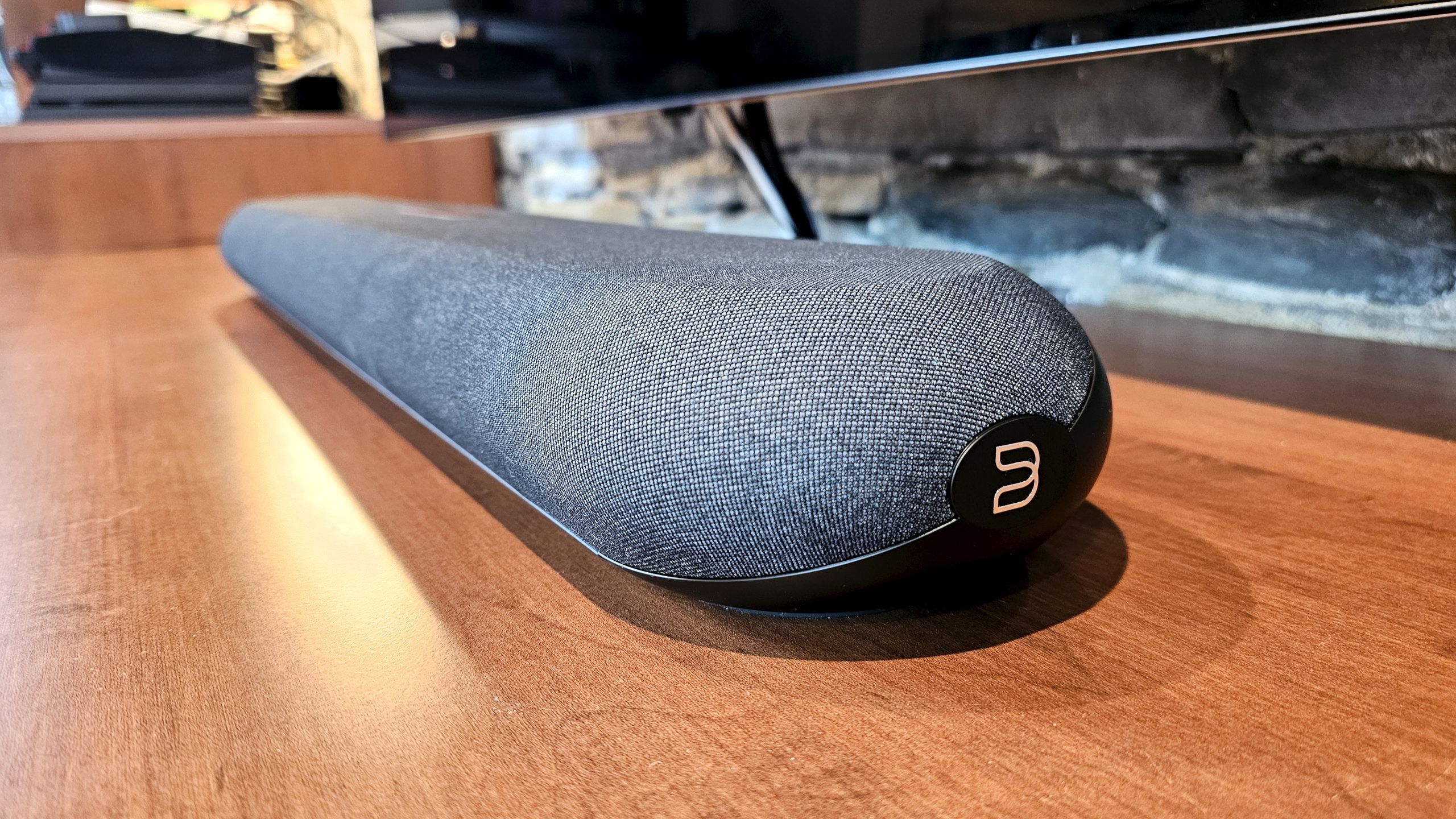
All-plastic construction is the norm for compact soundbars. This doesn’t necessarily mean they look bad — I’d argue the Sonos Beam Gen 2 is quite handsome — but the Bluesound Pulse Cinema Mini’s fabric-wrapped and gently curved shape looks a little more upscale, and a little less speaker-ish.
At 33.3 inches wide, the Cinema Mini is bigger than most compact soundbars. By contrast, the Beam Gen 2 is 25.6 inches, and the Bose Smart Soundbar is 27.3. The Cinema Mini is also slightly taller and deeper. Still, despite this larger footprint, it won’t look out of place under any TV from 32- to 55-inches, and as I noted in the Sound Quality section, this extra size pays dividends.
Under that soft grille lies the Pulse Cinema Mini’s unusual driver arrangement: the midrange drivers and tweeters are placed at the ends, each slightly angled up and out — no front-firing units and no centrally mounted high-frequency driver for dialogue. Meanwhile, the central body is occupied by the two woofers and their matching passive radiators.

This design (plus built-in, automatically triggered EQ changes) lets the Pulse Cinema Mini sound more or less the same whether you place it on a tabletop or mount it to a wall. Unlike the Beam Gen 2 and Smart Soundbar, whose optional wall mount brackets amount to small shelves, the Pulse Cinema Mini’s included hardware lets it cling to the wall without sticking out into the room.
Like Sonos’ speakers, Bluesound doesn’t ship its products with remote controls, but the Pulse Cinema Mini has a built-in IR receiver and can be operated with any IR remote you already own by teaching the soundbar (via the BluOS app) what to do when you press certain remote buttons. Sonos can do this, too, but only when using its soundbars for TV audio.
On the top surface, you’ll find a glass panel that houses the soundbar’s touch controls. Only the central play/pause icon remains lit — the presets and volume icons light up when you approach. There’s no independent volume level indicator, something I wish more companies would offer; however, your TV will likely display an on-screen indicator when the Pulse Cinema Mini is playing TV audio via HDMI.
Bluesound Pulse Cinema Mini review: Setup and usability

- Easy set up with excellent app support
- App has a learning curve
Like most soundbars, getting the Bluesound Pulse Cinema Mini set up at a basic level is super easy: Plug it into your TV using the included HDMI cable, and then plug it into the wall with one of the included power cables (Bluesound puts both North American and E.U. versions in the box). You’ll immediately get great TV sound.
However, TV sound is only half of the experience with the Pulse Cinema Mini. To enjoy its awesome music capabilities, you need the BluOS app for iOS or Android. The app gets the soundbar connected to your Wi-Fi network and enables Apple AirPlay, plus it downloads and installs any available software updates, and gives you all of the deeper controls needed to customize the Pulse Cinema Mini to your liking.
The BluOS app also enables you to access multiple streaming services from a single interface and control playback across all BluOS compatible devices (which includes models from NAD, Dali, PSB Speakers, and Monitor Audio).
The BluOS app is fast and responsive, though, as with any platform that has as many features and options as BluOS, there’s a learning curve. Some things are straightforward, such as browsing music from available services, while others take some getting used to.
For instance, some of the Pulse Cinema Mini’s settings are available from the Now Playing screen or the Players tab, but others are only accessible via the Settings icon on the Home tab, and only if the soundbar is first selected in the Players tab.
There are loads of handy features like alarms, sleep timers, and smart playlists; however, BluOS hasn’t mastered one trick that makes Sonos, Wiim, and Denon/HEOS so appealing for those with multiple sources of music: universal search and favorites management.
If you decide to expand the Pulse Cinema Mini with Bluesound’s Pulse Sub+ and/or Pulse M/Pulse Flex speakers, these can easily be added and configured in the BluOS app.
Bluesound doesn’t integrate either Amazon Alexa or Google Assistant into its products, but if you’ve already got an Alexa smart speaker, there’s a Bluesound skill that will let Alexa control your Pulse Cinema Mini (and any other Bluesound products you add later).
- Setup & usability score: 3.5 / 5
Bluesound Pulse Cinema Mini review: Value

- Expensive, but better sound than the competition
- The best small soundbar for music
- Value grows if you’re planning to expand
Look, there’s no way to justify the Bluesound Pulse Cinema Mini’s price based purely on its performance as a Dolby Atmos soundbar. It’s got great sound, but it can’t hold a candle to bigger, more powerful models such as the Sonos Arc Ultra, Bose Smart Ultra Soundbar, or Sony Bravia Theater Bar 8, which are the same price (give or take $100).
However, there are several other attributes that set the Cinema Mini apart, and these may tip the value balance if you want them. Want to hook up a turntable? Do you have an existing wired subwoofer you’d like to use? Is your room just too small for a full-size soundbar, but you don’t want to compromise on audio quality — especially when it comes to music listening? Do you like the idea of connecting a set of Bluetooth headphones? And are you looking for ultimate flexibility when it comes to expanding both your home theater as well as your whole-home audio?
If you answered yes to any or all of these questions, the Bluesound Pulse Cinema Mini starts to look like it’s worth its nearly $1,000 asking price.
Just keep in mind that Bluesound’s other components often carry similarly high prices. Unless you get a bundle discount, adding the Pulse Sub+ will cost $899, and a pair of Pulse M surrounds adds another $998. You’re now up to $2,896, and your resulting 4.1-channel Dolby Atmos home theater system still lacks a center and height channels. Meanwhile, the same investment can get you a Sonos Arc Ultra + Sub 4 + 2x Era 300, with 9.1.4-channel sound.
Should I buy the Bluesound Pulse Cinema Mini?

|
Section |
Notes |
Score |
|
Features |
Some great rare features, including analog, subwoofer, and 2-way Bluetooth connections. But it’s also lacking some core soundbar features you get in the competition. |
3.5 / 5 |
|
Sound quality |
Impressive low end and virtual surround given its size. Best in class when it comes to music, as well. |
4.5 / 5 |
|
Design |
It has an elegant, fabric-wrapped, rounded shape. Larger than some smaller room soundbars. You can mount it with auto-orientation detection. |
4 / 5 |
|
Setup & usability |
Easy setup here and the app support is great, although using the app does come with a learning curve. |
3.5 / 5 |
|
Value |
There’s no getting around the fact it’s expensive but it is excellent for music and the value grows if you’re planning to expand. |
3 / 5 |
Buy it if…
Don’t buy it if…
Samsung HW-Q990H review: Also consider
| Header Cell – Column 0 |
Bluesound Pulse Cinema Mini |
Sonos Beam Gen 2 |
Bose Smart Soundbar |
Sonos Arc Ultra |
|---|---|---|---|---|
|
Price (May 2026) |
$999 / £799 |
$499 / £499 / $699 |
$499 / £499 / AU$799 |
$999 / £799 / AU$1,799 |
|
Dimensions |
33.34 x 2.91 x 5.51 inches (W x H x D) |
25.6 x 2.3 x 3.9 inches (W x H x D) |
27.34 x 2.21 x 4.01 inches (W x H x D) |
2.95 x 46.38 x 4.35 inches (75 x 1178 x 110.6mm) |
|
Speaker channels |
2.0 (2.1 with planned update) with virtual Atmos |
3.0 with virtual Atmos |
3.0.2 with virtual Atmos |
9.1.4 (including virtual Atmos) |
|
Connections |
1x HDMI out (with eARC), optical in, RCA stereo in, USB-A, Gigabit Ethernet, RCA subwoofer-out, Wi-Fi (802.11ac), Bluetooth 5.2 (two-way, with aptX Adaptive support) |
HDMI (with eARC), Ethernet. 802.11b/g/n/ac, 2.4 and 5 GHz Wi-Fi, AirPlay 2 |
HDMI, Optical, Bluetooth, USB, sub out, IR |
1x HDMI with eARC, Ethernet, Wi-Fi, Bluetooth |
|
Dolby Atmos/DTS:X |
Yes/No |
Yes/No |
Yes/No |
Yes/No |
|
Sub included |
No |
No |
No |
No |
|
Rear speakers included |
No |
No |
No |
No |
How I tested the Bluesound Pulse Cinema Mini
- Used Bluesound Pulse Cinema Mini as main audio system for one week
- Tested in basement media room
- Sources include Apple TV 4K, Nvidia Shield, and streamed music from various apps
I spent a full week with the Bluesound Pulse Cinema Mini as my main audio system for watching movies, shows, and music in my basement media room.
During that time, I played a variety of Dolby Atmos test clips from movies like No Time To Die, Ford v Ferrari, Mad Max: Fury Road, Dune, and Unbroken, paying special attention to details like dialogue clarity, surround sound, and height channel impact.
I streamed most content from an Apple TV 4K connected via an LG OLED TV, which fed the MK2 from its HDMI eARC output, but I also connected an Nvidia Shield TV to an eARC extractor so I could hear the Cinema Mini’s treatment of Dolby Atmos in Dolby TrueHD.
For music, I used a variety of apps, including Tidal, Qobuz, and Amazon Music, listening to a wide range of genres. Some were played from apps on the Apple TV 4K and Nvidia Shield, while others were streamed wirelessly using AirPlay, Bluetooth, Tidal Connect, and Qobuz Connect. I tested several of these within the BluOS app as well.
