

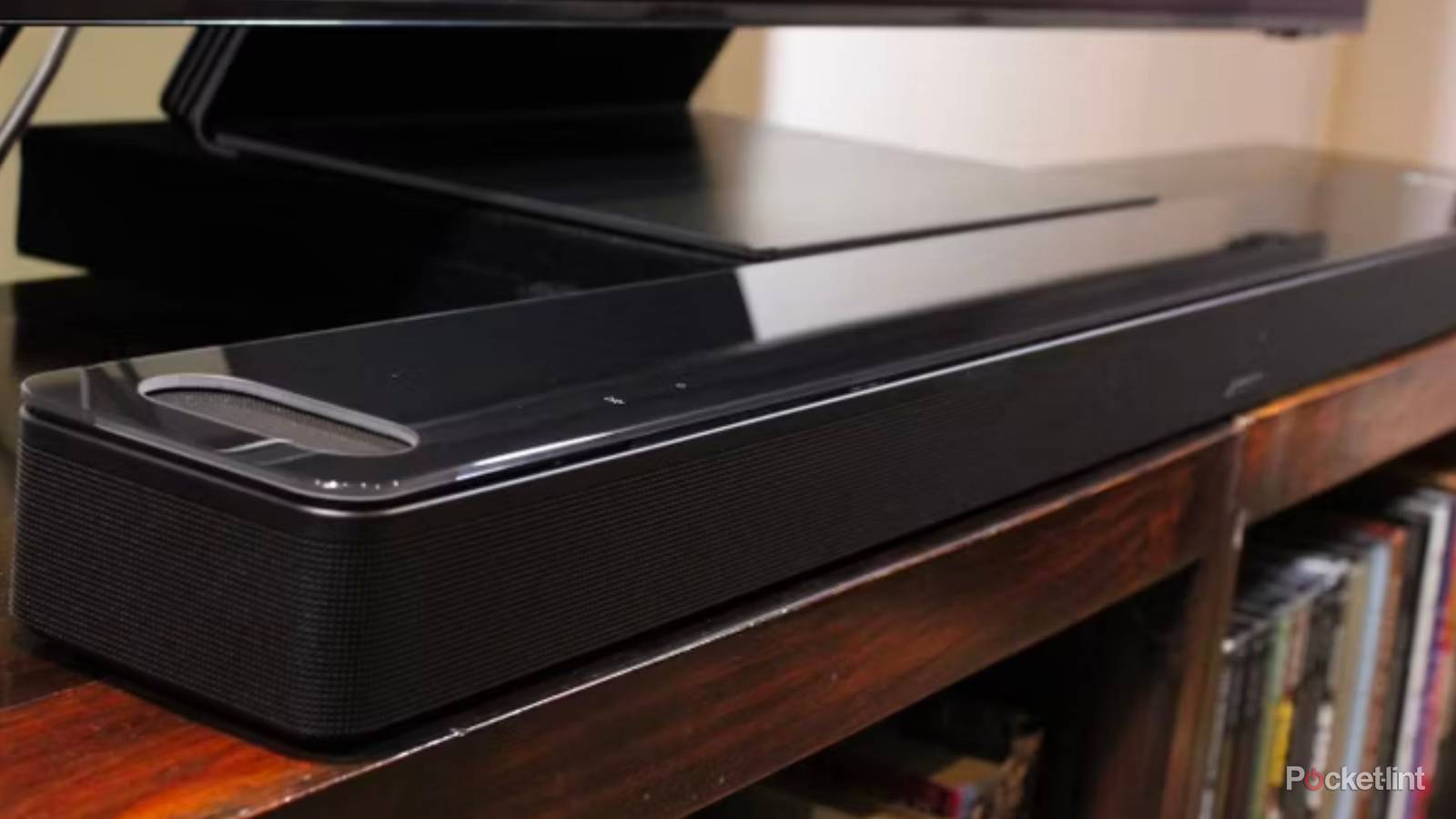

To be clear, I’m going to say something I’ve repeatedly said elsewhere, if not in such explicit terms: you don’t need a high-end soundbar to enjoy a movie. While a cheap bar or your TV’s internal speakers are going to be disappointing with, say, Dune or Terminator 2, the most important thing is the movie itself, followed by a sharp and decently-sized picture, then clear dialogue and bass response. Back in the ’80s, people counted themselves lucky to be able to watch any movie at home in stereo without it being sliced up for commercial breaks.
If you want to take your home theater to the next level, there are a variety of advantages to choosing a high-end soundbar. There’s one in particular I’m going to focus on, but I’ll touch on some of the others too. I’ll also talk about when an alternate approach might be better.
 Quiz
QuizTV speakers and soundbars
Trivia challenge
From built-in tweeters to Dolby Atmos monsters — how much do you really know about TV audio?
SoundbarsTechnologyBrandsFormatsHistory
What does the term ‘Dolby Atmos’ refer to in home audio?
Correct! Dolby Atmos is an object-based audio format that places sounds in a three-dimensional space, including overhead height channels. It was originally developed for cinema in 2012 before making its way into home theatres and soundbars.
Not quite. Dolby Atmos is an object-based surround sound format that adds height channels to create a three-dimensional listening experience. It debuted in cinemas in 2012 and later arrived in home audio products including soundbars.
What does a soundbar’s ‘2.1’ configuration refer to?
Correct! In speaker configurations, the first number represents full-range or satellite speakers, and the ‘.1’ refers to a dedicated subwoofer channel. A 2.1 soundbar therefore has two speakers plus a subwoofer for bass reproduction.
Not quite. Speaker configuration numbers follow a simple convention: the first digit is the number of full-range speakers and the ‘.1’ denotes a dedicated subwoofer. So a 2.1 soundbar has two speakers and one subwoofer.
Which company developed the Acoustic Research bookshelf speaker and is widely credited with popularising the hi-fi speaker market in the 1950s?
Correct! Acoustic Research, founded by Edgar Villchur in 1952, revolutionised speaker design with the acoustic suspension (sealed box) woofer. This innovation dramatically improved bass response from compact enclosures and helped launch the modern hi-fi industry.
Not quite. The answer is Acoustic Research, founded by Edgar Villchur in 1952. His acoustic suspension speaker design transformed the industry by delivering deep bass from a compact sealed cabinet, setting the stage for the hi-fi revolution.
What is the primary purpose of an HDMI eARC connection on a TV?
Correct! HDMI eARC (Enhanced Audio Return Channel) allows a TV to send high-quality audio — including lossless formats like Dolby TrueHD and DTS-HD Master Audio — downstream to a soundbar or AV receiver. It improved on the original ARC standard, which was limited to compressed audio.
Not quite. HDMI eARC stands for Enhanced Audio Return Channel, and its job is to send audio from the TV to an external speaker system such as a soundbar. Unlike original ARC, eARC supports lossless audio formats including Dolby TrueHD.
In what decade did the first commercially available soundbar products begin to appear on the consumer market?
Correct! Soundbars began appearing as commercial consumer products in the early 2000s, driven by the rise of flat-panel TVs whose slim profiles left little room for decent built-in speakers. Brands like Yamaha were among the early pioneers of the format.
Not quite. Soundbars emerged as a consumer product category in the early 2000s. The shift to thin flat-panel televisions created a need for a compact audio solution, and companies like Yamaha helped popularise the soundbar as an accessible alternative to full surround sound systems.
What technology do upward-firing drivers in a soundbar primarily aim to simulate?
Correct! Upward-firing drivers are designed to bounce sound off the ceiling and back to the listener, simulating the overhead height channels used in object-based formats like Dolby Atmos and DTS:X. They allow a soundbar to approximate a full overhead speaker setup without ceiling-mounted speakers.
Not quite. Upward-firing drivers bounce audio off the ceiling to simulate overhead height channels, which are a key part of object-based formats like Dolby Atmos. It’s a clever workaround that avoids the need to physically mount speakers in the ceiling.
Sonos launched its first wireless home speaker system in which year?
Correct! Sonos launched its first product, the Sonos Digital Music System, in 2004. It was a groundbreaking multi-room audio system that allowed users to stream music wirelessly throughout the home, well before smart speakers became mainstream.
Not quite. Sonos actually launched its first wireless multi-room audio system in 2004, making it a very early pioneer in the wireless speaker space. The company helped define the category years before smart speakers like Amazon Echo became common household names.
What does ‘passive radiator’ mean in the context of a TV speaker or soundbar design?
Correct! A passive radiator is a diaphragm with no voice coil or magnet — it moves purely in response to changes in air pressure inside the cabinet caused by an active woofer. This allows manufacturers to extend bass response without using a bass reflex port, which is useful in slim soundbar designs.
Not quite. A passive radiator is an unpowered driver — essentially a cone or diaphragm with no voice coil — that vibrates sympathetically with the air pressure generated by an active woofer. It’s a common technique in compact soundbars to boost bass without adding a port or increasing size.
Your Score
/ 8
Thanks for playing!
The one-and-done solution…possibly
Fixing the fun-to-frustration ratio

The primary advantage is getting most of the benefits of a multi-speaker configuration in a compact package — one that’s easier to install, to boot. That last point shouldn’t be undersold. While it doesn’t necessarily take forever to install a true 5.1- or 7.1-channel system, it’s all too easy for that to get complicated. You might have to rearrange furniture, install wall mounts, or buy a receiver. If nothing else, you’re forced to figure out how you’re going to plug in all those cables, preferably in a way that avoids tripping hazards or being too conspicuous. Some enthusiasts take things to another level, installing ceiling channels to get native vertical effects out of Dolby Atmos or DTS:X.
The best soundbars are true all-in-one products, using drivers deliberately aimed at your ceiling and walls to produce spatial audio without the need for additional hardware. The Sonos Arc Ultra, for instance, is equipped with a whopping 14 drivers, in theory simulating a 9.1.4-channel Atmos setup without making your wiring any more complex than an HDMI eARC connection and a single power cord.
I say “in theory” because there are, of course, some limitations to this approach. These bars require calibration for your specific room, and some rooms will naturally be better suited than others, depending on factors like materials, obstacles, and wall decorations. Ideally, sound should be bouncing off of hard, unadorned surfaces — but good luck convincing your partner to swap out their posters or plants for acoustic panels.
Dedicated satellites will naturally provide more oomph, and potentially better frequency coverage, depending on their exact specs. Still, I consider this a worthwhile sacrifice, since I’m not sold on the idea of spatial audio being essential in the first place. Sure, it’s impressive when it’s done well, but I wasn’t really complaining about stereo. Anything beyond that is a plus. As I said up top, my priorities in the audio department are clarity and bass.
Speaking of bass, you might be tempted to at least add a dedicated subwoofer, which makes sense if you really want the room to rumble during explosions or that first appearance of the T-rex in Jurassic Park. I’m going to argue, though, that the majority of people don’t need one. A lot of these bars produce heavy bass on their own, so much so that in an apartment, you might trigger noise complaints without any help. I wouldn’t bother shopping for a subwoofer these days unless I knew there was zero chance of it rattling someone else’s walls.
Something I haven’t touched on much here at Pocket-lint is the convenience of an all-in-one product when moving. It may be awkward to pack an ultra-long bar if you haven’t kept the original box, but that’s still better than having to disassemble a multi-speaker system, which will probably demand multiple boxes, and is probably the last thing you want to cope with on your way out the door. Obviously, this is less of a concern if you’re a homeowner. Many people aren’t that lucky, however, and even homeowners can end up relocating frequently. I’m about to sell my third house in eight years. Hopefully the fourth will be something I hold onto longer, but it’s difficult to predict where life will take me.
What else do you get with a high-end soundbar?
Maybe the meat of the matter

Those extra drivers aren’t just for spatial audio. They’re also intended to cover wide frequency ranges, with tweeters tackling the highs, and woofers handling the low end. You don’t necessarily have to splurge to get good coverage, but if you do, you’ll get clear and punchy audio without distortion, no matter what volume level you’re at. Dialogue and bass-booster enhancements can be a workaround with cheaper bars, but those inherently compress range.
Spending big also usually gets you advanced smart functions, such as voice control, automatic room calibration, and/or the ability to stream music and podcasts without using Bluetooth or turning on your TV. Bluetooth simply can’t match the fidelity or spatial audio support of Wi-Fi, since it’s designed as a low-power technology.
In some cases, if you choose a speaker brand that matches your TV, you can unlock other perks. LG, for example, supports wireless pairing with compatible sets — no HDMI cable required — and integration of your TV’s internal speakers into the mix. Those things don’t matter much to me personally, yet I can see how someone would go that route if they wanted a minimalist setup, and didn’t care about being locked to a TV brand to keep those extra features working.
You may also get more expansion options. While you’ll find plenty of cheap Atmos systems on Amazon, they’re often sold as package deals — you have to pick 5.1 or 7.1 from the get-go or forever hold your peace. Conversely, the Sonos ecosystem lets you add or replace elements at will, including the bar itself. You might, for instance, stick to a Beam in your current apartment, but add a pair of Era speakers once budget and noise pollution aren’t concerns.
When should you choose something else?
Sit down, be humble

If you are a homeowner or just don’t mind turning things down (or switching to headphones), I’m not going to discourage you from buying a multi-speaker system. You’ll get the best possible audio — it’s just that you may have to spend a few thousand dollars to maintain fidelity, rather than $1,000 or so. It’s time to weigh the other things that money could buy you. After all, an Atmos system with dedicated ceiling channels isn’t much good if you can’t afford the Blu-raysor premium streaming plans needed to exploit it.
My recommendation to most people is to focus on sound quality first, treating Atmos, DTS:X, and even smart features as perks that are simply nice to have when they come along for the ride, or you get that bonus pay at work. Sonos’ entry-level Ray soundbar will be a massive improvement over any TV’s internal speakers, despite it being a stereo product with zero spatial audio support — its optical connection doesn’t have the bandwidth. Indeed some of you should probably insist on an HDMI soundbar for its convenient control, regardless of whether it comes with Atmos or killer woofers.

- Connectivity
-
HDMI eARC, Bluetooth, Wi-Fi, Apple AirPlay 2
- Audio Channels
-
9.1.4
- Surround Sound Support
-
Dolby Atmos
