

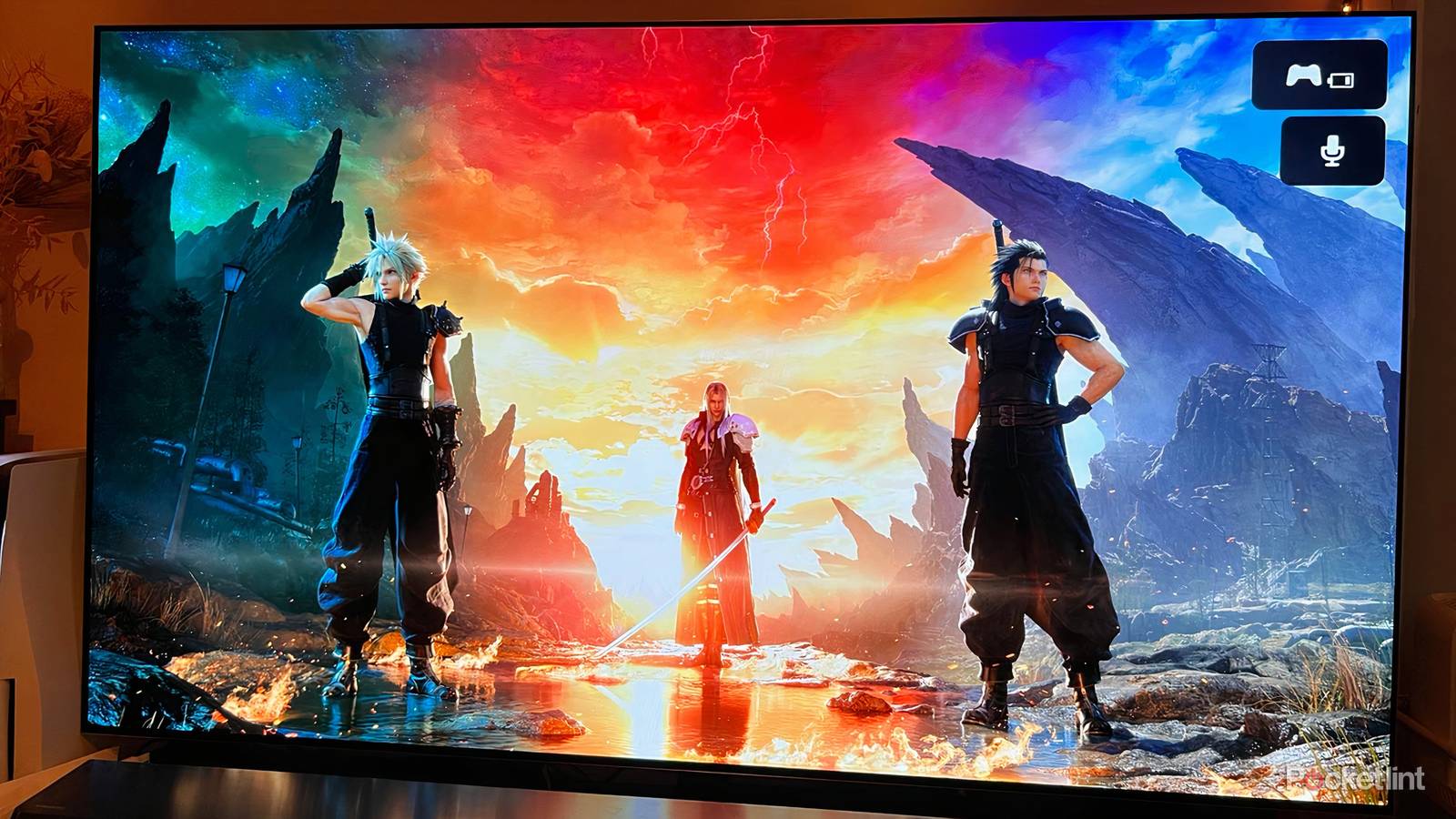

As TV manufacturers continue to innovate, seeking to create a more detailed, immersive home entertainment experience, there are some hits and misses when it comes to smart TVs. A pursuit that falls into the latter category, at least for the time being, involves 8K resolution. It makes sense that companies would strive for this highly detailed resolution: there was 720p, then 1080, and then 4K resolution. It follows that 8K would be the next mountain to scale.
However, even though there are 8K TVs available, there are large barriers to these products that have made them mostly an afterthought. They are not caught up and with good reason. Don’t buy an 8K TV. Here’s what you should do instead.
 Quiz
Quiz
8K TV trivia
The ultimate resolution challenge
Think you know your pixels from your panels? Put your 8K TV knowledge to the
test.
ResolutionTechnologyBrandsStandardsHistory
What is the exact pixel resolution of an 8K TV display?
Correct! 8K resolution is 7680 x 4320 pixels, which works out to around
33 million pixels in total. That’s four times the pixel count of a 4K display and a staggering 16 times
more than a standard 1080p Full HD screen.
Not quite. 8K resolution is 7680 x 4320 pixels. You may have been
thinking of 4K (3840 x 2160) or Apple’s 5K iMac display — both impressive, but neither reaches the
heights of true 8K.
Which organization officially defined the 8K Ultra HD standard for consumer
televisions?
Correct! The International Telecommunication Union (ITU) defined the 8K
Ultra HD standard under its BT.2020 recommendation. This standard covers not just resolution but also
color space, frame rates, and bit depth for next-generation displays.
Not quite. The ITU (International Telecommunication Union) is
responsible for defining the 8K Ultra HD standard through its BT.2020 recommendation. The ITU is the
UN’s specialized agency for information and communication technologies.
Which company became the first to commercially sell an 8K television to consumers?
Correct! Samsung launched the first commercially available 8K consumer
TV — the Q900R QLED — back in 2018. It was a landmark moment for display technology, even if content and
affordability remained significant barriers at launch.
Not quite. Samsung beat rivals to market by launching the first
commercial 8K TV, the Q900R QLED, in 2018. While Sharp had demonstrated 8K technology earlier in
professional settings, Samsung was first to bring it to consumers.
What is the minimum HDMI specification required to carry a native 8K signal at 60Hz?
Correct! HDMI 2.1 introduced a massive bandwidth boost up to 48Gbps,
which is essential for carrying 8K video at 60Hz. Earlier HDMI versions simply don’t have enough
bandwidth to handle the enormous data throughput that 8K requires.
Not quite. You need HDMI 2.1 to carry an 8K signal at 60Hz. HDMI 2.0b
tops out at 18Gbps, which is enough for 4K HDR but falls well short of the 48Gbps bandwidth that 8K at
60Hz demands.
What technique do most 8K TVs use to improve the appearance of lower-resolution
content on their screens?
Correct! Since native 8K content is extremely rare, manufacturers rely
heavily on AI upscaling processors to intelligently enhance 4K, HD, and even standard-definition content
to near-8K quality. Samsung’s Neural Quantum Processor and Sony’s Cognitive Processor XR are well-known
examples of this technology.
Not quite. AI upscaling is the key technology here. Because almost no
native 8K content exists for everyday viewing, brands like Samsung and Sony have invested heavily in
AI-driven processors that analyze and enhance lower-resolution footage frame by frame.
What is the name of Sony’s flagship 8K TV panel technology used in its premium
Master Series sets?
Correct! Sony’s 8K Master Series TVs use Full Array LED backlighting
combined with their proprietary processing. Sony has leaned into precise local dimming zones and their
Cognitive Processor XR to deliver the picture quality their flagship sets are known for.
Not quite. Sony uses Full Array LED technology in its flagship 8K sets,
paired with its Cognitive Processor XR. Neo QLED is actually Samsung’s mini-LED marketing term, while
QNED belongs to LG’s lineup.
Which video codec is most commonly associated with encoding and streaming native 8K
content?
Correct! H.265, also known as HEVC (High Efficiency Video Coding), is
the codec most widely used for 8K content because it compresses video roughly twice as efficiently as
H.264. This makes it far more practical for storing and transmitting the enormous file sizes that 8K
footage generates.
Not quite. H.265 (HEVC) is the codec most commonly used for 8K video.
While AV1 is a promising open-source alternative gaining ground on streaming platforms, H.265 remains
the dominant standard for 8K broadcast and physical media applications.
At which major sporting event did Japan’s NHK broadcaster debut the world’s first
live 8K public broadcast?
Correct! NHK, Japan’s public broadcaster, made history by conducting the
world’s first live 8K public broadcast during the 2016 Rio Olympics. It was a major milestone that
demonstrated 8K’s real-world potential long before consumer TVs became widely available.
Not quite. NHK first publicly broadcast live 8K footage during the 2016
Rio Olympics, showing it in special public viewing venues in Japan. NHK has long been a pioneer of 8K
broadcasting and continues to run a dedicated 8K satellite channel in Japan.
Your Score
/ 8
Thanks for playing!
Why 8K TVs aren’t worth it
Video hasn’t caught up to the screen technology

Myriad reasons have led to 8K stalling out, though perhaps the most noteworthy is the lack of value. 8K TVs come at a high cost. They are more difficult and expensive to make, and they come with a higher price tag than 4K alternative. That invesetment, however, doesn’t open a lot of new doors.
That’s because there isn’t a lot of native 8K content available to watch. There are some videos on YouTube and a few other websites, but there aren’t any streaming services that offer 8K and there aren’t any Blu-ray available in 8K. As a result, what you’ll be watching on an 8K TV is 4K video that is upscaled. It may look better and more detailed, but that will be relative, based on the quality of what you’re watching and the way it’s being transmitted to your TV.
Without much native 8K content available, it makes such a TV a questionable investment. Instead of spending that extra money, reroute it to other areas of your home entertainment system.
Invest in top video formats
Prioritize color, contrast, and brightness

Instead of boosting resolution, you’ll be better served investing in either of the top two video formats: HDR10+ or Dolby Vision. Both of these dynamic formats signicantly improve contrast and color on the scene, creating deeper blacks, more vibrant colors, and sharper boundaries between shades.
Most smart TVs and streaming platforms come with some kind of HDR. High Dynamic Range improves a TV’s color range and contrast; HDR10 is the basic, universal format that most people will encounter. However, it’s worth looking at the top formats above standard HDR10 because these adjust the image on each and every scene. Whereas HDR10 is static, toggling color and contrast to a single state throughout a title, HDR10+ and Dolby Vision are dynamic.
Dolby Vision is the more premium offering; it’s a licensed format that tends to increase the price of associated smart TVs and platforms. It has a slightly larger color gamut, however, many users likely won’t notice a big difference between this format and HDR10+.
Keep in mind, though, that every part of your entertainment system needs to be compatible. Some TVs only offer one format or the other, and some streaming platforms only offer one format or the other. If your TV only serves HDR10+ and you’re watching a movie that is only available in Dolby Vision, the experience will be downgraded. Ideally, your TV is connected online via the ethernet and any physical media player is connected to your TV with an HDMI 2.1 cable.
Consider an OLED smart TV
Achieve true black and infinite contrast ratio

Another worthwhile investment instead of an 8K TV would be a 4K OLED model. Organic LED TVs offer better contrast than LED units, and, as a result, can adhere closer to a director’s vision. These TVs are ideal for those seeking cinematic fidelity.
An infinite contrast ratio, in my opinion, is far superior to detailed 8K resolution, which is what an OLED TV will provide. These units don’t have a backlight, but instead feature individual pixels on the screen that can turn completely off on their own. That means they can achieve true black, which makes for the best contrast on screen. You will be able to discern more details in darker scenes, and you won’t have issues with shadows or blurring.
LED TVs boast about aspects like peak brightness and explosions of color, but they can still struggle with contrast. That’s because these models use a backlight that can dim but never get things to true black. Some LED TV feature numerous zones so that there is more control over which parts of the screen grow brighter and which grow dimmer. Some of these models offer quality contrast, but that infinite contrast ratio can only be achieved when a pixel can go completely black.
Make sure your audio system is complete
Create a theater-like experience at home

A home entertainment experience isn’t just about what you see. It’s important to consider audio, especially for those who want to immerse themselves in an epic blockbuster or prestige series. It’s worthwhile investing in a three-channel soundbar to begin your sound system. Three channels, as opposed to simply two, give you a center channel in addition to a left and right so that dialogue is clearer and music can be louder.
Once you have a three-channel soundbar, then you can consider expanding to five, seven, and even nine channels. That would be you invest in rear speakers, side speakers, and potentially even ceiling ones to create spatial audio. This can be a big investment over time, but it’s better than spending money on an 8K TV. When you have sound all around, you’ll feel like you’re watching a movie in a theater. And it’s not just good for movies and shows; you can better enjoy concerts and music on your TV too when you invest in a quality soudn system.
