


Streaming music puts millions of songs in our hands at a low monthly cost, but it encourages the use of wireless protocols with serious bottlenecks. When streaming high-resolution lossless music through a Wi-Fi network or cellular connection, speed and bitrate become concerns. Using a Bluetooth connection to connect your streaming device to earbuds, headphones, or speakers means you’ll be further limited to the bitrate of the Bluetooth audio codec used. Streaming sounds “bad” when your gear and wireless communication protocols aren’t good enough to support the quality of files you want to play.
I use Ethernet throughout my home, but I didn’t expect it to solve my biggest problem with music streaming. Then, I tried a review unit of the Fiio K15 desktop amplifier. It’s frankly too expensive of an amplifier for my budget. That said, the amp’s support for Gigabit Ethernet and multiple lossless streaming methods makes it unlike any other DAC or amplifier I’ve tried.
Lossless audio is pointless without these cheap Android accessories
Want to use Apple Music or Spotify’s lossless audio support? You’ll need some extra gear to make the most of it.
This DAC uses Wi-Fi and Ethernet for streaming
I didn’t know I needed Gigabit Ethernet in my amplifier until I tried it
The Fiio K15 retails for $599, which is in a different stratosphere compared to the Fiio K11 I bought for my desk. I’m no stranger to high-end audio gear, as my living room setup includes an $880 Dolby Atmos A/V receiver and a 5.1.2 speaker layout. That receiver supports Wi-Fi and Ethernet, but desktop solutions I’ve used typically receive audio directly from a USB, optical, or line input rather than stream it independently.
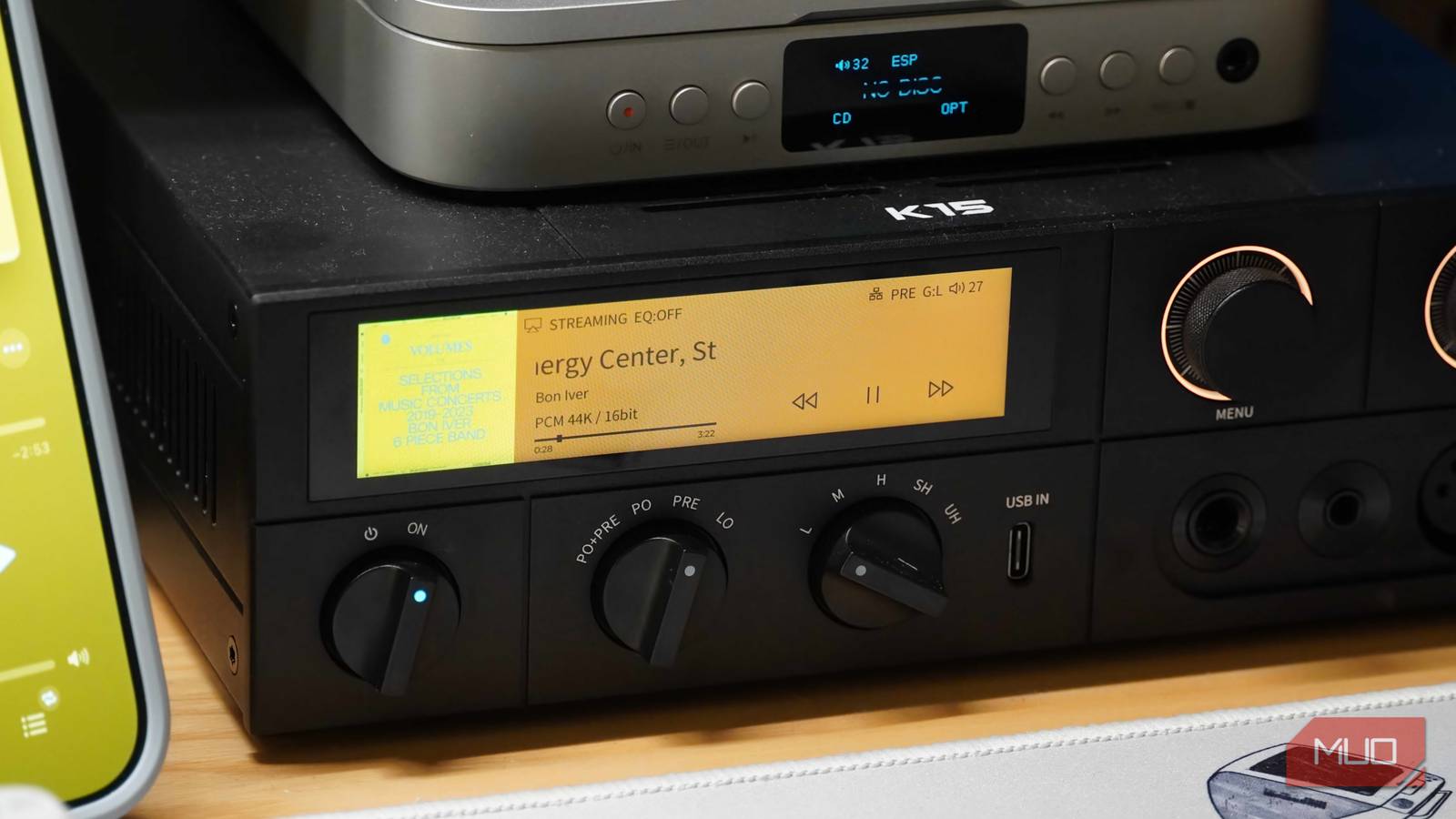
Instead, the Fiio K15 is less reliant on wired audio inputs. It has a slew of knobs and switches on the front of the device for tactile control, and a built-in 3.93-inch touchscreen. This is an upgrade compared to the Fiio K11 I usually keep on my desk, as that digital-to-analog converter (DAC) only has one knob for manual control. The amplifier’s standalone UI comes with a serious learning curve, so you may still prefer to use the companion app, remote, or physical knobs instead.
It’s impossible to understate the importance of that touchscreen, though. It helps the Fiio K15 stream music from nearby devices and home media servers. Bridging the connection is dual-band Wi-Fi with support for 2.4GHz and 5GHz networks, but the more exciting addition is the Ethernet jack on the back. It supports Gigabit speeds, and takes stress off your wireless network. By hooking up your amplifier to Ethernet, every audio output connected to it immediately becomes capable of stable lossless music playback.
Ethernet allows you to stream true CD-quality audio while avoiding the constraints of a wireless-only setup. The touchscreen makes it possible to change songs, play/pause media, and adjust playback options straight from the amplifier.
I never use Wi-Fi for these 4 tasks, and using Ethernet instead saves me hours each week
I don’t try to run Ethernet cables to every device in my home. Instead, I use it for specific tasks, and I save time in the process.
Use AirPlay 1 and Roon to stream to your desktop gear
AirPlay 1 might actually be better than AirPlay 2 for high-fidelity playback

Whether you use a streaming service or a self-hosted music server for wireless playback, the Fiio K15 can handle it. The amplifier supports AirPlay 1 — not AirPlay 2 — and I think this is by design. AirPlay 2, like Google Cast, has a tendency to downsample or compress lossless audio during the transmission process. The original version of AirPlay supports true 16-bit, 44.1kHz streaming, making it ideal for lossless playback.
The difference comes down to bitrate. AirPlay 1 regularly reaches bitrates between 720Kbps and 1,000Kbps, whereas AirPlay 2 is compressed to 256Kbps. With the Fiio K15 connected to Ethernet, you can guarantee you’re getting stable playback at the highest quality settings.
When using AirPlay to stream, a known issue causes the album artwork to freeze on the first song and fail to update. In the official user manual, Fiio says: “This is an iOS issue, and we hope it will be resolved in future updates.” Whoever is to blame, this bug is a snag in the AirPlay experience, and I hope Fiio is doing everything it can to fix it.
For those into self-hosting with a music server or NAS, the Fiio K15 also supports Roon. It’s a platform that provides access to local music files on your network, plus songs available on music streaming services. In other words, Roon consolidates music stored locally, music stored on your network, and music streamed from subscription services. The Fiio K15 is a Roon Ready endpoint, meaning you can stream music from Roon through the amplifier and any of its connected outputs.
Use the K15 amplifier with Roon backed by that Gigabit Ethernet connection, and you can stream even higher-quality audio than if you had used AirPlay. The platform natively supports sample rates between 44.1kHz and 192kHz using the Fiio K15, which covers not only lossless, but the upper tier of quality typically referred to as “high-res lossless.” Roon can handle files up to 384kHz, but they are downsampled to 192kHz or below before reaching the K15.

Depending on the speed of your Wi-Fi network, streaming this quality of music can be taxing. It all depends on what else is going on at the same time. Have tens of smart home devices on your network or a big household where multiple concurrent 4K streams are common? Your Wi-Fi network is already strained, and taking your amplifier off Wi-Fi and onto a Gigabit Ethernet could be the streaming fix you need.
I turned my wired audio setup into a multi-room wireless speaker system for cheap
I picked up used Apple AirPort Express base stations for just a few dollars each and transformed my wired audio gear into AirPlay-compatible speakers.
Lossless streaming is pointless — unless it’s done like this
You need a proper DAC, amp, and balanced audio outputs to get the most of it

Lossless audio is little more than a gimmick without the right gear. Using a lossy Wi-Fi or Bluetooth transmission protocol, and you’re barely enjoying the benefits of the higher-quality files. On bad Wi-Fi networks, these larger files can stutter or lag. This is why, on paper, a device like the K15 with a great DAC, amplifier, and Gigabit Ethernet jack is the perfect way to maximize lossless streaming.
Looking past the specs, the $599 price point will be the sticking point. It’s more than I would spend on personal gear, and I think there are better ways to put that amount of money to use, unless your setup is otherwise outstanding already. If it is, the Fiio K15’s wired networking and streaming chops make it an attractive option for those looking to rely less on Wi-Fi.

- Color
-
Black, Silver
- Bluetooth
-
Bluetooth 5.1 (LDAC/aptX Adaptive)
- Wi-Fi
-
2.4G/5G dual-band (and Gigabit Ethernet)
- DAC
-
Dual AK4497SVQ DACs
- Amplifier
-
3000mW x2 Balanced Power
The Fiio K15 is a powerful desktop DAC and amplifier with a small touchscreen and a variety of audio inputs and outputs. The amplifier supports dual-band Wi-Fi and hardwired Gigabit Ethernet connections. It can be used with digital, analog, and optical inputs, as well as for streaming as a Roon Ready endpoint and AirPlay-compatible receiver.
