

Close Menu

    Subscribe to Updates

    Get the latest Tech news from SynapseFlow

    What's Hot

    iPhone 18 Pro vs Google Pixel 11 Pro: iOS or Android?

    September 13, 2026

    I’ve tried dozens of Android launchers, but I always end up reinstalling this one

    September 13, 2026

    Think twice before wall mounting that new TV

    September 13, 2026
    Facebook X (Twitter) Instagram
    • Homepage
    • About Us
    • Contact Us
    • Privacy Policy
    Facebook X (Twitter) Instagram YouTube
    synapseflow.co.uksynapseflow.co.uk
    • AI News & Updates
    • Cybersecurity
    • Future Tech
    • Reviews
    • Software & Apps
    • Tech Gadgets
    synapseflow.co.uksynapseflow.co.uk
    Home»Future Tech»NASA’s Hubble Spots Star-Spangled Cosmic Scene
    NASA’s Hubble Spots Star-Spangled Cosmic Scene
    Future Tech

    NASA’s Hubble Spots Star-Spangled Cosmic Scene

    The Tech GuyBy The Tech GuyJuly 5, 2026No Comments3 Mins Read0 Views
    Share
    Facebook Twitter LinkedIn Pinterest Email
    Advertisement


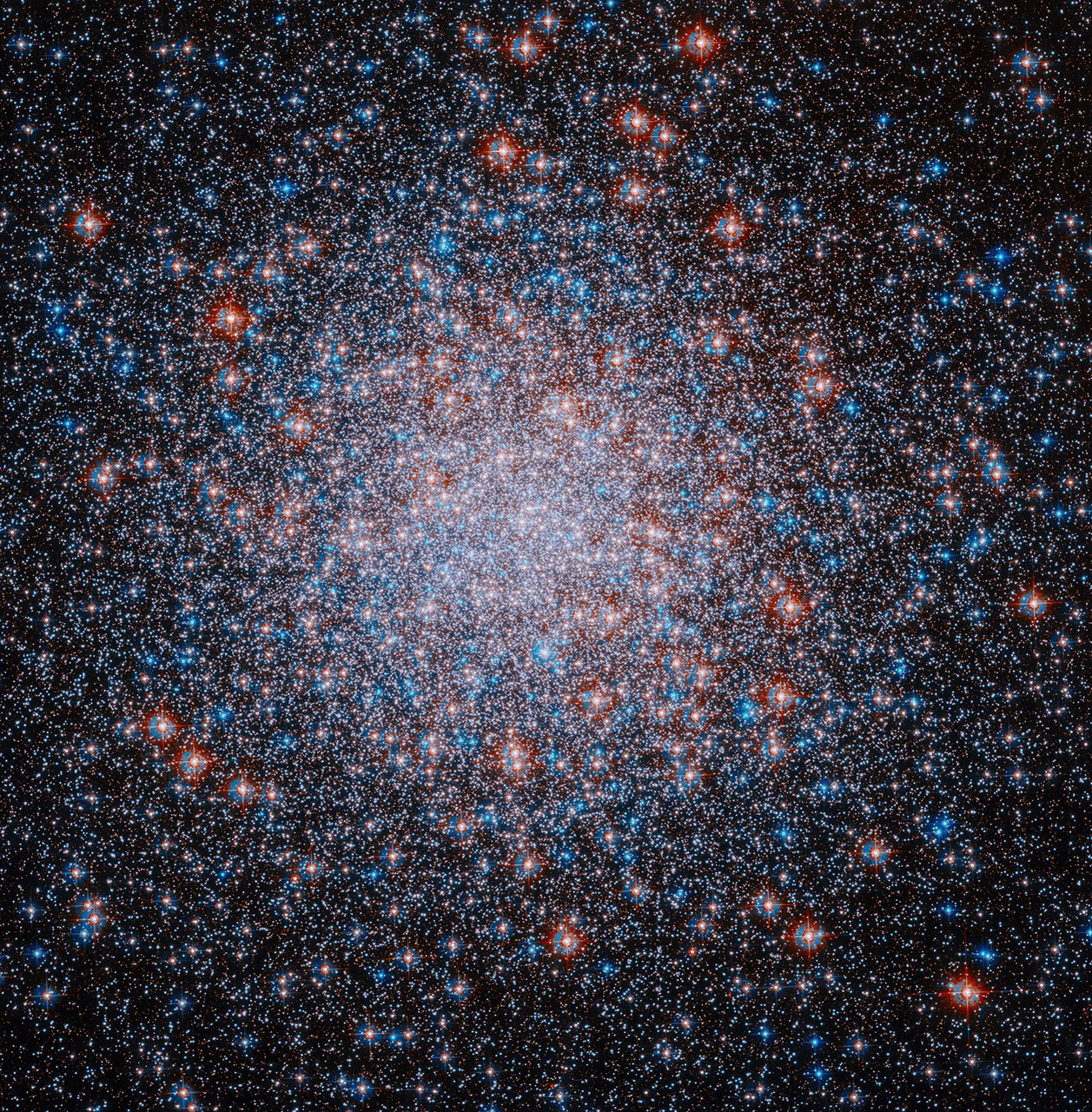
    More than 500,000 stars blaze red, white, and blue in this image from NASA’s Hubble Space Telescope, released in celebration of the United States’ 250th anniversary. The image showcases Messier 3 (M3), one of the Milky Way galaxy’s most massive globular clusters, or spherical collections of gravitationally bound stars. Globular clusters are made up of ancient stars that formed at roughly the same time from the same cloud of gas, giving those stars similar ages. Around 150 known globular clusters are sprinkled around the outer regions of the Milky Way.

    Advertisement

    In addition to its significant mass, M3 is unusual because it lies relatively far from the galactic center and has more than 240 RR Lyrae variable stars, the most of any globular cluster in our galaxy. RR Lyrae variables are some of the galaxy’s oldest stars and are of special interest to astronomers, due to their age and because their light fluctuates over time in a way that tells us their intrinsic brightness. This true brightness can be used to measure distances in the cosmos, just as knowing the brightness of car headlights on a dark road can help estimate the distance to an oncoming vehicle.

    The M3 globular cluster also contains around 70 identified “blue straggler” candidates, which are stars that shine with a bright, blue light that makes them look like younger stars than the typical, redder residents of globular clusters. This was the first cluster in which these oddball stars were located. These stars are thought to have gravitationally pulled mass from companion stars, rejuvenating them and making them appear bluer and younger despite their true age.

    The unusual characteristics of M3 may arise from its origins. The globular cluster, which contains two distinct populations of stars, may be the result of a merger of two globular clusters. These two clusters were members of the same dwarf galaxy, which was later swallowed up by the Milky Way.

    Hubble has taken several images of M3, also known as NGC 5272, documenting its complicated and intriguing characteristics. In this image, blue indicates the shorter wavelengths that are visible light, while red depicts the longer wavelengths of visible light, as well as some near-infrared light. Colors in Hubble images are chosen based on standard image processing techniques to best represent the wavelengths of light that pass through the filters used in the observation. Because the color and temperature of stars are directly related, we know that the blue stars in this image are hotter and the red stars are cooler.

    This image is part of a Hubble Treasury program survey designed to observe approximately half of the Milky Way’s globular clusters to construct a detailed chronology of how the Milky Way galaxy formed. With over 30 years of observations, Hubble is one of NASA’s flagship observatories and works in complement with its sibling space missions, including the infrared-detecting Webb Space Telescope and the upcoming Nancy Grace Roman Space Telescope, to weave together a comprehensive picture of our vast universe.

    Explore More

    Media Contact:

    Claire Andreoli
    NASA’s Goddard Space Flight Center, Greenbelt, MD
    claire.andreoli@nasa.gov

    Advertisement
    Share. Facebook Twitter Pinterest LinkedIn Tumblr Email
    The Tech Guy
    • Website

    Related Posts

    Aging Congress Is Completely Ill-Equipped to Regulate AI, or Seemingly Even Understand It

    September 12, 2026

    Space Telescope Interferometer to Image Exoplanet Continents – NextBigFuture.com

    September 12, 2026

    Help Refine Data from Space Telescopes with Artifact InSPECtor

    September 12, 2026

    OpenAI Claims Another Huge Mathematical Result Amid Fights Over Credit, Ethics, and Privacy

    September 12, 2026

    Lawyers Already Lining Up to Defend Victims of Cybercab Crashes

    September 11, 2026

    Gen1 Makes It Easy To Capture GrandParents Stories – Know Your Family History – NextBigFuture.com

    September 11, 2026
    Leave A Reply Cancel Reply

    Advertisement
    Top Posts

    You don’t need a NAS to self-host — I proved it with hardware from my closet

    June 7, 2026391 Views

    Spotify is giving one of its best playlists a big visual upgrade to give subscribers ‘a closer connection’ to its New Music Friday curators — and I think it could be the update it’s always needed

    June 12, 2026210 Views

    The iPad Air brand makes no sense – it needs a rethink

    October 12, 202517 Views
    Stay In Touch
    • Facebook
    • YouTube
    • TikTok
    • WhatsApp
    • Twitter
    • Instagram
    Advertisement
    About Us
    About Us

    SynapseFlow brings you the latest updates in Technology, AI, and Gadgets from innovations and reviews to future trends. Stay smart, stay updated with the tech world every day!

    Our Picks

    iPhone 18 Pro vs Google Pixel 11 Pro: iOS or Android?

    September 13, 2026

    I’ve tried dozens of Android launchers, but I always end up reinstalling this one

    September 13, 2026

    Think twice before wall mounting that new TV

    September 13, 2026
    categories
    • AI News & Updates
    • Cybersecurity
    • Future Tech
    • Reviews
    • Software & Apps
    • Tech Gadgets
    Facebook X (Twitter) Instagram Pinterest YouTube Dribbble
    • Homepage
    • About Us
    • Contact Us
    • Privacy Policy
    © 2026 SynapseFlow All Rights Reserved.

    Type above and press Enter to search. Press Esc to cancel.

    Ad Blocker Enabled!
    Ad Blocker Enabled!
    Our website is made possible by displaying online advertisements to our visitors. Please support us by disabling your Ad Blocker.