


Elon Musk replied on X to the video and posts from Cern Basher, Herbert Ong and me, and confirmed every SpaceX AI data center being built.
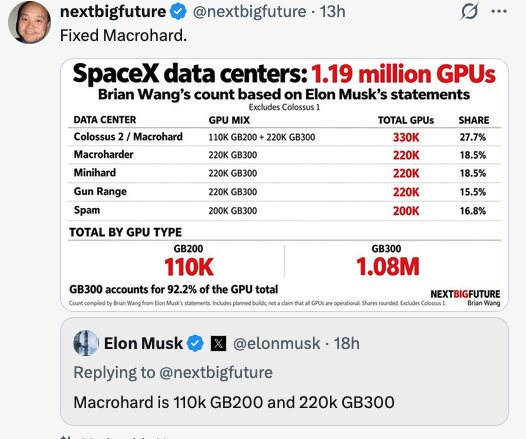
What each one is, their names, how many GPUs, and when they finish. Macroharder and Minihard each have 220,000 GB300s configured for training. Macrohard has 330,000 GPUs, not 550,000. Gun Range is another 220,000 GB300s, and Spam (the former Hormel warehouse on Tulane Road in Southaven, Mississippi) gets about 200,000 GB300s for inference. That’s about 1.19 million GPUs at Colossus 2 and about 3.2 GW of facility power by the end of 2026, by my math. I also walk through my Q4 revenue scenario of $25 to 27 billion (my estimate, not company guidance). Then Cern, Herbert and I go site by site through the buildings in Tennessee, Mississippi and Texas, and the path to 20 GW.
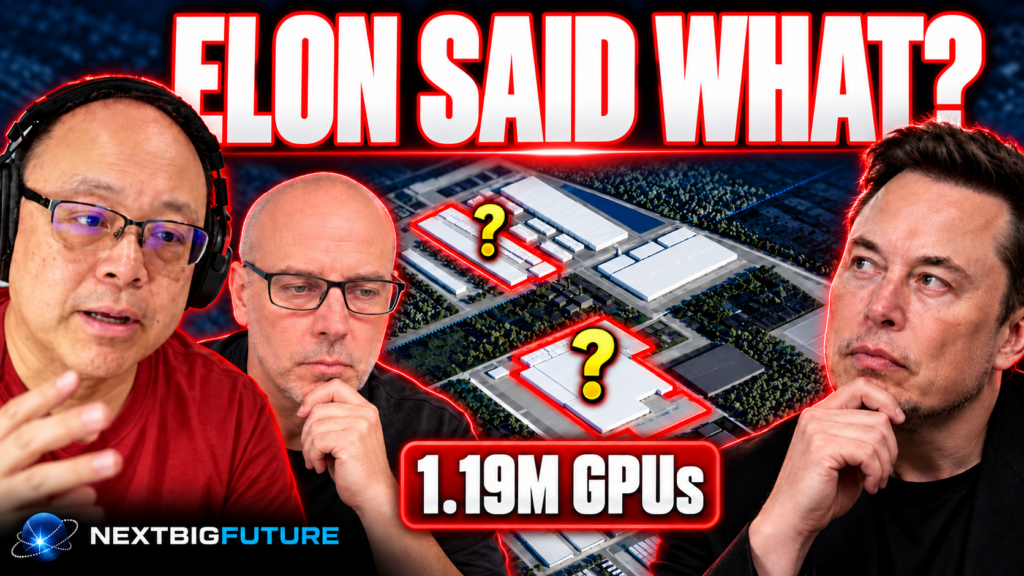
We now have the GPU count for every Colossus 2 building.
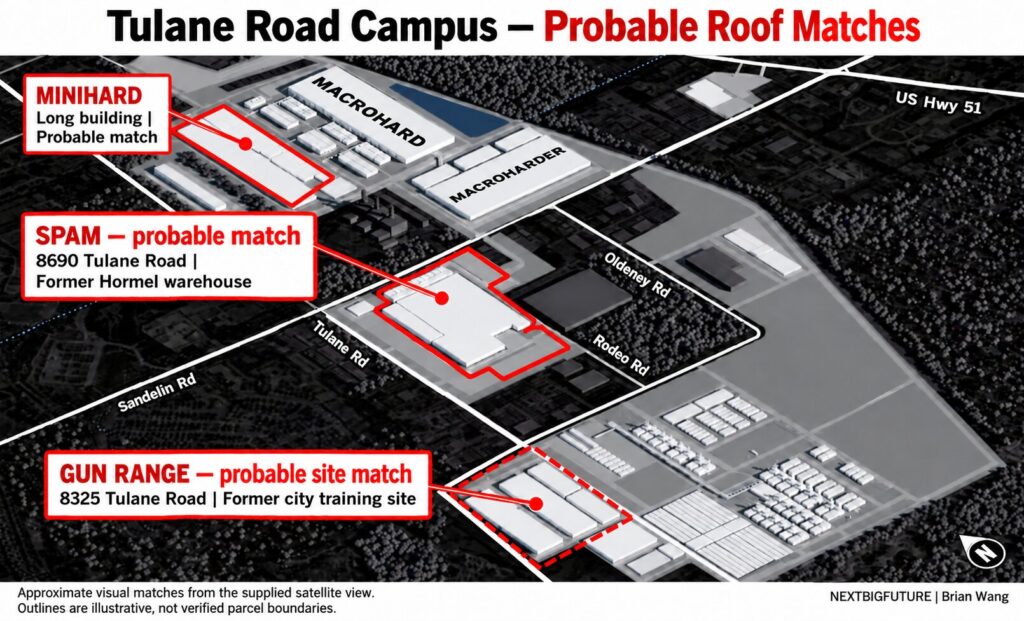
Minihard is now a product
Macrohard takes up about 810,000 square feet and hplds 330,000 GPUs. Minihard is about 312,000 square feet, but it still holds 220,000 GPUs. Elon has said there is a reason it is 220,000. That configuration works well for networking and efficiency.
So Minihard is not a one-off building. It is a product that SpaceX can repeat. Semianalysis said SpaceX can build a Minihard in about five months. The Memphis Minihard went from dirt in March or April to completion in November. That is about six months, and the builds are getting faster.
The new Texas buildings near Brownsville are on 444 acres that are now part of Starbase. They look about 60% bigger than the Memphis Minihard, so maybe 500,000 square feet each. Cern thinks that site could hold six to eight Minihard-class buildings. There are another 893 acres north of the port.
There is a possibility that the Texas Minihard are double minihard buildings with 400,000 or 440,000 GPUs. Another possibility is they are built for future shifts when Rubin chips are removed and replaced with next generation or Rubin data centers need to be larger.
The path to 20 GW<.b<
Elon has said SpaceX is confident about 10 GW and building toward 20 GW added in 2027. He also said 20 GW is no longer a 0% probability.
Here is the math. A GB300 Minihard draws about 400–450 MW. A Vera Rubin version needs about 1.5 times that, roughly 600–700 MW. To get to 20 GW, SpaceX needs about 24 to 28 of these buildings. That is two or three new buildings a month in 2027.
SpaceX builds its own power, which most data center builders cannot do and they do not have multiple sources of FAST power.
Doosan turbines
APR Energy’s mobile turbines made from aircraft engines
A permanent power plant
About 1,200 Megapacks
The dark GPUs
This is the BIG idea. Elon has said there is a lot of stranded compute in partially finished data centers. Hyperscalers have bought GPUs and racks but do not have the power or buildings to run them. Most of them need about two years to build a data center.
My view is that SpaceX lights up those dark GPUs. A hyperscaler could move its idle racks into a SpaceX building with power for 12 to 18 months. It earns money from its backlog while its own site is finished. SpaceX gets paid either way. Turning backlog into revenue improves the financials for Google, Microsoft, Amazon, Meta, Nvidia, Micron and Anthropic.
Paid partnership: Kalshi. Get a $50 sign-up bonus at https://kalshi.com/r/nextbigfuture or use code NextBigFuture.
Disclaimer: This content is for informational and educational purposes only and does not constitute financial, investment, legal, or tax advice. Trading event contracts on Kalshi involves substantial risk of loss and is not suitable for everyone. You could lose some or all of the money you deposit. Past performance or market activity is not indicative of future results.
Kalshi is a CFTC-regulated Designated Contract Market. Availability, products, fees, and rules are subject to change and may vary by jurisdiction. Event contracts are not securities, and trading them does not confer ownership in any underlying asset or entity. Eligibility requirements apply (including age and location restrictions).
Any opinions expressed are personal and may not reflect Kalshi’s official views. Always review Kalshi’s official terms, fee schedule, risk disclosures, and rules before trading, and consider consulting a qualified professional. Do your own research.
Not financial advice. I own Tesla and SpaceX.
Brian Wang is a Futurist Thought Leader and a popular Science blogger with 1 million readers per month. His blog Nextbigfuture.com is ranked #1 Science News Blog. It covers many disruptive technology and trends including Space, Robotics, Artificial Intelligence, Medicine, Anti-aging Biotechnology, and Nanotechnology.
Known for identifying cutting edge technologies, he is currently a Co-Founder of a startup and fundraiser for high potential early-stage companies. He is the Head of Research for Allocations for deep technology investments and an Angel Investor at Space Angels.
A frequent speaker at corporations, he has been a TEDx speaker, a Singularity University speaker and guest at numerous interviews for radio and podcasts. He is open to public speaking and advising engagements.
