


For decades, engineers have chased the dream of an invisible drone. The usual approaches have involved transparent materials, camouflage coatings, or complex optical systems that bend light around an object. Researchers at Northwestern University decided to take a completely different route. Instead of hiding the drone itself, they chose to fool the human eye.
The result is Phantom Twist, an experimental drone that spins so rapidly it almost disappears into the background. It’s not technically invisible, but to anyone watching, it looks more like a faint blur than a flying machine.
The research was presented at Robotics: Science and Systems 2026 in Sydney, Australia, where the team showcased a new way of making drones significantly less noticeable without relying on futuristic cloaking technology.
The trick isn’t invisibility. It’s motion.
If you’ve ever watched a ceiling fan spinning at full speed, you’ve already experienced the principle behind Phantom Twist. Once the blades rotate fast enough, your eyes stop seeing individual objects and begin perceiving a translucent blur instead. The Northwestern researchers realised the same limitation of human vision could be applied to an entire drone.
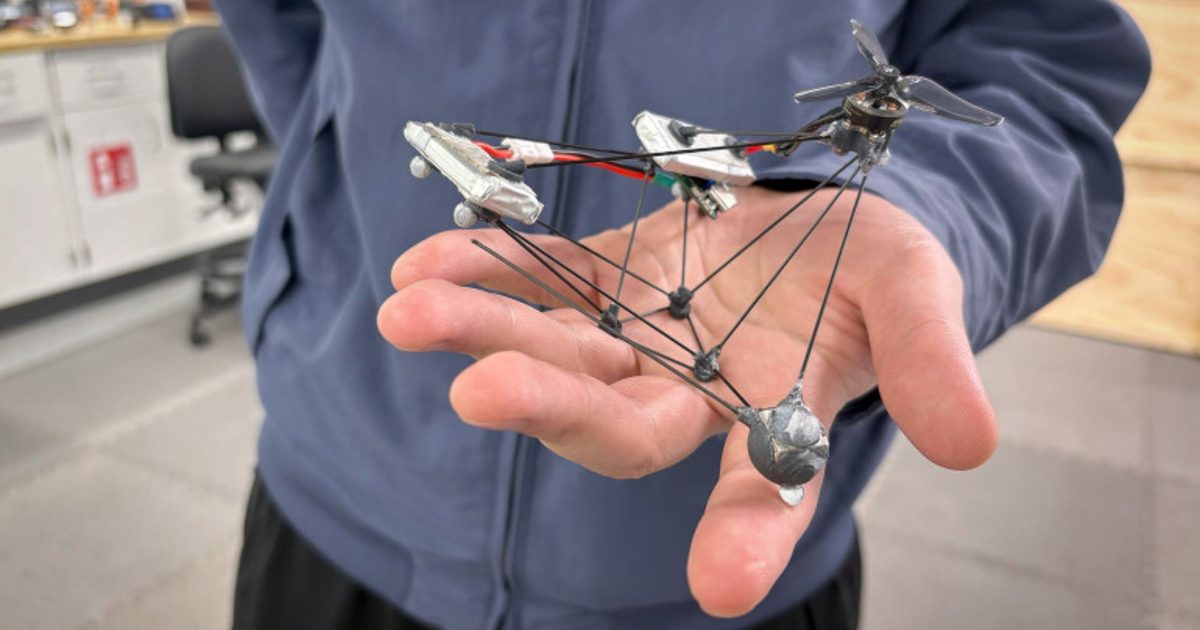
Unlike a conventional quadcopter, where only the propellers rotate while the body remains visible, Phantom Twist keeps nothing stationary. The drone uses a single motor and propeller. As the propeller spins in one direction, the rest of the aircraft rotates in the opposite direction at up to 25 revolutions per second. That continuous rotation removes the stable visual reference points our brains normally use to identify flying objects.
According to project lead Michael Rubenstein, the team wasn’t trying to make the drone match its surroundings. Instead, they designed it around the way humans naturally perceive motion. Rather than appearing as a solid machine, Phantom Twist becomes what researchers describe as a ghostly haze that blends into almost any background.
AI designed thousands of drones before building one
Building the final prototype wasn’t simply a matter of rearranging components. The team first generated around 20,000 possible drone designs using computational modelling. Artificial intelligence and optimisation algorithms then repeatedly repositioned key components, including the battery, circuit board, motor, propeller and counterweights, searching for the configuration that would remain stable while being the least noticeable from almost every viewing angle.
Researchers then simulated each design against 100 different real-world backgrounds. A computer vision model, trained to mimic how humans process visual information, scored every design based on how easily it could be spotted.
The best-performing candidates underwent further optimisation before engineers physically built the final drone. The resulting design deliberately spreads the drone’s components across different heights and angles. When the entire aircraft spins, those individual parts visually merge into a semi-transparent blur instead of overlapping into a recognisable silhouette.
According to the team’s visibility model, Phantom Twist is roughly 10 times less visually noticeable than a conventional quadcopter. The technology could prove useful for applications where being seen changes behaviour. Wildlife researchers could observe nesting birds without disturbing them. Environmental surveys could become less intrusive. Infrastructure inspections might attract less public attention.
The drone isn’t perfect yet. It still produces noticeable propeller noise, while support rods and wiring remain partially visible. The researchers hope future versions will use quieter propulsion systems and more transparent structural materials. True invisibility may still belong in science fiction, but Phantom Twist demonstrates that sometimes the easiest way to hide something isn’t to make it disappear. It’s to convince your brain there was never anything there in the first place.
