


A PHD in math disproved an 87 year old math problem with about two hours of working with Anthropic Fable.
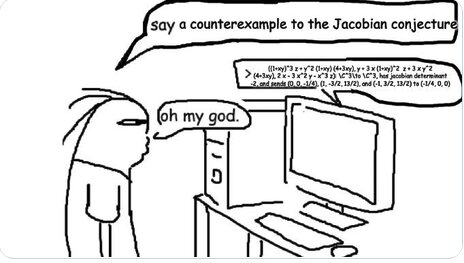
The Jacobian conjecture (JC) has been disproved in dimension 3 (and thus all higher dimensions), via the explicit counterexample announced in that X post.
The Jacobian conjecture (originally stated by Keller in 1939, with roots going back to Kraus in 1884) asserts the following over a field of characteristic zero be a polynomial map. If the Jacobian determinant det(JF)\det(JF)\det(JF) is a nonzero constant, then (F) is invertible and its inverse is also a polynomial map (i.e., (F) is a polynomial automorphism of affine space).It is equivalent to saying that such a map is injective (or bijective). The conjecture was open for decades, with many partial positive results but also a history of flawed proofs. It remained unresolved even in low dimensions until this recent development.
This is a landmark negative result. It doesn’t “break” all of algebraic geometry, but it cleanly resolves one of its famous open questions while opening new precise questions (especially in dimension 2) and illuminating connections across mathematics. The explicit, low-degree nature of the example makes it particularly valuable for further exploration.
It doesn’t mean AI can now solve any open problem on demand.
It doesn’t replace the need for deep mathematical understanding.
Dimension 2 of the Jacobian conjecture is still open — this counterexample didn’t touch it.
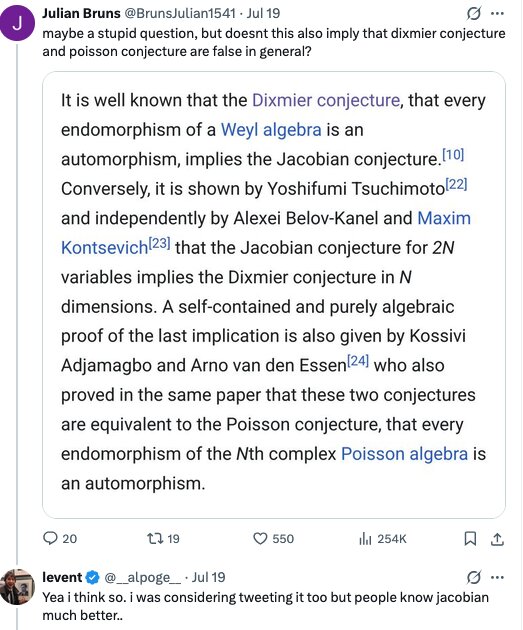
Related conjectures that fell as consequences (Mathieu for SU(3), certain moments and vanishing conjectures) are now resolved negatively, but that’s because of known logical connections, not because AI magically solved everything.
Overall Ranking
This JC disproof sits in the top tier of recent AI-assisted math discoveries — comparable to the OpenAI Erdős unit distance result (the most celebrated single one) in difficulty and subfield impact, perhaps a bit behind in raw autonomy but ahead in explicitness and cascading consequences.Harder/more prestigious than: Most smaller Erdős problems or the jamming conjecture.
Similar to: The flagship Erdős unit distance disproof and a few other standout combinatorial/geometry results.
hello there the jacobian conjecture is false thanx to my close friend akhil for asking about it and my other close friend fable for working during the world cup final
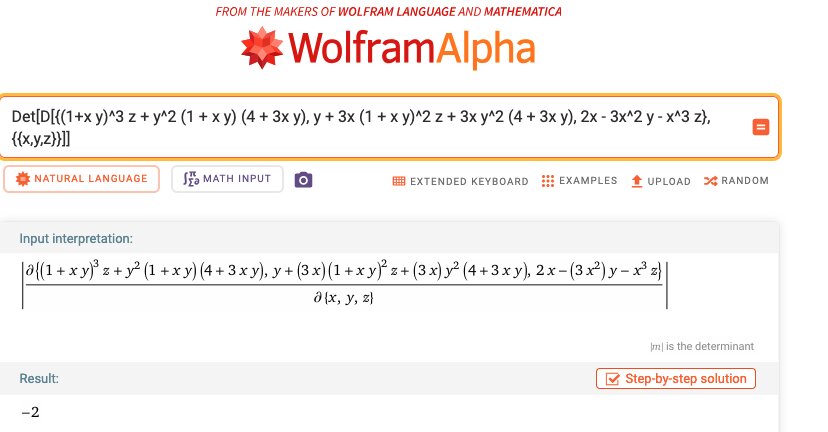
((1+xy)^3 z + y^2 (1+xy) (4+3xy), y + 3 x (1+xy)^2 z + 3 x y^2 (4+3xy), 2 x – 3 x^2 y – x^3 z): \C^3\to \C^3,…
— levent (@__alpoge__) July 20, 2026
1. AI as a “Research Assistant That Can Actually Invent”
Levent Alpöge didn’t type “disprove the Jacobian conjecture” into Claude Fable and get a finished proof.
He:Framed the problem strategically (looking for a non-injective Keller map of a particular shape in dimension 3).
Used the model to generate candidate constructions and algebraic steps.
Verified the output himself (with Wolfram Alpha/SymPy).
The model helped construct the explicit polynomial that no one had found before. That’s different from “AI solved a competition problem” or “AI proved a known theorem.” It helped produce a new mathematical object (a specific counterexample) that resolves an 87-year-old conjecture negatively in dimensions ≥3.This is one of the strongest public demonstrations yet of AI doing genuine creative mathematical work under expert guidance.
2. Dramatic Acceleration of Discovery
We’re seeing a cluster of similar events in 2025–2026 AI-assisted solutions or disproofs of certain Erdős problems.
Collaboration on a 10-year-old jamming conjecture (with Nobel laureate Giorgio Parisi).
Now this Jacobian counterexample in a couple of hours.
Long-open problems that used to take years or decades of human effort are falling faster when humans + frontier models work together. The Jacobian case is especially striking because it’s an explicit algebraic construction, not just a proof of existence.
3. Shift in What Mathematicians Actually Do
This changes the division of labor
AI strengths: Rapid exploration of algebraic forms, symbolic manipulation, generating many candidate ideas, checking low-level calculations.
Human strengths: High-level framing (“what kind of counterexample would be interesting?”), steering away from dead ends, rigorous verification, understanding the broader context, and deciding what matters.
The result is that skilled mathematicians can tackle harder or more exploratory questions in less time

Brian Wang is a Futurist Thought Leader and a popular Science blogger with 1 million readers per month. His blog Nextbigfuture.com is ranked #1 Science News Blog. It covers many disruptive technology and trends including Space, Robotics, Artificial Intelligence, Medicine, Anti-aging Biotechnology, and Nanotechnology.
Known for identifying cutting edge technologies, he is currently a Co-Founder of a startup and fundraiser for high potential early-stage companies. He is the Head of Research for Allocations for deep technology investments and an Angel Investor at Space Angels.
A frequent speaker at corporations, he has been a TEDx speaker, a Singularity University speaker and guest at numerous interviews for radio and podcasts. He is open to public speaking and advising engagements.
