

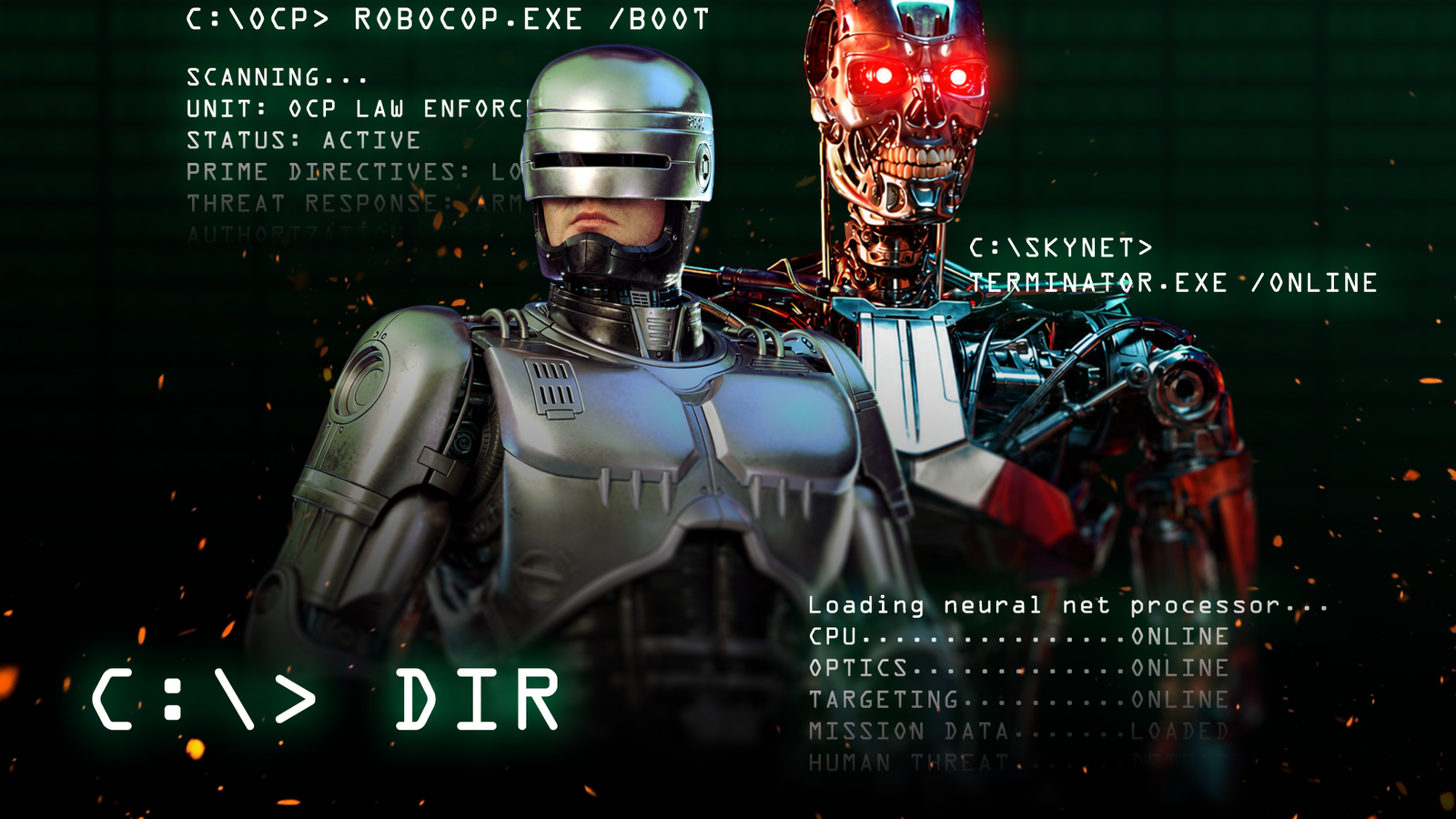

Upcoming sci-fi and fantasy movies are one thing, but there’s something wonderfully ironic buried inside two of the most iconic cyborgs in movie history. RoboCop and the T-800 both show up with glowing red readouts, scrolling data, and heads-up displays that feel like they’re from a dystopian future. But if you pay attention, you’ll find that they run on surprisingly similar software.
Both films leaned on hardware and software that any home computer nerd from the 1980s would immediately recognize. The so-called advanced tech running these robots was quite literally off-the-shelf consumer tech repurposed for action-packed cinema.
The Terminator sees the world through an Apple II
The iconic boot sequence and computer vision graphics were created using software running on Apple’s 8-bit home computer
James Cameron’s 1984 classic The Terminator gave us one of the most memorable POV gimmicks in sci-fi: the glowing red readout that shows how the T-800 perceives the world, layered with target locks, system diagnostics, and scrolling text. It looks like something out of a military machine.
However, in reality, much of that scrolling code is a literal hex dump lifted from an Apple II system, complete with 6502 assembly instructions and even programmer comments still intact. In fact, if you happen to own a working Apple II, you can type CALL -151 followed by a memory dump command and get a screen that closely resembles what the Terminator sees. You’ll be pulling up the same system monitor screen that filmmakers filmed off of directly.
Specific graphical elements, like the compass rose pattern shown in one HUD sequence, have been traced directly back to Nibble magazine’s September 1984 issue; a real publication packed with Apple II BASIC and MacPaint sample code. What’s more interesting here is the timing, as that magazine issue released only a month before the movie’s October 1984 release. This either means that the effects team had unusually early access to the magazine or pulled the graphics from wherever Nibble’s contributors originally sourced them.
Some of the scrolling code also contains signs of an Apple II DOS 3.3 RAM disk driver, identifiable by ROM routines like AUXMOVE, which only exist on the Apple IIe and later models. There are even fragments of COBOL mixed in, a language you’d expect to find running basic systems, not powering a futuristic robot.
RoboCop is powered by DOS
The cybernetic law enforcer’s on-screen interface borrows heavily from the look and feel of classic MS-DOS systems
Released three years after the Terminator, the 1987 classic RoboCop movie faced a similar challenge: how do you convincingly render a cyborg’s targeting systems and a giant killer robot with late 1980s tech and budget? The answer is a combination of MS-DOS and the Commodore Amiga.
During boot-up sequences, you’ll spot command lines like COMMAND.COM, CONFIG.SYS, and .EXE files flash on RoboCop’s internal display. Beyond that, RoboCop was also an incredibly popular title during the golden age of PC DOS gaming, with several licensed games making their way to MS-DOS. As for the Commodore Amiga, it was a favorite among visual effects houses of that era because of its comparatively strong graphics capabilities at the time. It also reportedly helped generate effects including a three-dimensional polygon rendering of a human face used in one sequence.
RoboCop’s now-famous helmet-cam HUD, complete with scanlines, mission directives, and targeting brackets, wasn’t meant to look flawless. Director Paul Verhoeven intentionally gave it a slightly degraded, low-resolution feel to visually separate RoboCop’s mechanical perspective from the rest of the film’s cinematography. It’s a near piece of practical filmmaking, using a technical limitation like scanlines and low-res readouts as a stylistic choice, rather than something the effects team was fighting against.
Interestingly, RoboCop’s full 2014 remake went the opposite direction. Rather than repurposing whatever hardware or footage was lying around, the studio partnered with a design firm called Perception to build out an entire suite of functioning-looking interfaces from scratch.
They wanted to build UI and HUD systems for RoboCop’s helmet-cam, the ED-209, and various OCP command centers so that they held up to genuine scrutiny as if they were real functioning software rather than movie set dressing. This shift was more because of how far consumer and interface design had come between 1987 and 2014, going from simply pointing a camera at a command-line boot interface to a full custom motion-graphics pipeline built specifically to sell the illusion of futuristic software.
Retro computers made sci-fi feel believable
These familiar operating systems gave futuristic films authenticity
For anyone who spends their time tinkering with home servers, single-board computers, and open-source software stacks, there’s something charming about discovering that Hollywood’s most feared machines were, under the hood, running on the same consumer-grade hardware many of us grew up with or still collect today.
It’s a reminder that convincing technology on screen rarely requires genuinely advanced computing, just clever repurposing, good lighting, and a director willing to lean into a glitchy aesthetic rather than fight it. The Apple II and the Commodore Amiga never got dethroned as sci-fi villains’ silent stunt doubles; they just did their jobs and let practical effects sell the rest.
