

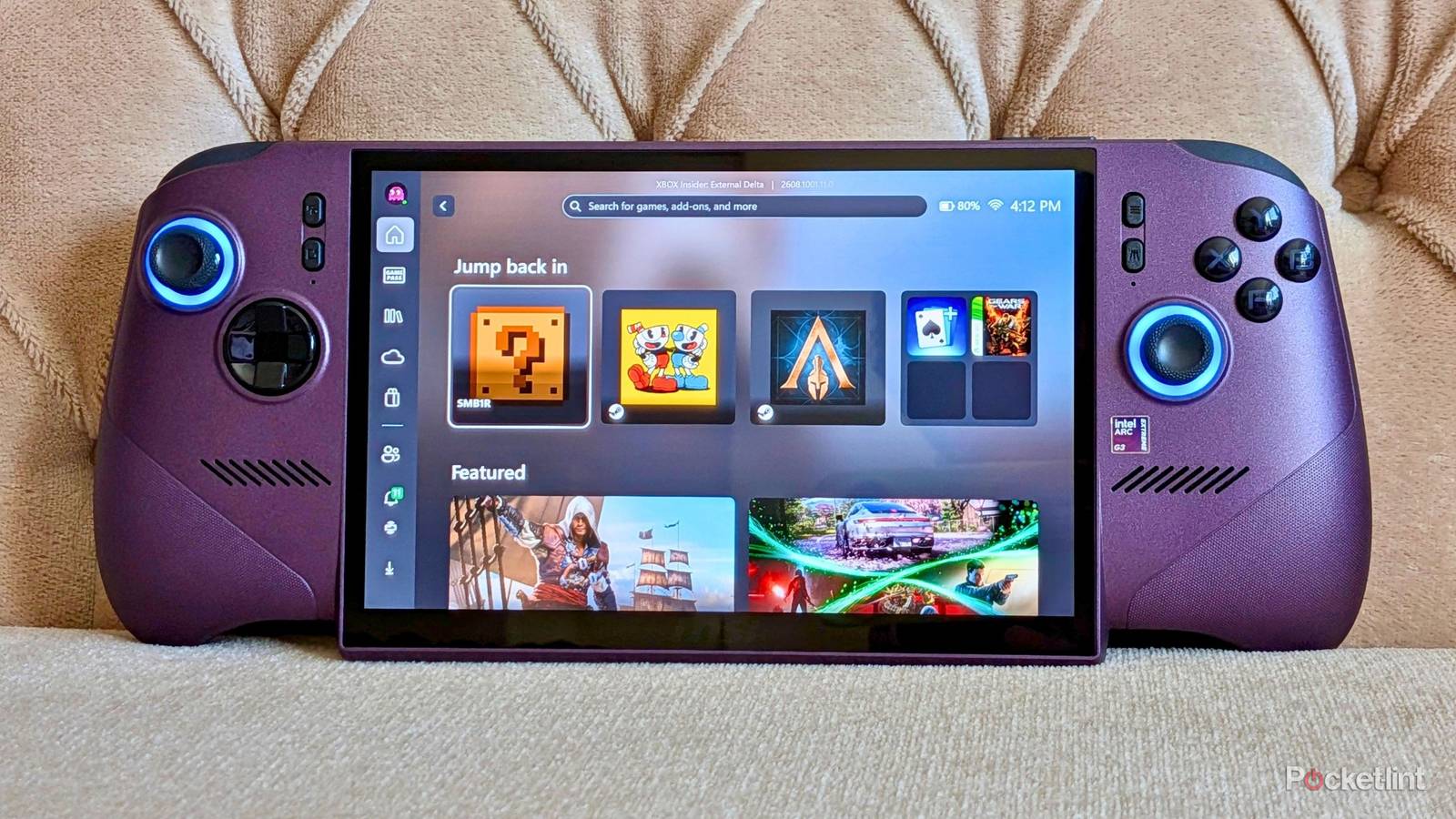

The handheld gaming PC space is in an interesting place. On the one hand, the devices themselves are hitting their stride, what with refined ergonomics, powerful and energy-efficient internals, and better-than-ever software implementations. On the other hand, owing at least in part to the AI-fueled RAM memory shortage, prices for handhelds are palpably expensive, adding to the barrier of entry.
MSI’s third-generation handheld PC, the all-new Claw 8 EX AI+, is born right in the midst of this tumultuous backdrop. The device certainly has a lot going for it, as I’ll point out throughout this review, including being a halo product for Intel’s new ARC G3 Extreme mobile processor. The question, then, is whether the hardware refinements MSI has made, mixed together with Intel’s under-the-hood improvements, are enough to justify the device’s jaw-dropping $1,800 MSRP in the United States.
Here are my thoughts after using the MSI Claw 8 EX AI+ for a couple of weeks as my main mobile gaming rig.


4/5
- Dimensions
-
11.65-12.64 x 5.12 x 0.98-1.89-inches (296-321 x 130 x 25-48 mm)
- Brand
-
MSI
- Weight
-
1.73 lbs (785g)
- Chipset
-
Intel Arc G3 Extreme
The MSI Claw 8 EX AI+ (CG3EM) is a high-end Windows 11 gaming handheld PC that’s powered by Intel’s ARC G3 Extreme mobile processor, with Hall Effect analog sticks and triggers, VRR support, and more.
- Comfortable in-hand feel
- Refined physical controls
- Excellent performance
- XBOX mode still a work in progress
- No OLED display option
- Very expensive
The MSI Claw 8 EX AI+ is all about refinement
It’s all in the details

The MSI Claw 8 EX AI+ is a gorgeous piece of kit. The unit’s void purple colorway glistens in the light, its silhouette is refined and classy, and its fit and finish is on point. Despite being quite large at 11.65-12.64 x 5.12 x 0.98-1.89-inches (296-321 x 130 x 25-48 mm) and fairly hefty at 1.73 lbs (785g), weight distribution is excellent, making for a deceptively svelte in-hand feel.
MSI has refined the Claw’s chassis with a more natural flair-shaped grip design, with ergonomic cues taken directly from Microsoft’s XBOX Series X/S controller. I appreciate the addition of a laser-etched dot texture for added gripability, and I find the shape and size to overall be comfortable for extended periods of gameplay.
…MSI has fitted both the analog sticks and the triggers on the unit with Hall Effect sensors.
The company has also refined the control scheme, which it says helps with comfort and in particular makes for a better fighting game experience. The directional pad features a new metal dome underneath for more precise tactile feedback, and the four face buttons are redesigned with rounder, smoother edges. I’m a big fan of the clickier and more precise d-pad, and the rest of the buttons on the machine are all satisfying to press down upon.
It’s worth noting that MSI has fitted both the analog sticks and the triggers on the unit with Hall Effect sensors, which should improve long-term durability while eliminating the perpetual issue of stick drift. I appreciate this inclusion very much, though I will say that it’s jarring to go back to the analog sticks on this and every other handheld device after experiencing the smoothly engineered sticks of the Nintendo Switch 2.
In addition to Hall Effect sticks and triggers, MSI has fitted the Claw 8 EX AI+ with another high-tech goody: a linear resonant actuator (LRA or voice coil) motor. Similar to the haptic engines found on smartphones (and not unlike the advanced haptics found on the PlayStation 5’s DualSense controller or the Nintendo Switch and Switch 2 with HD Rumble), the Claw can provide faster responses and more detailed vibrations, all while consuming less power in the process.
There’s a new software algorithm on deck that helps to provide a richer and more detailed rumble effect, though there aren’t too many PC games that can fully take advantage of the LRA technology in its current state. For the time being, games like Forza Horizon 6 provide a solidly elevated rumble experience, but it’s nothing groundbreaking in my experience. Nevertheless, I appreciate its inclusion here, and I hope to see Microsoft swoop in to provide the low-level API support needed in Windows 11 to better take advantage of such a hardware feature in the future.
Turning to port selection, the Claw 8 EX AI+ features two Thunderbolt 4 / USB-C ports, a microSD Express card slot, and a 3.5mm headphone jack. As ever with handheld PCs of this nature, you can leverage the Thunderbolt ports to dock to accessories, allowing you to transform the device into a mini PC right on the fly. The 1TB standardized M.2 SSD fitted into the unit is also user-serviceable by removing the rear plate of the device, which is a generational improvement MSI has made over the previous Claw (there’s no longer a need to remove the cooling system or any other components).
…I do wish the screen used OLED technology at this price for added punchiness.
Speaking of cooling, MSI calls the system Cooler Boost HyperFlow, and it talks up a big game: according to the company, the upgraded fans allow for 25 percent more static pressure, 9 percent greater airflow, and 5W more cooling capacity than the previous generation Claw. The end result should translate into more stable performance without thermal throttling, even at full power settings. This cooling system works in tandem with Intel’s all-new ARC G3 Extreme processor that runs the show behind the scenes, supplemented by 32GB of LPDDR5x RAM.
Other key specifications worth mentioning are Wi-Fi 7, Bluetooth 6, a capacitive Windows Hello fingerprint sensor mounted to the power button, a 500 nit 8-inch IPS LCD touch display with a 48-120Hz variable refresh rate (VRR) and a 16:10 aspect ratio, a 2x2W speaker system, and a massive 80Wh battery powering the entire system. I do wish the screen used OLED technology at this price for added punchiness and for pure black levels, but I do like the taller aspect ratio included here.
Interestingly, the bottom of the display juts out slightly from the frame, which is an interesting design choice. It actually allows the unit to stand upright on its own, which I’d normally call a perk, but unfortunately the upright angle isn’t suitable for tabletop use — this is quite a missed opportunity, I reckon. My hope is that with a next-generation sequel, the product is engineered to stand upright at a more comfortable angle, all without the need to implement a dedicated kickstand.
- Dimensions
-
11.65-12.64 x 5.12 x 0.98-1.89-inches (296-321 x 130 x 25-48 mm)
- Brand
-
MSI
- Weight
-
1.73 lbs (785g)
- Chipset
-
Intel Arc G3 Extreme
- RAM
-
Up to 32GB LPDDR5x
- Storage
-
Up to 1TB PCIe Gen4 M.2 SSD
- Wireless Connectivity
-
Wi-Fi 7, Bluetooth 6
- Display
-
8-inch IPS LCD, 1920 x 1200, 16:10, 48-120Hz VRR
- Ports
-
2x Thunderbolt 4, 1x microSD Express, 1x 3.5mm combo headphone jack
- Battery
-
80Wh
Intel’s ARC G3 Extreme processor packs a serious punch
Major performance per watt prowess

The star of the show with the MSI Claw 8 EX AI+ is undeniably its use of the Intel ARC G3 Extreme processor, which promises to be a major step-up from not only previous generation Intel chips, but also from competitors like the AMD Z2 Extreme used in the ROG XBOX Ally X. The ARC G3 Extreme is based on Intel’s Panther Lake architecture, with major performance gains made without sacrificing on efficiency.
According to the company, the new chip delivers up to 24 percent better gaming performance when compared to the Z2 Extreme when at the 17W sweet spot for both battery life and performance, and up to 42 percent better performance when both are at their full power wattage settings. When at 12W, Intel’s new chip can outperform the G2 Extreme by up to 37 percent.
In the AI Engine User Scenerio mode, which can be selected right from MSI’s Center M application, I benchmarked the following scores:
- Geekbench 7: 2,407 single-core CPU, 14,466 multi-core CPU, 51,373 GPU
- Cinebench: 475 CPU single-thread, 3,474 CPU multi-thread
Needless to say, the Claw 8 EX AI+ absolutely screams. When paired with the high-end cooling system (which can admittedly get fairly loud under intense loads), I was able to play AAA games at high frame rates and at high fidelity. This is bolstered by Intel’s XeSS 3 AI-based Multi-Frame Generation system, which, when enabled and supported on the software side, can improve frame rates by many dozens of frames.
MSI says it’s working with Intel to bring a quick toggle for the feature to the Quick Settings overlay accessible via the XBOX Game Bar interface, which should streamline access to the feature once implemented.
Needless to say, the Claw 8 EX AI+ absolutely screams.
The device’s 80Whr power pack is quoted at roughly 5+ hours of gameplay under Endurance Mode (30 frames per second (FPS)) with XeSS enabled, which was tested with Diablo IV. In my experience, 5 hours is about accurate, and I’m able to get upwards of 7 hours in Endurance Mode with XeSS disabled while playing indie games and retro titles.
Endurance Mode caps frame rates at 30 by default, but it can be adjusted to a higher rate if you’d like to eke out a smoother gameplay experience at the expense of some stamina. Of course, in Performance Mode, you can feasibly drain the unit’s battery in far less than 5 hours depending on the title in question and its frame rate and individual performance metrics.
The Claw’s software is a work in progress
XBOX mode is slowly but surely getting there

Software wise, the MSI Claw 8 EX AI+ is roughly in the same boat as other high-end x86-64 handheld gaming PCs on the market. By virtue of running Windows 11, the device is locked in with several pros and cons. On the positive side of things, the Claw can run the full breadth of PC games directly without any translation or emulation layers adding overhead, and the operating system is highly flexible and can be used for non-gaming purposes without a hitch.
From a user experience perspective, Windows 11 is a double-edged sword, though. The amount of updates needed to simply get started is staggering (OS updates, driver updates, MSI updates, Microsoft Store updates, XBOX updates…the list goes on and on). XBOX mode itself is still actively being developed after having debuted with the ROG Xbox Ally line, and while it’s great as a launcher for jumping right into games, it still comes with some friction-filled hiccups throughout.
The MSI Claw 8 EX AI+ is Copilot+ PC certified, which means it supports advanced AI features from Microsoft like Windows Studio Effects, Windows Recall, and Click to Do.
Luckily, Microsoft is actively working to improve not only XBOX mode, but the underpinnings of Windows 11 itself through an internal effort known by the codename of K2. This effort includes reducing the memory footprint of the OS and switching over to more native code, which should smoothen out the feel of traversing through Windows over time. I have high hopes for Windows 11’s future as a gaming platform, but just know that at the moment, you’ll still experience some quirks when it comes to navigating smoothly across both handheld and docked modes.

As for MSI’s own M Center control panel, which is preinstalled on the Claw EX AI+, I’m not the biggest fan of its implementation. I find the setup visually clunky and jittery, with several bugs in need of ironing out. As a way to change performance profiles, it’s more than serviceable, but it looks and feels out of place when compared with other Windows 11 software. To MSI’s credit, it did redesign the aforementioned Quick Settings overlay with a new, streamlined design, which I certainly appreciate.
Is the MSI Claw 8 EX AI+ worth the hype?
Yes, but it’s hard to justify the price tag

Overall, I’m a big fan of the MSI Claw 8 EX AI+. It’s clear to me that MSI has greatly refined the handheld gaming PC experience from top to bottom, covering all the essentials and then some. The addition of Intel’s ARC G3 Extreme processor is a huge win for the device, which is capable of playing just about any and every AAA game release at high settings and with a stable, adequate frame rate.
The device is incredibly comfortable to hold for long periods of time, its screen is big and beautiful (albeit not OLED, unfortunately), its speaker system is powerful, its cooling system is top-notch, repairability isn’t an afterthought, refreshingly, and its control scheme is buttery smooth. XBOX mode is still a work in progress, and I’m not the biggest fan of MSI’s Center M control panel in its current state, but these are issues that can (and likely will be) addressed in future software updates.
It’s clear to me that MSI has greatly refined the handheld gaming PC experience from top to bottom.
As mentioned at the top, the main thing letting down this third-generation Claw is its $1,800 price tag. If money is no object, then it doesn’t get much better than the 8 EX AI+, but, for the vast majority of gamers, the added processing grunt and the refined physicality of the device aren’t enough to justify paying so much money — not when competitors like the Valve Steam Deck, the Asus ROG Xbox Ally / Ally X, the Nintendo Switch 2, and others are more affordable (albeit still highly expensive on the whole, and only getting more expensive).
Of course, pricing is as high as it is, thanks in part to the RAM and component shortage, and so my hope is that in the next couple of years we’ll see a normalization of more affordable prices for high-end handheld PCs like the Claw 8 EX AI+. If MSI can refine its Center M software suite, and if Microsoft can reign in Windows 11 to the extent that is necessary to streamline gaming, then the Claw 8 EX AI+ will be one of, if not the very best mobile gaming rigs out on the market that money can buy.
This device was provided to Pocket-lint by Intel.
4/5
- Dimensions
-
11.65-12.64 x 5.12 x 0.98-1.89-inches (296-321 x 130 x 25-48 mm)
- Brand
-
MSI
- Weight
-
1.73 lbs (785g)
- Chipset
-
Intel Arc G3 Extreme
The MSI Claw 8 EX AI+ (CG3EM) is a high-end Windows 11 gaming handheld PC that’s powered by Intel’s ARC G3 Extreme mobile processor, with Hall Effect analog sticks and triggers, VRR support, and more.
