

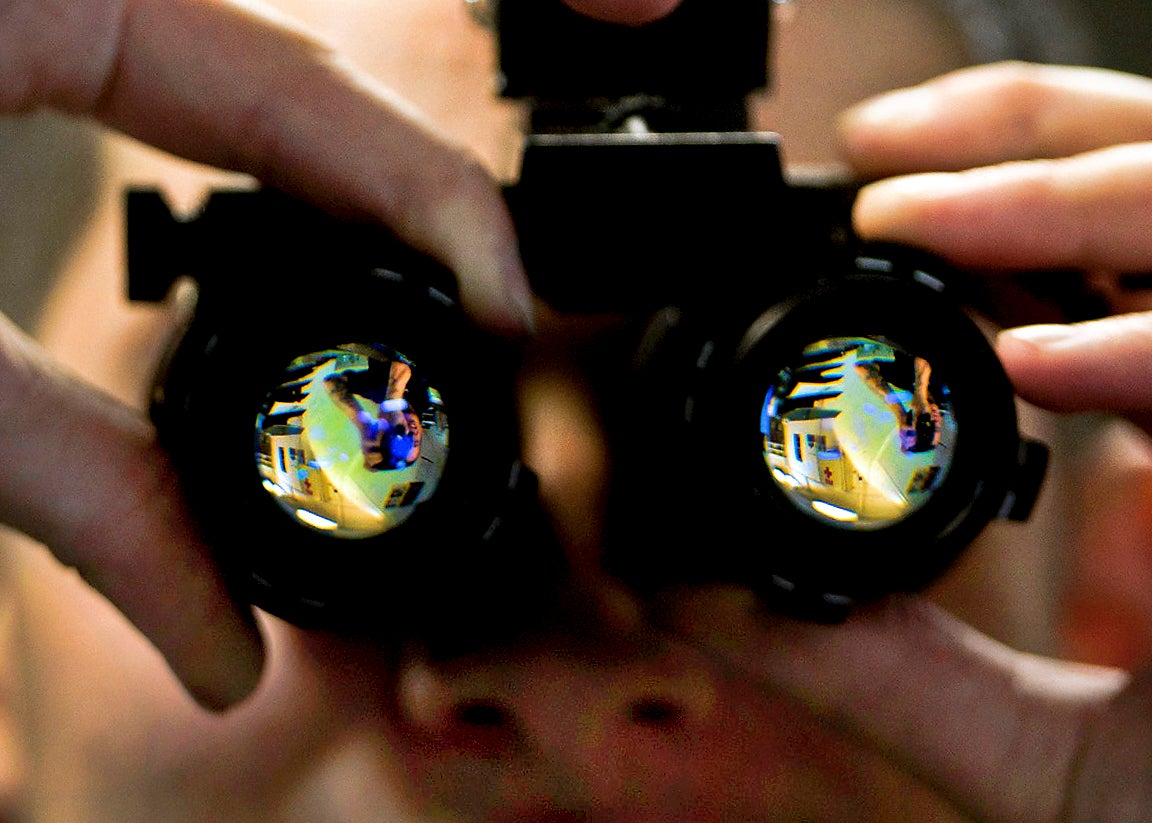

Night-vision technology has changed little for decades, producing grainy green images that make it difficult to distinguish objects and depth. Now, researchers have developed a system that converts infrared light into color images.
Standard night-vision goggles amplify the scant light available and convert it into monochrome green images that only vary by brightness. This is not a good match for our eyes, which are much better at picking out different shades than gradations of brightness.
But now a device built by researchers at the Beijing Institute of Technology translates infrared wavelengths into a color night-vision system. To demonstrate the system’s potential, the team built it into a pair of eyeglasses and even showed it could be bound to light-sensitive cells, making them responsive to infrared.
“We redefine infrared vision by transcending the monochrome paradigm, translating infrared spectral and intensity signatures into discernible color variations rather than mere brightness changes,” the authors write in a paper in Science Advances.
The prototype device, known as an upconverter, consists of a stack of thin films on a glass slide that is only a few hundred nanometers thick. The key component is a film of mercury telluride quantum dots. These semiconductor crystals, which are under four nanometers across and exhibit novel quantum mechanical effects, can detect tiny amount of infrared radiation.
Directly above this layer sits an OLED display, much like those used in phones and televisions. But where a standard display has one light-emitting layer, this one has two. A lower layer that glows red responds to relatively low levels of charge from the detector, while an upper layer that glows cyan needs a much stronger flow before it responds.
The upshot is that a weak infrared signal produces only red, but as the signal strengthens it bleeds into cyan, brightening the image and shifting its color as the two mix. The signal is supplied by the quantum dots, which release more charge when the infrared falling on them is brighter. But they also release more when the wavelength is shorter because shorter wavelength photons carry more energy.
This means the color on the display tracks how strong the infrared signal is and also roughly what wavelength it is. The team calculates a person could register infrared power differences of 0.11 milliwatts per square centimeter using color and brightness together, against 23.71 for brightness alone—a roughly 200-fold improvement.
To demonstrate the idea’s real-world potential, the researchers built the device into a spectacle frame. Exposed to infrared light, the lens shifted from deep red through orange to yellow as the illumination grew stronger. It could also render patterns like letters and track targets as they moved and rotated.
The team also tested the approach’s ability to augment natural vision. In one experiment, they engineered neurons to produce channelrhodopsin-2—a protein that makes a nerve cell fire when hit by blue light—and bound the upconverter to them.
When they hit the system with infrared, their device gave off blue light strong enough to trigger the proteins and stimulate the neurons. Electrical recordings also showed the currents inside those cells grew stronger as the strength of the infrared signal was turned up.
Finally, the team tried taping an upconverter over the eyes of mice and humans and recording the electrical responses in their brains and retinas respectively. Infrared pulses alone produced no reaction, but when the device was in place both reacted strongly.
The device is still a long way from practical use. All the demonstrations took place in highly controlled lab settings, the OLED display needs a power source, and the device also requires an infrared illuminator to generate reflections for the detector to pick up.
Nonetheless, it’s a first step towards far more powerful night-vision technology.
