

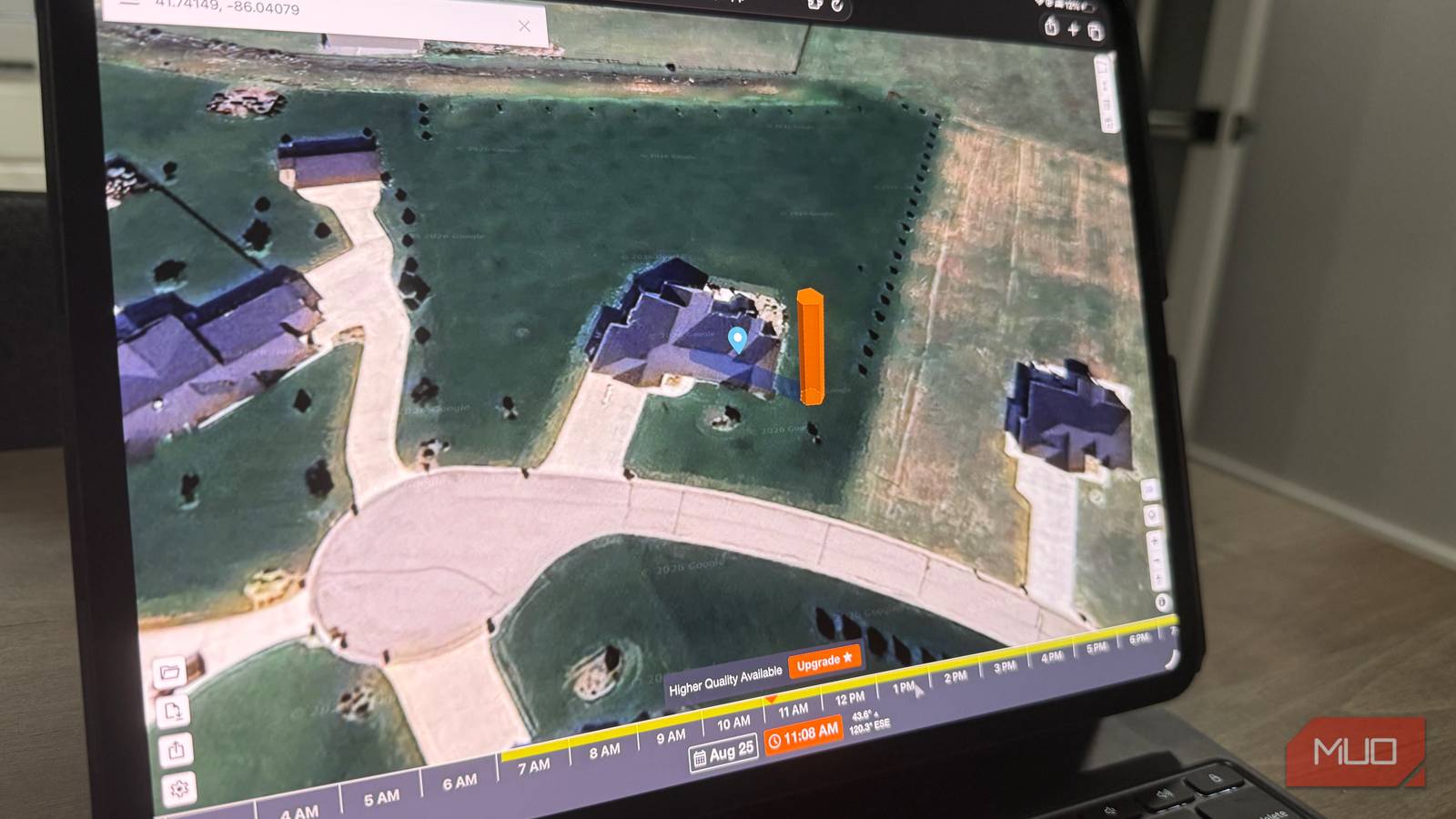

My house faces south, so the front rooms take direct sun all afternoon, and my son’s bedroom turns into a sauna by four o’clock. I’ve already used smart thermostat sensors to even out the worst of those swings, but that only manages heat after it shows up. This spring I bought two silver maples, two tulip poplars, and more than 30 Green Giant arborvitae to place across 2.5 acres in Northern Indiana. Put a silver maple in the wrong spot, and you find out 20 years later, when it is 70 feet tall and shading nothing. Before I dug a single hole, I ran my address through ShadeMap and watched a full year of shadows cross my roof.
A shade tree is a bet you only get to place once
Twenty years is a long time to be wrong
The Department of Energy puts a 6 to 8 foot deciduous tree at window shade in its first year and roof shade in 5 to 10 years. Silver maple runs 50 to 80 feet tall with a 35 to 50 foot spread. Tulip poplar climbs past 70 feet.
Research backs the usual rule of thumb. NIST and the USDA Forest Service tracked 460 homes in Sacramento through the summer of 2007 and found that tree cover on the west and south sides cut summertime electricity use by 185 kWh, about 5.2%. North-side trees pushed consumption up by 55 kWh. East-side cover showed no measurable effect at all.
That last finding is where the rule of thumb stopped being useful to me. A study of 460 houses in California does not know that my air conditioner sits on the east wall.
ShadeMap runs in a browser and costs nothing
A time slider, a date picker, and shadows on my actual roofline
ShadeMap simulates mountain, building, and tree shadows anywhere on Earth for any date and time. You don’t need an account, or need to install anything. I opened it in Google Chrome and used Add to Home Screen, which turns it into something that behaves like a native app.
Its controls sit along the bottom edge: a date button and a time slider. Drag the slider, and shadows sweep across the map in real time. The Layers menu holds the two features I leaned on hardest. “Hours in the sun” maps cumulative direct sunlight for a single date, and “Annual sunlight” does the same across a full year.
Building and tree data comes from OpenStreetMap, Overture Maps, and Mapbox. This is the same category of free-tool win as the one that used my photos to sort out which plants in my beds were weeds.
The default map had my house wrong until I drew it in
Buildings without height data default to one story
Any structure missing height data gets set to 3.1 meters. My ranch was close enough by accident. My outbuildings were not, and several maples I planted years ago never appeared at all.
The drawing tool in the upper right corner fixes this. Trace a footprint, type a height, and ShadeMap casts that shadow immediately. Deleting works the same way: draw a polygon over a phantom tree, set the height to 0, and it drops out. If tree shadows vanish at midday, the Above canopy and Below canopy toggle in Settings brings them back.
Default heights come from crowdsourcing and modeling, so errors run several meters. A drawn polygon casts a solid shadow, meaning a simulated tree reads as a block rather than dappled light.
The map sent most of my trees east, not west
Morning sun was cooking my condenser, not my living room
My outdoor AC unit sits on the east wall. It takes direct sun from sunrise until the house itself starts shading it near midday. Scrubbing the time slider through a July morning made that obvious in a way that standing in the yard never had.
At roughly 41.5 degrees north, the late-June sun clears the horizon around 58 degrees on the compass, well north of due east. That is a long, low morning angle, and it meant a screen along the east property line would do real work.
So 25 Norway spruces went in along the east border. As they fill in, they will shade the east wall from sunrise until somewhere between 10:00 and 11:30 a.m., depending on the season. A newer cluster of three arborvitae will eventually cover the condenser until 11 a.m. or so.
The payoff there is debated. The Department of Energy credits condenser shade with up to 10% better efficiency; Florida Solar Energy Center measurements land under 3%. After 12 years in HVAC, I sit somewhere in the middle, and know that airflow clearance beats shade either way.
The big trees went in outside falling distance
Shade on the wall, nothing overhanging the roof

One silver maple went on the east side, one on the west, and a tulip poplar on the east. All three sit far enough back that a mature canopy will never reach the roof, and far enough that a failed limb cannot land on the house.
That distance is not paranoia. Missouri Extension rates silver maple’s storm resistance as very poor, and common guidance is 30 to 50 feet of separation from a structure. Tulip poplar gets a gentler number near 20 feet.
Of the 30-plus arborvitae, only about five went in for house shade. The rest are screening and windbreak along the property line, and the spring yard tools I already owned handled the digging.
The trees are in, and the shadows already line up
Two months in, my arborvitae cluster throws its shadow in the right direction toward the condenser. However, they aren’t tall enough to shade it just yet. The spruces have decades of filling in ahead of them. That is the odd thing about planting trees: you are building something you will not see finished for 20 years, and simulating it first is the only honest way to check the work. ShadeMap cost me an afternoon and moved three of my five house-shade placements. Run your own address before the next planting window.
