

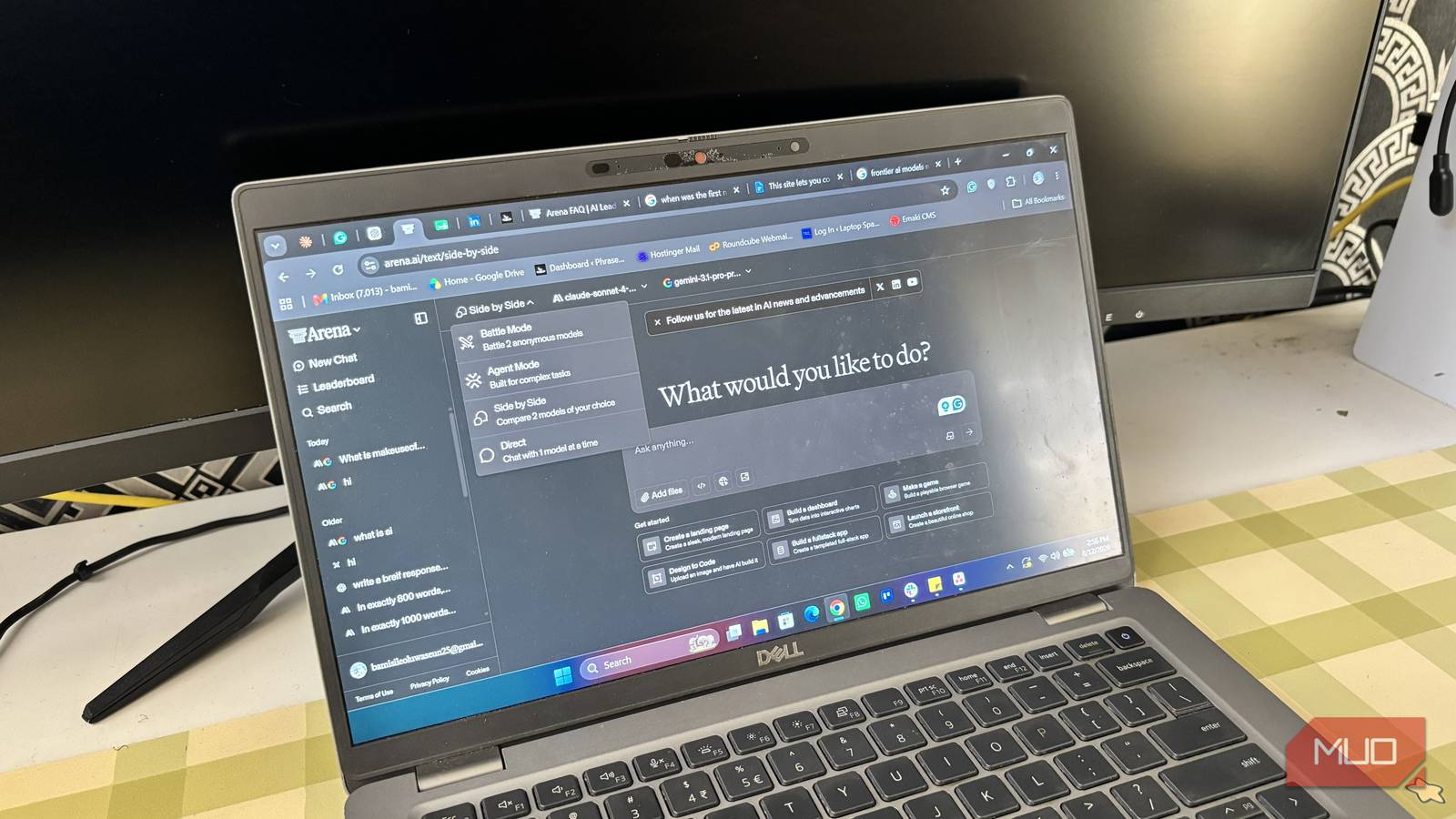

Ever since the first version of ChatGPT was released to the public in November 2022, we’ve seen tons of AI models come out from various AI companies. And every so often, these companies release newer models to improve on their previous models. Anthropic released Claude Fable 5 in June, Google launched Gemini 3.6 Flash in July, and OpenAI released its latest model, GPT-5.6, also in July.
Sure, newer models are better, but people have preferences, and certain models may provide better results than others. I, for example, prefer to use Claude Sonnet 5 because it’s usually straightforward and uses fewer fluff words. The problem is that trying different AI models usually means jumping between different websites, creating accounts, and dealing with separate usage limits. Arena.ai changes that by bringing them together in a single interface.
There are a lot of AI models to choose from
But not all are available

Arena.ai’s whole shtick is access to a wide range of AI models in one place. So, instead of jumping between platforms, I can simply pick from the models currently available and start testing right away.
You can select models directly in Arena’s Direct and Side by Side modes, rather than having to visit each company’s website separately. Arena’s model selector includes proprietary and open-source models. But you may not always find every newly released model, and models can also disappear at any time. Arena says it may remove models to maintain stability and access across the platform.
Still, that’s a small complaint considering what you’re getting. Being able to open a website and experiment with a long list of models without paying is the real selling point for me. I can test a model I’ve never used before, compare its response with one I already like, and decide for myself which one I prefer.
Side by Side mode makes comparing models easy
Give two models the same prompt and see which response you prefer
As I mentioned earlier, the platform has a Side By Side mode, and, as the name suggests, it lets you select two AI models and send them the exact same prompt. Both models then generate responses side by side, making it easy to compare them.
This is much more useful than simply reading AI leaderboards. A model can rank highly on a benchmark and still not be the one you personally enjoy using. For example, if I’m trying to find the best AI model for writing emails, I can give two models the same prompt and compare their writing style, structure, accuracy, and adherence to my instructions.
That’s something I find much more useful than someone telling me which model is “better.” The best model is often the one that works best for what you actually do.
Yes, there’s a usage limit
The limits depend on the model and the type of feature you’re using

Arena.ai doesn’t offer unlimited access, but how far you can go depends on the model you’re using. For example, while comparing Claude Sonnet 4.5 and Gemini 3.1, I hit a limit with Claude Sonnet 4.5 after just about five messages. Meanwhile, the Gemini model kept going much longer, up to around 20 messages or so before I eventually hit a restriction. So, considering Claude Sonnet 4.5 is the more recent of the two, I would say newer models tend to reach usage limits faster than older ones.
And when you do run into a limit, you usually have to wait about an hour for it to reset, depending on the model and the type of cap you’ve hit. But the thing is, once you hit a limit with a specific AI model, you can easily switch over to a different model and keep going while the one you were using cools down in the background.
There are also separate limits for some of Arena’s more demanding features. For example, video or image generation is currently limited to two generations every 24 hours. Besides, the platform is working on a new usage limit system, which is being gradually rolled out. The idea is to better balance heavy usage while still keeping the platform free and accessible.
Your prompts may be shared publicly
Nothing is completely free

There’s a saying that goes, “if it’s free, then you’re the product,” and that’s the exact case here. Arena.ai says that user conversations may be used to support the community, enhance the platform, and help build more reliable AI systems. This can also involve publishing anonymized chat data publicly as part of research collections.
So, I wouldn’t use Arena to paste confidential work documents, private conversations, passwords, financial information, or anything else I’d be uncomfortable seeing published online. Arena’s current Terms of Use also explicitly prohibit users from submitting personal or sensitive information.
There’s also a notice right before you send a prompt that says, “Your prompts may be shared publicly to support AI research.”
Arena is your go-to hub for testing AI models
I don’t think Arena is going to replace every AI service I use. I still have my preferred models, and sometimes I want the specific features that only their official apps provide. But Arena has become one of the easiest places for me to experiment and compare. And the fact that I can do all of this without paying a dime is the cherry on top. Yes, they might choose to include a subscription later to add more features and AI models, but for now it’s completely free.
