

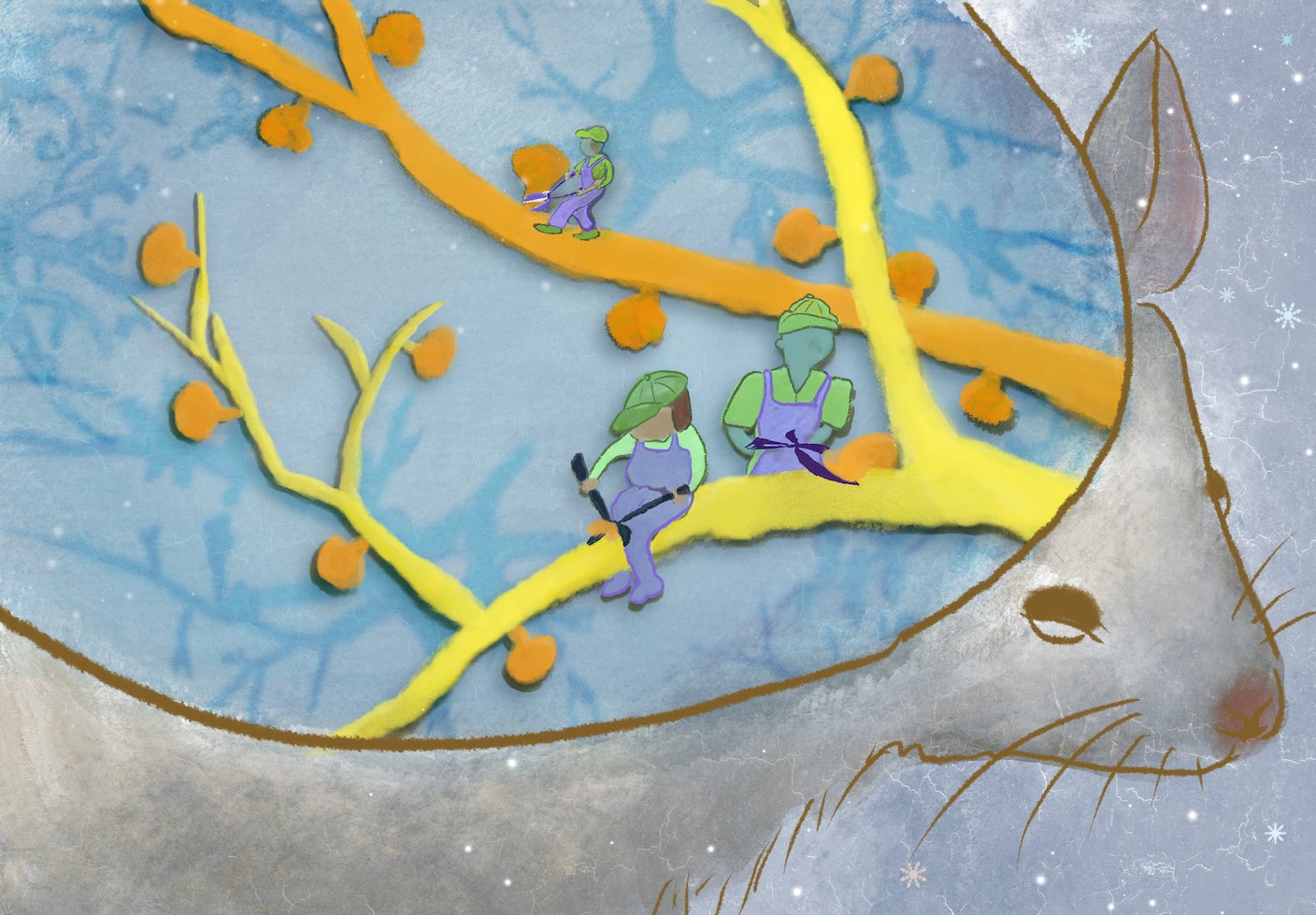

Our cherished memories may be more resilient than previously thought.
Long-term memories are stored in synapses, the connections between neurons. These structures sit on tiny protrusions called dendritic spines, which dot neurons’ branching arms.
When we learn, these spines grow. Larger spines tend to form stronger synapses and are more likely to persist during learning. In Alzheimer’s and other diseases that eat away at these connections, memories can fade.
At least, that’s the traditional picture. A new study suggests the story is more complicated.
Mice in artificial hibernation rapidly lost roughly half of their synapses, both large and small. Yet once awakened, they resurfaced memories of previously learned tasks. Spines that had withered during the induced deep sleep regrew in their original spots, once again forming functional synapses. This suggests their brains had rebuilt parts of broken circuits.
A small number of stubborn synapses that survived hibernation may explain how this happened. These synapses formed clusters that preserved memories as patterns of neural activity called engrams. The more surviving clusters the mice had, the better they performed on a previously learned task after awakening.
“It was astonishing. Logically, if all our engram synapses were essential in memory retention as traditionally thought, memory should have massively deteriorated,” said study author Yu-Ju Lin at Japan’s Okinawa Institute of Science and Technology Graduate University in a press release.
The findings suggest that memories may not depend on preserving every individual synapse. Instead, they may be distributed across a higher-level architecture of connections, with some synapses acting as anchors that can reconstruct the rest.
Artificial hibernation is an extreme case, and it’s far too early to know how the findings translate to diseases like Alzheimer’s. Still, they suggest that even under extreme circumstances, the brain can bring back memories once thought lost.
Forest for the Trees
Neurons are often called the brain’s computational units. But each one is actually a sophisticated mini computer in its own right.
A neuron’s branching arms receive signals from neighbors, while a long, winding extension carries outgoing messages to other neurons. Spines dot the receiving branches. These structures can strengthen, weaken, appear, and disappear depending on the input. This allows synapses to simultaneously gather data, learn, and store memories. When neurons repeatedly activate each other, the connections between them grow stronger, mostly because of larger spines. This is the idea behind the popular neuroscience saying: “Neurons that fire together, wire together.”
For episodic memories—the when, where, what, and who of our lives—these changes begin in the hippocampus, a region central to forming and retrieving memories, and one of the first areas damaged by Alzheimer’s disease.
During the day, the hippocampus forms engrams associated with individual memories. During sleep, some of these are erased, while others are gradually incorporated elsewhere in the brain for long-term storage. The hippocampus also helps recall memories by adding context, such as where something happened or how you felt at the time.
All of this should, in theory, require relatively stable brain circuits. “Long-lasting changes in synaptic connections are widely thought to provide the structural basis of memory,” wrote the team.
But recent studies have challenged that view. The brain is anything but static. Synapses are constantly being remodeled. Even which neurons are recruited into a particular engram can change over time. Some synapses may effectively hand off information to others, freeing themselves to encode something new.
If physical traces of memories are always shifting, why don’t our memories disappear with them? That’s the question the new study explored.
Going Under
To probe the paradox, the team turned to an unorthodox method: Artificial hibernation. Like natural hibernation in bears and other animals, artificial hibernation dramatically lowers body temperature and metabolism and causes animals to enter a sleep-like state. As the brain decreases its activity to conserve energy, synapses begin to wither.
Yet hibernating animals do retain memories. Chipmunks, for example, remember where they’ve stored food, returning to their stashes when periodically awakening for “midnight” snacks. This suggests hibernation could be a useful way to study how memories survive major changes in the brain.
“Our brains are incredibly complex. If hibernation can reduce and simplify brain activity and structure, it could make studying these convoluted systems a bit easier,” said study author Kazumasa Tanaka. “That’s why I wanted to use artificial hibernation techniques to study memories.”
The team first trained mice on two standard memory tasks. In one, the critters received a mild electrical zap to their paws inside a chamber with distinctive smells and decorations, teaching them to associate that setting with danger. In the other, they learned to navigate a maze towards a sugary reward.
The researchers then activated a neural circuit that drove the mice into artificial hibernation for two days. Using fluorescent proteins, they tracked changes in the animals’ synapses throughout the process.
Spine remodeling began within minutes. Some rapidly shrank and disappeared, taking their synapses with them. Within a day, over half of the synapses were gone. Even the larger spines thought to be especially important for long-term memories were pruned.
Yet memories survived. When the mice awoke and revisited the shock chamber, they froze in fear. In the maze, they still knew how to find the reward. Previously pruned spines also returned, with roughly 80 percent growing back at their original locations along the neuron’s branches.
To test whether this recovery is unique to hibernation, the team compared the animals with a second group that underwent anesthesia and were dosed with a drug that blocks synaptic changes—a combination known to cause amnesia. These mice also lost a large number of synapses but never recovered their memories.
A core cluster of unusually resilient synapses may explain the difference. These synaptic clusters formed a unique architecture in which one neuron linked to multiple neighbors like Grand Central Station. The clusters were often located in areas where spines were tightly grouped—making them more likely to receive inputs from multiple sources at once. Somehow, they kept memories intact even as surrounding synapses disappear.
“This suggests that for long-term memory, only particular clusters of synapses matter—the rest may be dispensable,” said Tanaka.
Exactly how these clusters preserve memories remains unclear. How does the brain create and maintain them? Do they anchor multiple memories? And could the same mechanism help explain why some memories remain as synapses are lost in disease?
The team is now using genetic and molecular tools to decipher what makes the clusters so resilient. Tinkering with their formation could better reveal their role preserving memories and, in theory, inspire ideas for tackling synapse loss in the early stages of diseases.
Beyond neuroscience, demystifying how memories linger could inspire neuromorphic chips—hardware that loosely mimics the brain—or even new AI models. For now, the findings offer a twist on an old idea: A memory may not need every single synapse that helped create it. It may just need the right ones to rebuild the rest.
