

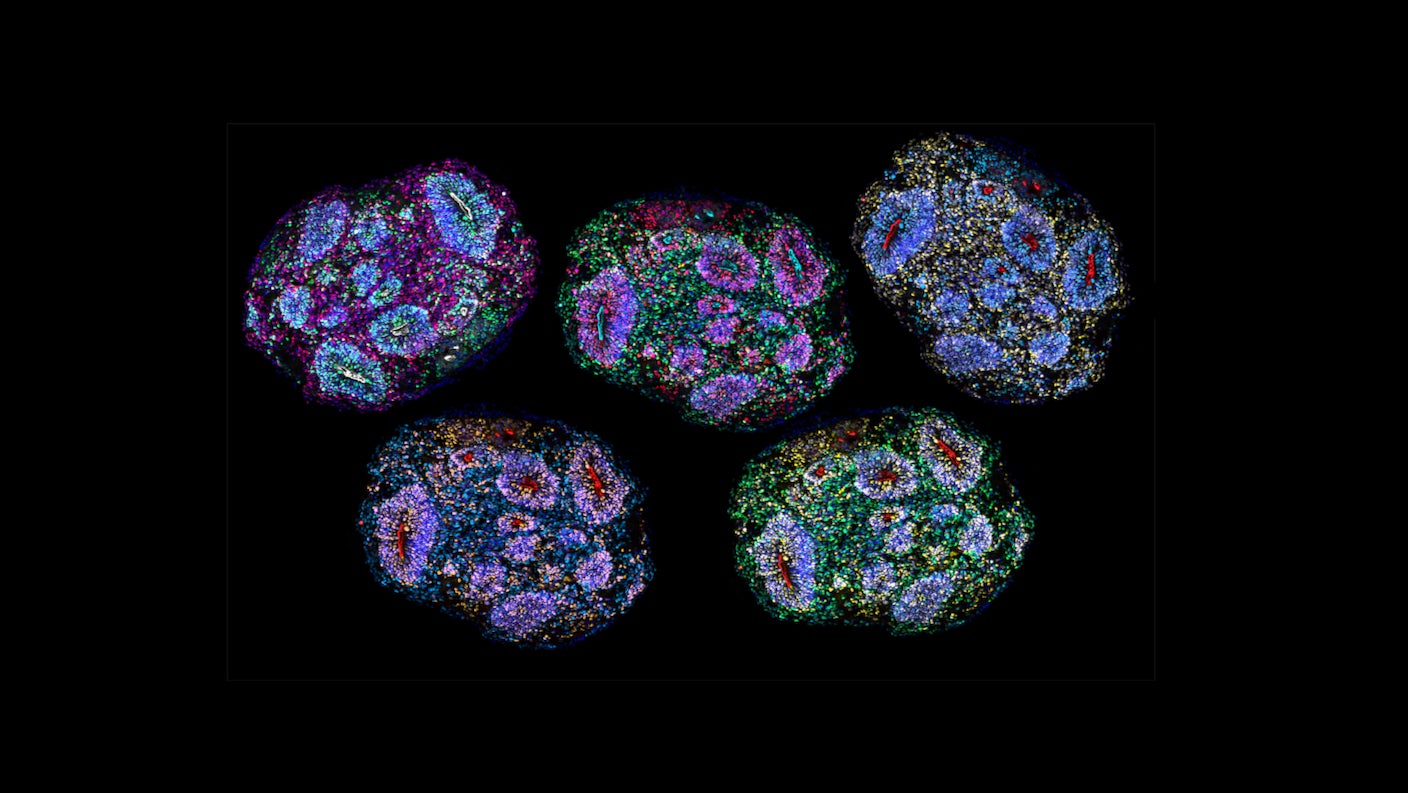

Five years is an eternity for brain organoids. Also called mini brains, these blobs of tissue have taken neuroscience by storm for their ability to capture the intricacies of developing brains.
Organoids begin life as a collection of stem cells. Within weeks, they spontaneously produce a range of brain cells. Neurons form circuits that spark with electrical activity. Gene expression resembles that of early fetal brains. Some organoids learn to control small, isolated muscles. Others link to spinal cord organoids and process pain signals.
Over time, they grow more sophisticated in both structure and function—eerily similar to near-term fetuses—prompting bioethicists to ask if they could one day become conscious.
But time isn’t on their side. Most mini brains survive only a few months before their sensitive neurons start to wither. Circuits break down, structures collapse, and eventually the organoids die. As a result, they can model only the early stages of human brain development, leaving what happens during the later months of pregnancy and after birth largely mysterious.
These periods are especially relevant to schizophrenia, epilepsy, severe autism, and a host of other disorders. Scientists have studied late-stage development using donated tissue, but samples are scarce and raise ethical concerns.
A team led by Harvard’s Paola Arlotta is now pushing the boundaries with organoids. Last week, they described a method that kept mini brains alive for over five years—the longest yet—and tracked their development throughout. Despite growing outside the body, the organoids matured on a timetable similar to normal brains. Genetic activity in the oldest ones resembled that of a typical 4-year-old.
The findings were originally reported in a preprint and have now been peer-reviewed and published in Nature.
The developmental lockstep surprised the team. Cells from older organoids, when mixed with younger ones, continued maturing on schedule, suggesting they carried an internal developmental clock that keeps track of their progress.
“The brain doesn’t develop in a vacuum. It’s an organ of incredible complexity that interacts with so many other systems,” study author Irene Faravelli said in a press release. “It was not a given at all that our simplified model would match natural development in this many ways.”
Brain, Interrupted
Because mini brains generate nearly the full range of human brain cells, they’re promising models for the study of early brain development. But early versions survived only a few weeks. Without blood supply, cells at their centers starved and died.
Through trial and error, researchers learned to coax them into increasingly sophisticated structures that included layers resembling the cortex and had integrated blood vessels. This vastly extended their lifespan.
In 2021, a study kept mini brains alive for up to two years, capturing cortical development from pregnancy to roughly a year after birth. Four years later, Arlotta’s team announced a way to extend organoid lives to a staggering seven years. Roughly the size of a pea, each nugget was packed with some two million healthy neurons and other brain cells.
Following these organoids for years offers an unprecedented window into how the brain grows and wires itself—and how genetic changes early on might contribute to diseases later in life.
Our brains take roughly two decades to mature. Throughout this period, neurons constantly rewire their connections. Scientists have long known that conditions such as schizophrenia and some forms of epilepsy first emerge during adolescence. Because mini brains can be grown from a person’s skin cells and retain genetic mutations associated with neurodevelopmental disorders, they offer a way to probe how, and when, neural wiring goes awry.
But timing matters. The question is, how faithfully does a growing blob in a dish follow the developmental journey of a human brain?
Time Stamp
To answer that question, the team grew 34 organoids and tracked them at regular intervals. They collected data every three to six months for the first 18 months, then annually until the organoids were over five years old.
Crucial to the brain blobs’ longevity was switching the growth medium—a nutrient- and protein-rich slurry—halfway through development. The new recipe kept neurons alive longer, giving them time to support increasingly complex activity.
The team then tracked changes in gene activity and epigenetic markers (chemical tags that control which genes are turned on or off). They then compared the findings with data from younger organoids—ranging from 15 days to six months old—and donated human tissue.
The developmental timeline was surprisingly similar to that of a human brain. Young organoids showed gene activity resembling the first trimester; by three to six months, they looked more like second-trimester brains. After a year, their gene activity profiles resembled those of newborns. By the end of the experiment, they most closely matched a typical 4-year-old.
The team also tested them with epigenetic methods used to gauge biological age as opposed to calendar years. The organoids gained and shed epigenetic markers in patterns that broadly tracked those seen in natural brain development.
The organoids seemed to retain a “sense” of time. The team mixed cells from year-old organoids with those from 15-day-old organoids. Both followed their usual trajectory: The younger cells developed into early-stage neurons. But the older ones skipped those stages and rapidly produced more mature neurons often requiring months to grow.
“I like to think of this as a sort of ‘warping of developmental time’ indicating that the organoid cells record and recall the time they have already spent in culture,” said Arlotta.
In other words, the cells seem to carry an internal developmental clock, which could be especially useful for studying disorders with symptoms emerging long after the early stages of development.
To be clear, though, a mini brain resembling a 4-year-old’s brain at the molecular level doesn’t mean it has the same wiring or computational capabilities. Gene activity only captures part of a brain’s development; real brains are shaped by experiences and interactions with the rest of the body. Without input, mini brains can only offer a molecular blueprint of brain development, not its entire rich tapestry.
Still, long-living organoids are a breakthrough. Researchers could freeze cells from organoids at different developmental stages and later thaw them for experiments. This could speed up discoveries because scientists wouldn’t have to grow new organoids from scratch for each new study. Think of it as a save point in video games.
The team plans to grow long-lived organoids from people with schizophrenia or epilepsy and use them to study disease progression and screen drugs. Keeping ethics in mind, they’re also considering exposing mini brains to sensory stimuli such as sight, sound, or touch.
“There is still much to learn about how the embryo naturally builds a progressively more complex and mature brain,” Arlotta said. “Applying these lessons to organoids will allow us to model unexplored events of human brain maturation that occur after birth.”
