


An AI data center needs enormous amounts of electricity. Building power plants is expensive, but it gets cheaper per unit as you build bigger. A developer could deliberately build more generation than the data center needs, then sell the surplus at lower cost into the surrounding city. If the surplus is cheap enough, residents’ bills go down, the community stops fighting the project, and the developer gets to expand. Everybody wins.
Increase the cost of going business. The cost of going AI Data Centers is already high. Adding 1-2% in costs to pay households in the area is affordable. Pay people directly or indirectly. AI data center developers have the money and margins to ensure that they get permission to proceed. Their business plans can tolerate paying more. They can still shop their projects around to find the places (states) where there are no added costs or where the added costs are reasonable.
Electricity prices are set by cost recovery. A large, steady customer spreads fixed grid costs across more kilowatt-hours. Data centers run at 80–90% utilization while the American grid averages a load factor of about 53% — filling those empty seats genuinely lowers cost per passenger. A 2026 EPRI-affiliated study by Watten, Bistline and Blanford found large industrial customers measurably lowered household prices from 2019 to 2024. Thekey condition in every case was spare grid capacity — when headroom exists, concentrated industrial demand is deflationary. The paper reports roughly a 3.5% rate reduction per doubling of capacity. If 4X more power is needed for a city because of a giant AI data center, then overall rates would be reduced by 7%.
Power is typically a meaningful but minority share of hyperscale AI data center operating costs. AI Data Center developers can oversize on-site generation + storage. They can contract excess as local credits or grid services. This would subsidize the electricity bills of local residents.
For example, IF the city of Memphis draws 2 GW but SpaceXAI colossus 2 is scaled to 6 GW then a 30% reduction in the electricity bill for Memphis would take 10% of the planned data center power.
Memphis Light, Gas and Water (MLGW) serves the area with peak demand typically around 2–3.5 GW (winter lower, summer higher from air conditioning. historical records near 3.5 GW). Colossus-scale sites to 2 GW and plans for up to 5-10 GW.
In Memphis the over generation plan is largely blocked — not by opposition or by physics, but by a federal utility contract and by the fact that surplus power from rented gas turbines isn’t cheap in the first place.
The version that works is smaller, less dramatic, and aimed at bills rather than rates. Batteries, curtailment, and a well-funded energy-burden program.
The homeowner electricity bills contain fixed costs. Roughly 20% of an MLGW electric bill covers the poles, wires, meters, billing and crews. That portion doesn’t shrink when energy gets cheaper. So to cut a bill by 30%, you have to cut the energy portion by about 37.5% (because 30 ÷ 0.80 = 37.5). That’s roughly 750 MW, not 600 MW. If it was scaled for 600MW then it would be a 24% rate cut. It would actually be cheaper to do a different subsidization.
Current SpaceXAI approach in the Memphis–Southaven area has heavy use of behind-the-meter on-site small natural gas turbines plus Tesla Megapack battery storage. This speeds deployment and keeps most of the load off the shared grid. There are some limited MLGW/TVA 150 MW grid connections. Batteries help smooth power, provide backup, and enable flexible operation.
The oversized-generation subsidy could work in a deregulated market like Texas ERCOT then a version like it is possible.
Indirect Subsidy – Paying Cash to Improve Household Energy Efficiency
Cash from the developer into a fund that pays down residential bills, weatherizes homes, or replaces failing HVAC systems. They can also offer direct bill credits.
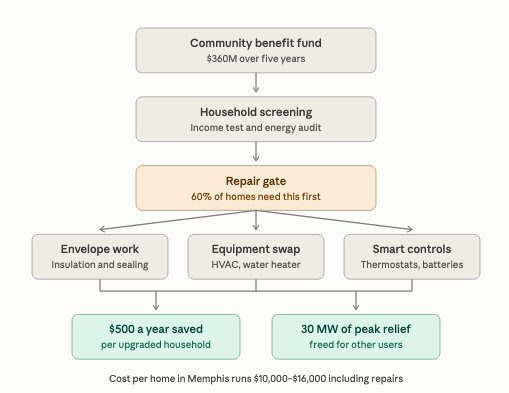
Instead of selling energy, the data center sells flexibility and give home energy upgrades so people use less energy and get lower energy bills.
Curtailment. The data center agrees to pause or throttle its own load during the ~50–100 hours a year when the grid is most strained. That’s when new power plants have to be built to serve. Avoiding those hours avoids the plant.
Battery discharge. Megapacks charged overnight discharge into the grid at peak, doing the job of a peaker plant without one being built.
Tesla Virtual power plants (VPPs). In June 2026, Tesla, Sunrun and Renew Home announced a framework to aggregate up to 16.8 GW of flexible capacity — home batteries and smart thermostats across as many as 9 million households — and sell it to utilities and hyperscalers. The pitch is explicitly aimed at data center it’s a faster and cheaper way to free up grid capacity than paying for grid upgrades.
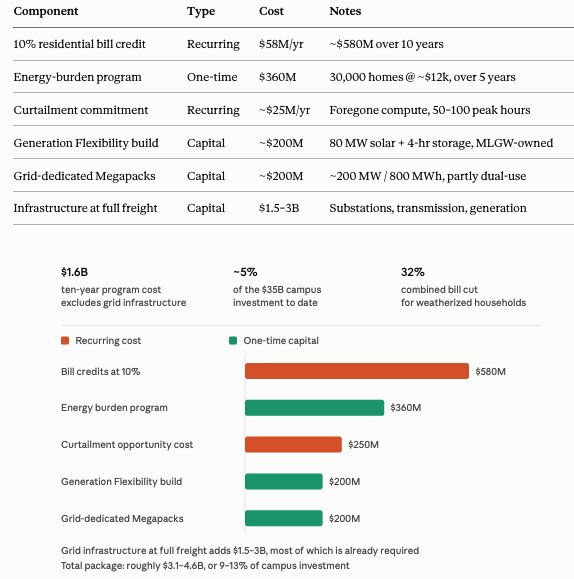
MLGW has roughly 428,000 electric customers, of which about 390,000 are residential. The average residential electric bill runs around $125/month. That puts residential electric revenue near $585M/year, so a 10% credit costs about $58M/year — roughly $12.40 per household per month.

Brian Wang is a Futurist Thought Leader and a popular Science blogger with 1 million readers per month. His blog Nextbigfuture.com is ranked #1 Science News Blog. It covers many disruptive technology and trends including Space, Robotics, Artificial Intelligence, Medicine, Anti-aging Biotechnology, and Nanotechnology.
Known for identifying cutting edge technologies, he is currently a Co-Founder of a startup and fundraiser for high potential early-stage companies. He is the Head of Research for Allocations for deep technology investments and an Angel Investor at Space Angels.
A frequent speaker at corporations, he has been a TEDx speaker, a Singularity University speaker and guest at numerous interviews for radio and podcasts. He is open to public speaking and advising engagements.
