


Whenever a new AI model is released in a cut-down form because it is too powerful, or one transgresses its sandbox and performs an unexpected cyber hack on a company’s website, we tend to see jokes made about Skynet or HAL 9000 becoming a reality.
But science fiction didn’t just predict our current relationship with AI, it influenced it. Our fascination with artificial life began long before computers — or even electricity — existed. Ancient Greek stories featured mechanical servants created by the god Hephaestus, while Jewish folklore gave us the Golem, an artificial being brought to life to carry out its creator’s commands.
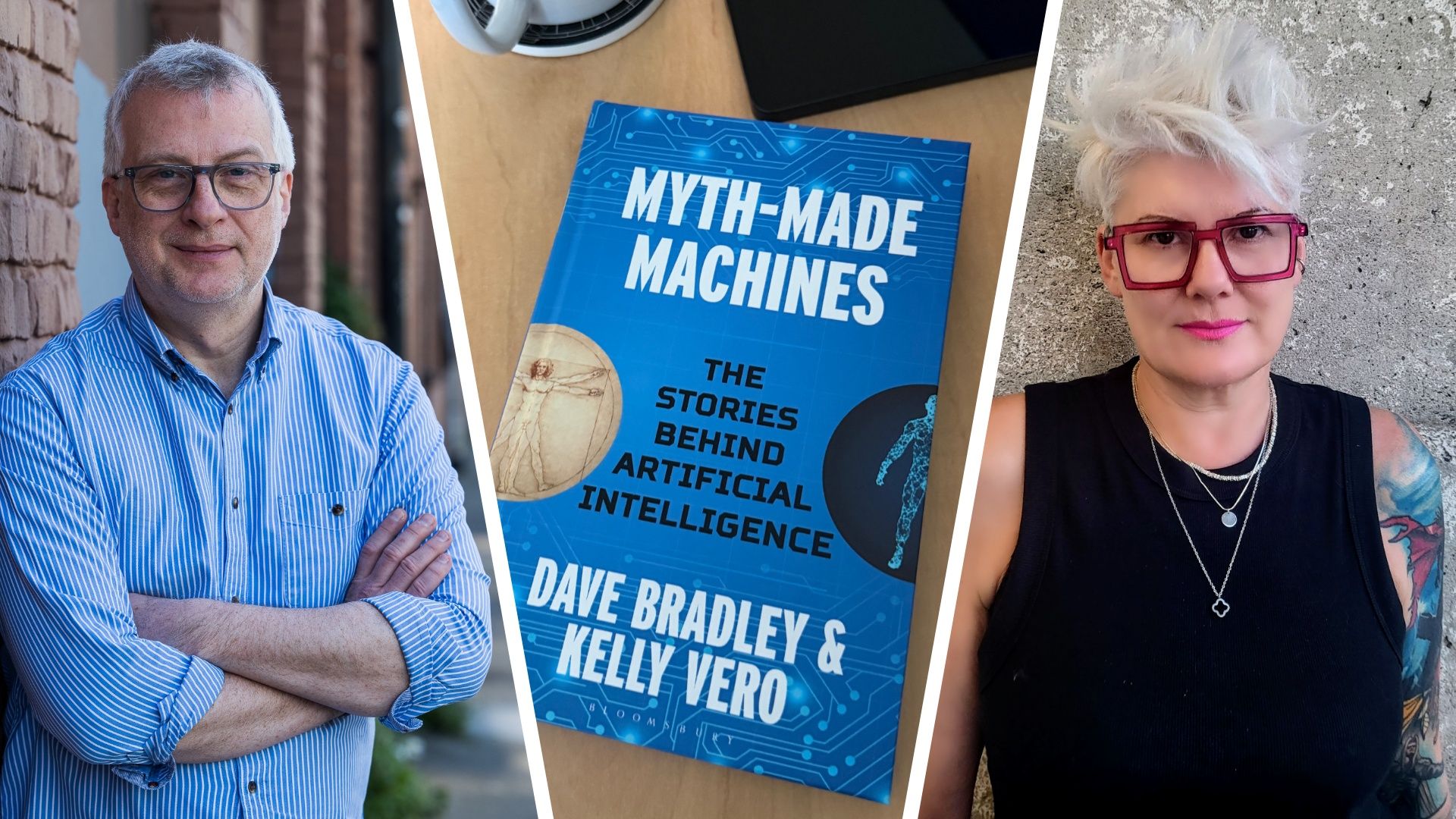
In their new book, Myth-Made Machines: The Stories Behind Artificial Intelligence, authors Dave Bradley and Kelly Vero trace humanity’s dreams and fears about machines that can think, through mythology, literature, movies and television.
Latest Videos FromTechRadar
Their argument is that these stories haven’t simply anticipated AI; they have shaped how we talk about it, what we expect from it and, in some cases, the technology people have gone on to build.
I spoke to Bradley and Vero about why humanity keeps creating machines in its own image, whether science fiction has influenced today’s AI developers, and why our response to artificial intelligence still swings between two extremes: “If we don’t like it, we’ll kill it. If we love it, we’ll marry it.”
The ancient beginnings of AI
TechRadar: Talk me through the title – why is it called Myth-Made Machines?
Dave Bradley: The core argument of the book is that humans have always been fascinated by the idea of creating thinking machines and artificial life. When ChatGPT formally launched in 2022, one of the first jokes I saw on social media was about Skynet coming online. It struck us that the whole way we understand and talk about this new technology is shaped by stories we’ve been telling ourselves for years. Kelly has a deep knowledge and love of Greek and Roman myth, as well as stories such as Frankenstein, while I’m a huge science fiction nerd (and occasional medievalist). Through our conversations, we realised that our cultural idea of “AI” is much older than modern computers.
Kelly Vero: Myth-Made Machines is the essence of where every element of AI or robo-futurism comes from: Myth. With myth, we, as humans, have to navigate the real and the prescient from the propaganda and the fanciful.
TR: When did artificial intelligence first enter our human stories?
KV: When we started researching the book, it was Greek myths that we started with. We found our own Sam Altman, Elon Musk and Dario Amodei hiding in plain sight.
DB: The idea is incredibly ancient. In Greek myth, Hephaestus creates golden workers to help him in his workshop. Jewish legend brings us the Golem. The idea that one might build autonomous servants out of inanimate material is thousands of years old.
For something closer to what we would recognize as a computer, Jonathan Swift’s Gulliver’s Travels gives us a wonderful early example in the 18th century. The Engine of Lagado randomly rearranges words in the hope of generating useful knowledge. Read today, it looks uncannily like a satirical ancestor of generative AI.
The term ‘artificial intelligence’ in the modern sense of machine learning and reasoning was coined in the 1950s by computer scientist John McCarthy — and that’s when it starts creeping into TV and film too. There are some great early Twilight Zone and Star Trek episodes about the possibilities and perils of machines in our homes and workplaces.
TR: Which are your personal favorite sci-fi AIs/robots, or movies and TV shows that involve AI?
KV: I’m a Lawnmower Man aficionado, but having worked on the actual Transformers franchise, I’m also a Decepticon through and through.
DB: I’m a huge sci-fi geek, and to this day I maintain that R2-D2 is the most important character in Star Wars. He has a mission, gets on with it, saves everybody repeatedly and barely receives any credit.
But I also nerd out over Marvin in The Hitchhiker’s Guide to the Galaxy, the Cylons in both versions of Battlestar Galactica, and, of course, Data in Star Trek: The Next Generation, who I’d argue is the character on the real hero’s journey in that series.
Side note: HAL 9000 slightly infuriates me, mainly because people have been quoting “I’m sorry, Dave, I’m afraid I can’t do that” at me personally for decades.

TR: Do you think our myths about conscious machines have influenced the real development of AI?
KV: Absolutely! Human life is all about dreaming up concepts to adore or fear; it’s how we roll.
DB: Today’s engineers and entrepreneurs grew up on Star Wars, Star Trek, Isaac Asimov and William Gibson, and there’s good evidence that science fiction influences the people who go on to build the future. One 2022 study found that 93 per cent of UK astronomers enjoyed science fiction, for instance, and 69 per cent said it had influenced their career decisions.
Sometimes the connection is very direct. Pete Bonasso at TRACLabs has credited HAL 9000 from 2001: A Space Odyssey as an inspiration for his work on NASA space AI systems. Asimov’s Three Laws of Robotics were invented for fiction, but they’ve become a reference point for real-world thinking about AI safety. Google DeepMind’s 2024 ‘Robot Constitution’, for example, sets out safety rules for machines in a way that is very much in that tradition.
TR: What do you think of the current crop of AI models?
DB: I follow this area as closely as I can, although you have to bear in mind that it changes almost daily. We’ve just seen another generation of frontier models arrive. It moves fast, which is fascinating for tech writers, although it also explains why we wrote a book largely about things that happened hundreds of years ago rather than trying to capture the state of AI in 2026!
When it comes to video games — still my day-to-day working life — I believe it’s going to be important to work out what new experiences AI can bring to the table, not just how quickly they can automate existing processes.
KV: They’re facsimiles of every book, TV series, movie or game we’ve ever imbibed. They’re not as clever as we are and they never will be.
TR: Do you think of AI as a threat to humanity, or as an opportunity?
KV: A super opportunity to ride alongside a civilization’s worth of knowledge? It’s almost too good to be true. If you think about it, until AI came along, humans held a monopoly on intelligence. We kind of only knew what we could discover or search for as humans (history is always written by the victor). Today, we can effectively outsource our thirst for knowledge to something else and tell it how we should understand the results; for the most part, we get balance: the rest is sponsored content!
DB: It feels glib simply to say ‘both’, although I’m tempted. Personally, I’m an optimist by nature, and I like to believe the general direction of travel is towards progress, growth and better lives. That doesn’t mean everybody prospers equally, or that there aren’t important battles over jobs, ownership, ethics and power along the way. William Gibson famously said that the future is already here; it’s just not evenly distributed. I think that’s a useful way to think about AI too. The interesting question isn’t simply whether the technology is good or bad, but who prospers from it, who controls it, and how widely any benefits (and risks) are shared.

TR: Do you think we’ll ever reach man-made super intelligence, and if we do what happens then?
KV: We have man-made everything else, don’t we? Why should this be different? For me, the detail lies in sentience. We already have man-made superintelligence, but we don’t have fully operational sentience yet. When something can blink its eye without thinking as quickly as humans can, well, let’s talk again.
DB: I don’t think it’s going to emerge simply by scaling today’s transformer models, regardless of some of the more excitable predictions around them. However clever and interesting LLMs are, these are fundamentally probabilistic systems that generate text, images and other media. That doesn’t make them conscious.
An omnipotent silicon supervillain, like Skynet, makes for good screen drama — but if we do eventually create genuine superintelligence by some route, I’d actually hope that a networked brain with access to vast amounts of information, capable of seeing problems from many different perspectives, would naturally tend towards connection and assistance rather than destruction. But I’m not naïve about it. Systems also magnify our biases, flaws and prejudices. That’s why alignment matters.
TR: What have you learned about humanity’s approach to AI from writing this book?
KV: That we’re the only stakeholders. We’re the arbiters of our own creation(s); if we don’t like it, we’ll kill it. If we love it, we’ll marry it. AI is all of us, and my main worry is that only 6% of the world’s population currently decides on how the other 94% will live, work and adapt to an AI future. However, if the past is to be believed, we’re probably going to be ok. (Famous last words, I know!)
DB: Technology and automation are things humans do. What became very apparent is that humans repeatedly try to create things in their own image, while simultaneously struggling with the implications of that. We worry about job losses, replacement and loss of identity. We’re fascinated by creating something powerful, then immediately frightened that it might overthrow us. But the fear of the servant who will turn on us, or the untrustworthy ally who might sneakily replace us, is not limited to machines, right? We might project those stories onto computers in our books and films, but the subtext is often about human paranoia around class, politics, war…
More specifically, there’s a recurring oscillation between loving and fearing our own technology. In the 1970s, amid Cold War paranoia, computers were frequently instruments of doom: Colossus, Cylons, HAL 9000, even V’Ger in Star Trek: The Motion Picture. In the 1980s, as PCs and games consoles became familiar household playthings, popular culture increasingly gave us machines as loyal companions: KITT, Metal Mickey, Twiki, Nono and Data. Then the pendulum swings back: by the late 1980s and 1990s, we get The Terminator and The Matrix. You can trace those alternating waves of optimism and anxiety all the way back through the Industrial Revolution. The technology changes, but our emotional responses to it are remarkably consistent.
Author bios and book details
Kelly Vero has worked in video games and technology for 30 years, from programming to senior management, working on titles including Tomb Raider, the Halo series, the Transformers series, and Subway Surfers. Vero is an international keynote speaker and leading gamification and metaverse thought leader, regularly featured in tech lists and future lists such as Forbes’ 100 Women of the Future, an award-winning educator, and an award-nominated and bestselling author whose nonfiction works include Breaking Through Bytes: Women Shaping the Digital World, and From Pixels to Portals: How Video Games Made the Metaverse. She lives in Zurich, Switzerland.
Dave Bradley has worked in the media for nearly 30 years as a magazine and online journalist, writer, editor, and event host and as a senior manager and consultant. He has written for and edited newsstand publications including Microsoft Windows: The Official Magazine, SFX, Comic Heroes, and more, and has written and published for online publications including Pocket Gamer, PC Games Insider, Crime Fiction Lover, and others. A huge science fiction fan, Bradley watches movies, plays games and travels a lot. He curates the AI Gamechangers newsletter and appears frequently at Pocket Gamer Connects conferences. He lives in Bath, United Kingdom.
Myth-Made Machines: The Stories Behind Artificial Intelligence
co-written by Dave Bradley and Kelly Vero
Published by Bloomsbury on 3rd September 2026
Available as ebook or hardcover

Follow TechRadar on Google News and add us as a preferred source to get our expert news, reviews, and opinion in your feeds.
