


One new AI data center every month. If SpaceX achieves that MiniHard production pace, the consequences for AI capacity, revenue, and competitors are enormous.
MiniHard will become SpaceX’s most important near-term product. Repeating a proven data-center design could turn individual construction projects into a steady stream of usable AI capacity.
I compare it to mass produced and fully monetized Tesla Robotaxi. A full 2027 of SpaceX minihard is equal to the profit IF Tesla could make 8 million robotaxi in 2027.
In this conversation with Royden D’Souza of Over The Horizon, we examine the buildings, power, chips, construction speed, and revenue math behind that argument.
The stakes: in my modeled scenario, a fully leased 0.5-gigawatt-equivalent MiniHard at $50 billion per gigawatt per year represents $25 billion in annualized revenue potential. Repeat that delivery pace, and the numbers compound quickly.
But a finished building alone earns nothing. Power, GPUs, cooling, networking, commissioning, and paying customers determine whether the factory thesis becomes a business reality.
Can SpaceX deliver usable compute month after month—and force competitors to chase its schedule?
SpaceX’s MiniHard Factory by the End 2027 Would Match the Profit of 8 Million Robotaxis
What would Tesla need to earn the same operating profit as a SpaceX production line delivering one fully monetized MiniHard AI data center every month?
Under the assumptions below, the answer could be eight million robotaxis deployed over a year.
That is the scale of the opportunity I see in MiniHard. Mass-produced AI infrastructure will become SpaceX’s most important near-term product—and a contender for the world’s largest product-family profit pool in 2027 and 2028.
The breakthrough is repeatability. A proven design, delivered again and again, could turn separate construction projects into a steady stream of revenue-generating compute.
In my conversation with Royden D’Souza of Over The Horizon, we examine the buildings, power, chips, construction speed, and revenue math behind that argument.
One MiniHard is $25 Billion in Annual Revenue Potential
My model uses a 0.5-gigawatt-equivalent MiniHard earning $50 billion per gigawatt per year when fully leased and operational.
The calculation is simple:
0.5 GW × $50 billion per GW-year = $25 billion in annual revenue.
At an illustrative 50% operating margin, that becomes $12.5 billion in annual operating profit per fully monetized unit.
These are scenario assumptions. The capacity, achievable lease pricing, utilization, and operating margin must all hold.
Twelve Units Create a $300 Billion Revenue Run Rate
Deliver one MiniHard every month for twelve months, and the resulting fleet represents six gigawatts of additional capacity.
Fully monetized, those twelve units would support $300 billion in annualized revenue and $150 billion in annualized operating profit at the assumed margin.
But a December opening does not earn twelve months of revenue that year.
Assuming one unit becomes fully operational in the middle of each month, the twelve additions contribute six full-year-equivalent units during their first calendar year.
That produces this scenario:
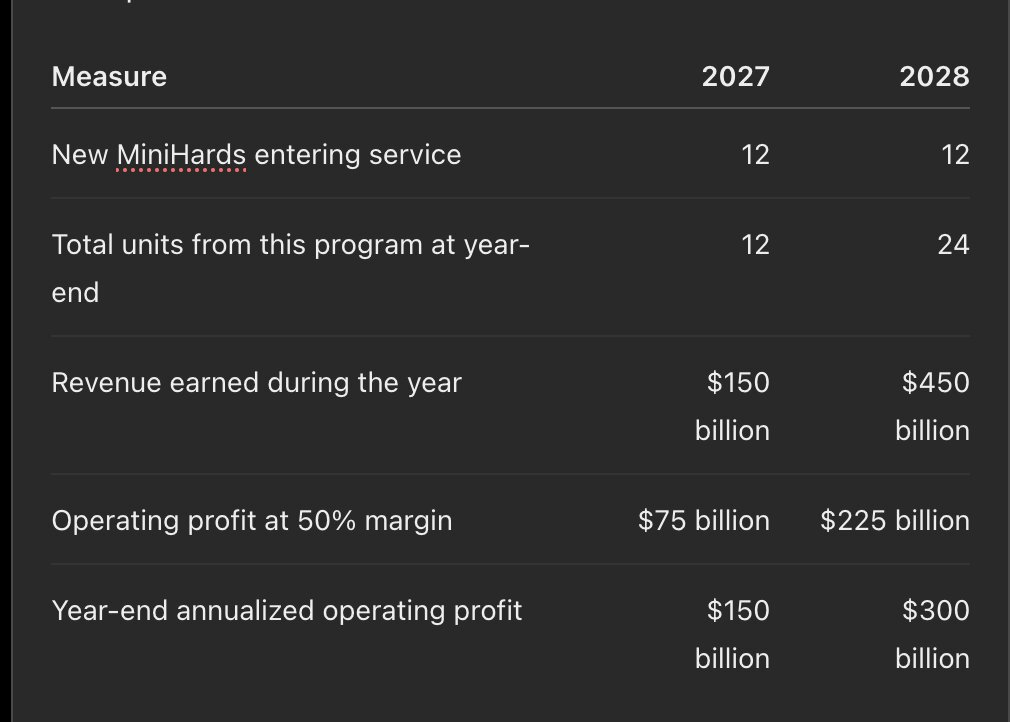
This isolates the new production program. It excludes any existing SpaceX AI capacity. The 2028 calculation assumes the first twelve units remain fully monetized, twelve more enter service evenly, and pricing and margins remain unchanged.
The Eight-Million-Robotaxi Comparison
Now give Tesla the same deployment clock.
Suppose Tesla deploys eight million revenue-producing robotaxis evenly through 2027. That creates approximately four million vehicle-years of operation during the year.
To match the MiniHard program’s modeled $75 billion of 2027 operating profit, each robotaxi would need to generate:
$75 billion ÷ 4 million vehicle-years = $18,750 of annual operating profit per vehicle.
At year-end, the eight-million-vehicle fleet would then support $150 billion of annualized operating profit—the same modeled run rate as twelve MiniHards.
That is the apples-to-apples comparison- two production programs ramping through the same year.
The $18,750 must be profit attributable to Tesla after the relevant operating costs and depreciation. It cannot be total fares, revenue belonging to vehicle owners, or vehicle-sale profit mixed with fleet-service profit.
If all eight million robotaxis were operating from January 1, they would need only $9,375 each to match the MiniHard program’s first-year $75 billion. Deployment timing changes the answer.
Why the Factory Model Matters
Standardization can reduce engineering repetition, simplify procurement, and make installation and commissioning more predictable.
The economic prize is earlier monetization. A customer who can begin using compute months sooner can begin generating revenue months sooner. SpaceX’s opportunity is to deliver that usable capacity repeatedly.
A Building Is Only the Beginning
The factory thesis depends on energized power, installed chips, working cooling and networking, completed commissioning, and customers paying the modeled rates.
The operating margin must absorb real costs, including GPU depreciation. Operating profit also does not equal free cash flow: building the next wave requires substantial capital.
Could MiniHard Become the World’s Most Profitable Product Family?
The model shows why it deserves attention. $75 billion of operating profit during a first year of monthly deployment, potentially rising to $225 billion in the following year under unchanged economics.
The decisive question is whether SpaceX can turn one successful build into a repeatable schedule of fully monetized AI capacity.
Watch the commissioning dates, customer contracts, realized pricing, and margins. If those confirm the factory thesis, MiniHard could become the business that defines SpaceX’s next stage.
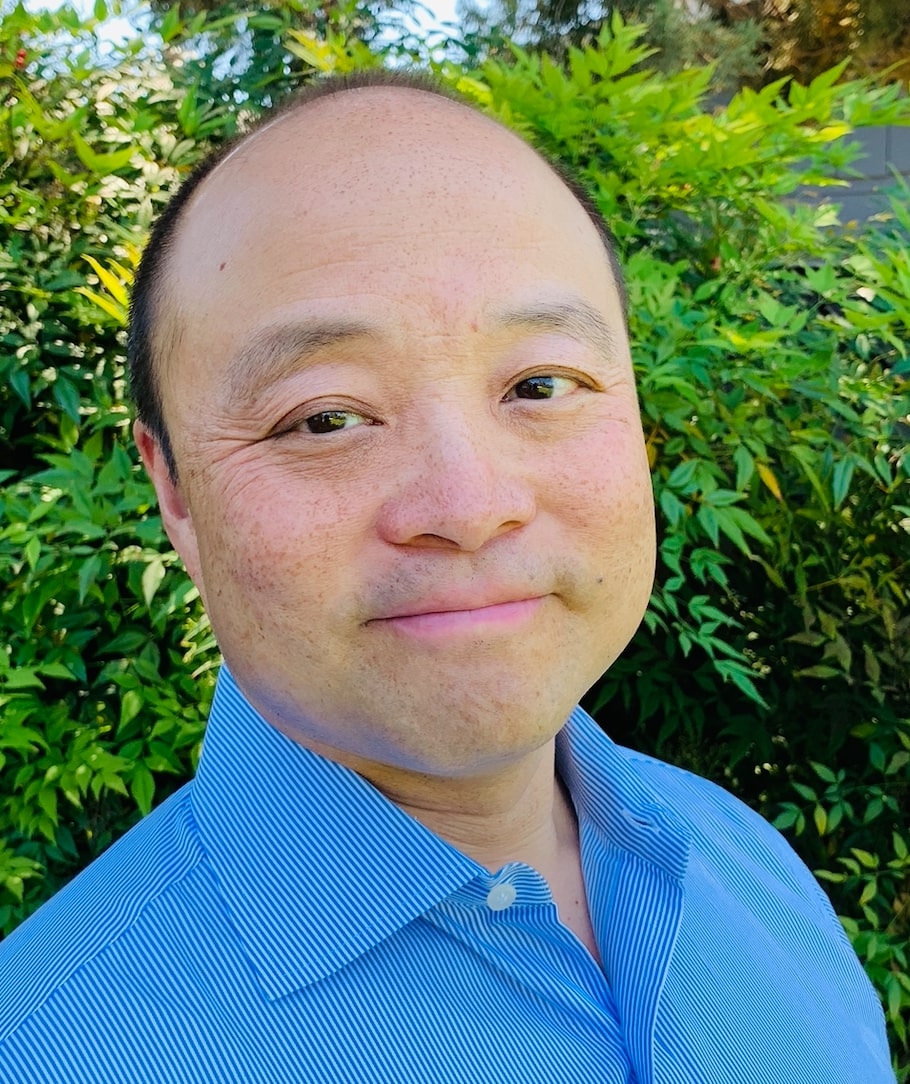
Brian Wang is a Futurist Thought Leader and a popular Science blogger with 1 million readers per month. His blog Nextbigfuture.com is ranked #1 Science News Blog. It covers many disruptive technology and trends including Space, Robotics, Artificial Intelligence, Medicine, Anti-aging Biotechnology, and Nanotechnology.
Known for identifying cutting edge technologies, he is currently a Co-Founder of a startup and fundraiser for high potential early-stage companies. He is the Head of Research for Allocations for deep technology investments and an Angel Investor at Space Angels.
A frequent speaker at corporations, he has been a TEDx speaker, a Singularity University speaker and guest at numerous interviews for radio and podcasts. He is open to public speaking and advising engagements.
