

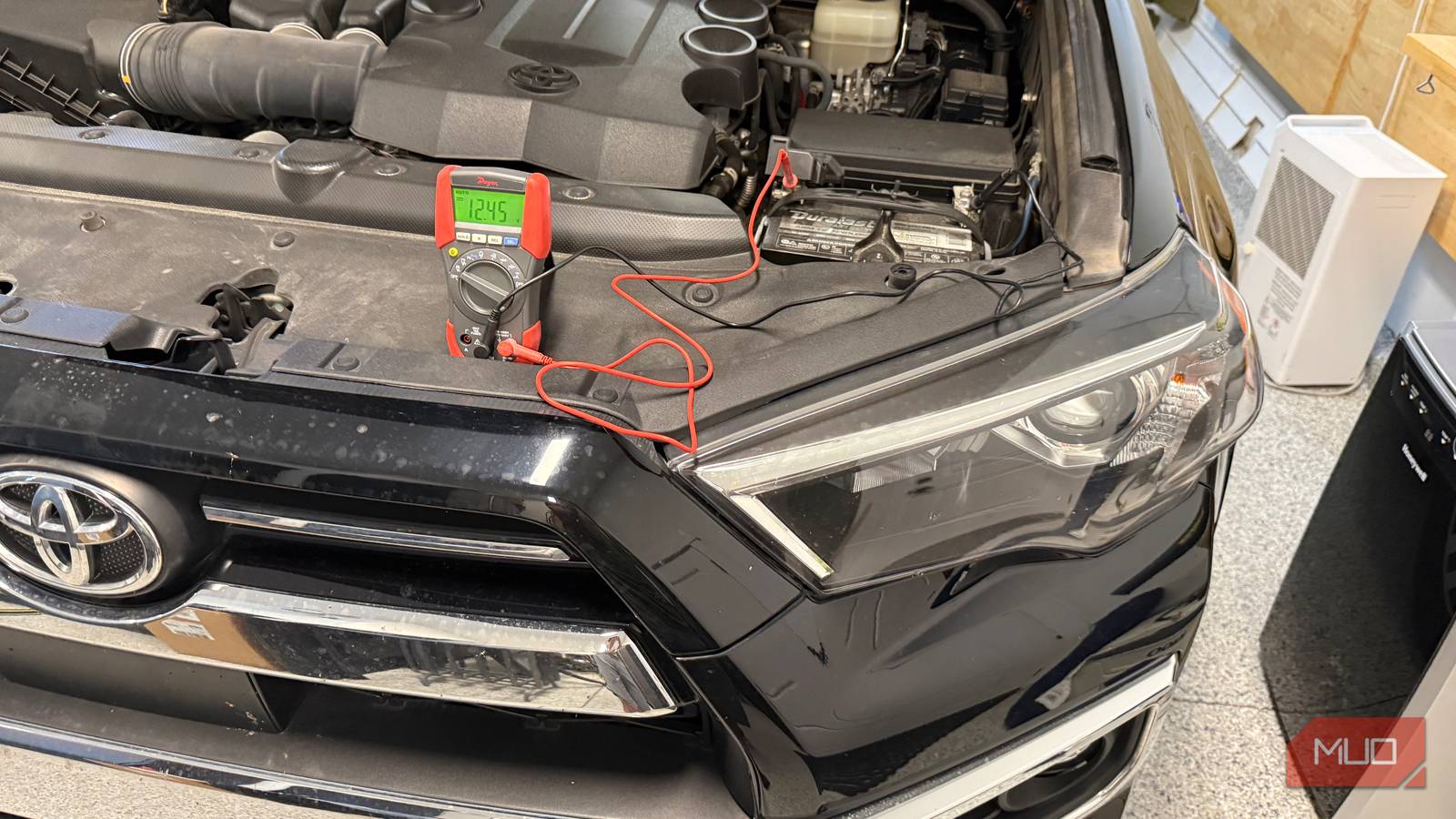

Every November, I check my 4Runner’s battery with my multimeter before the first hard freeze. I’ve already written up the 30-second test I use, but the car isn’t the only battery that can leave me stranded, cold, or offline once winter settles over Northern Indiana. My jump starter is useless without a charged pack. My Ryobi tool batteries have a long, idle winter ahead of them.
When ice drops a power line, a $77 UPS is the only reason my Wi-Fi network stays up, and the sensor next to my water heater can’t warn me about freezing temperatures once its CR123A cell runs out. All five fit into one afternoon, and most take less time than finding the multimeter.
The 4Runner’s AGM battery
Cold finds a weak battery in a hurry
I test our vehicles first, since a dead 4Runner strands me like nothing else here can. It runs a Duralast AGM. Cold makes lead-acid chemistry sluggish and the engine harder to spin, so the battery weakens right when the starter asks the most of it. A battery can start the truck daily for a month and still quit the first morning below 10°F.
I take two multimeter readings, one after the truck sits overnight and another while it cranks. The first tells me how charged the battery is. The second tells me whether it can still push current when the starter pulls hard. AGM batteries rest a little higher than flooded ones, so I read the results with that in mind. If either reading looks soft, I charge the battery and test again, or I take it to a parts store for a load test.
I also test the car battery on our family minivan the same way.

- Color
-
Red
- Battery Capacity
-
9 V
The 18V pack in my jump starter
My Ryobi 18V ONE+ 1600A jump starter rides strapped down in the 4Runner’s cargo area next to the tire inflator. After I left the lights on and drained the battery, it started the 4.0L V6 on the first try with a 4.0Ah HP pack and barely touched the charge. That happened in mid-60s weather, though, and a lithium-ion pack gives up less current when it’s cold.
So that pack gets attention all winter. I check its charge about once a week and rotate in a fresh one now and then, since a tool battery slowly loses charge while it sits. The 4Runner spends most of its time in my heated garage, so the pack only sees real cold during grocery runs and the kids’ activities. Ryobi recommends bringing packs to room temperature before cold-weather use, and parking indoors handles that. The jumper cables stay in the truck anyway.
The Ryobi packs I store until spring
My garage sits right at Ryobi’s minimum
My 40V trimmer, edger, and hedge trimmer go quiet after the last fall cleanup, along with most of my 18V tools. Their batteries stay in my heated garage, where the thermostat holds about 50–55°F. Ryobi recommends storing and charging its packs between 10°C and 37°C, or roughly 50°F to 99°F, so my garage barely clears the low end.
Charge level matters as much as temperature. Ryobi warns that leaving a pack discharged for long stretches costs capacity, so nothing goes on the shelf empty. I don’t top everything off to full and walk away either, since a partial charge holds up better over a long winter. Every couple of months, low packs get a short charge. My oldest 18V pack is nearing 10 years old, and I’d like to get a few more seasons out of it.
The UPS on my network rack
Pulling the plug is the only honest test
My basement rack runs off a CyberPower CP550SLG, which feeds my UniFi Dream Machine and the PoE switches. The access points and Echo Hubs get their power through that switch, so this one small UPS carries my entire home network when the power goes out. Winter storms are when it earns its spot, so I test it before one arrives.
With everything running, I unplug the UPS from the wall and watch. The router and switch should stay up, the Wi-Fi shouldn’t drop, and the UPS should start beeping to say it’s on battery. Mine passed. Then the cord goes back in, and the UPS gets the night to recharge.
Inside is a sealed lead-acid battery. Expect three to five years from one, or less if the room runs hot or the power drops often. My unit is still young, but every device I add to the switch cuts into runtime, so this test stays on my fall list.

- Number of Outlets
-
8
- Cord Length
-
5 ft
The Flood & Freeze Sensor by my water heater
Its freeze alert depends on one small lithium cell
My Ring Flood & Freeze Sensor sits on the basement floor near the water heater and sump pit. Most of the year it’s a leak detector, and it’s been one of the best home safety purchases I’ve made. Winter puts its other job front and center. It alerts me when the temperature around it drops to about 40°F, which leaves time to act before a pipe freezes.
That alert only works if the sensor’s CR123A battery does. Before heating season starts, I open the Ring app and check the battery level, and I replace the cell if it looks low instead of waiting for a warning. Then I touch the contacts on the bottom to make sure the sensor actually goes off. A healthy battery reading doesn’t help much if the alert never reaches my phone.
One afternoon in November saves a lot of January headaches
Nobody forgets the car battery. The rest die quietly: a flat pack in the jump starter, a tool battery stored empty since September, a UPS nobody tested, a sensor running on a spent cell. So block out an afternoon before your first hard freeze, and work your way from the garage to the basement rack. Winter tests every one of them regardless, and finding the weak one now lets you fix it on your schedule.
