

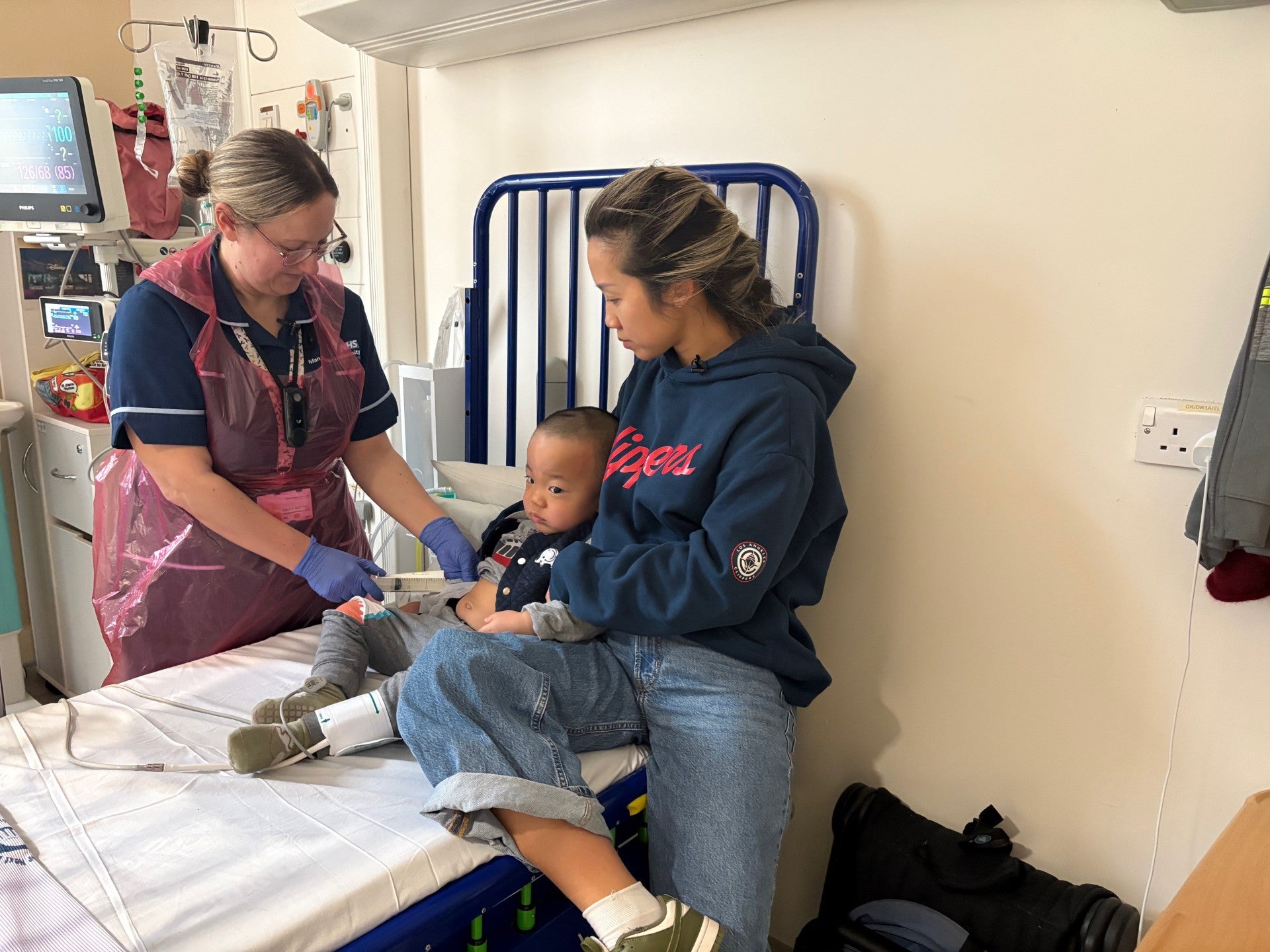

Ollie Chu was three years old when he received an infusion that would change his life.
Born with a rare inherited condition called Hunter syndrome, Ollie’s body couldn’t produce an enzyme that breaks down complex sugars.
Just a few months after his birth, the sugars had built up everywhere, wreaking havoc on lungs, liver, skin, and brain. In Hunter syndrome, joints stiffen and airways narrow, making it hard to breathe. The brain also struggles to grow, resulting in developmental delays and cognitive problems. Most kids diagnosed with the condition don’t live past 20.
There are a few treatments. One drug on the market counteracts some bodily symptoms but at a hefty price. It must be taken weekly for life and can’t rescue the brain. Another option is a full bone marrow replacement. While this offers a long-term solution, the procedure is risky for toddlers and depends on the availability of matching donors, who are few and far between.
Ollie’s treatment is new. Roughly a year ago, researchers at the University of Manchester removed stem cells from his body, genetically inserted a functional copy of the gene encoding the missing enzyme, and infused the edited cells back into his body through a catheter.
Now, he no longer depends on weekly drug infusions. “[He] is doing great since having the gene therapy. We have seen dramatic improvements, and he continues to grow physically and cognitively,” said his dad, Ricky, in a press release.
Ollie is one of five very young children in an ongoing clinical trial of gene therapy for Hunter syndrome. Led by the Royal Manchester Children’s Hospital and collaborators, researchers hope the one-and-done therapy will slash treatment time and offer a lasting solution.
“Gene therapy is not only safer and more effective [than bone marrow transplant], but it enables us to use the child’s own cells which cuts out the need to find a donor,” said joint clinical lead Rob Wynn. If successful, the principles could be adapted for other genetic diseases.
Broken Waste Plant
Cells are constantly building, destroying, and recycling proteins. They monitor the levels of different molecules—sugars, fats, and proteins—and shuttle excess to the lysosome.
Think of the lysosome as a cell’s “stomach.” Each bubble-like structure contains acidic fluids and a menagerie of enzymes to break down different types of molecules.
One of these enzymes, called iduronate-2-sulfatase (IDS), is missing in Hunter syndrome. The enzyme exists in all cells, but it’s most active in the liver, skin, immune system, and brain. Rather than staying put, IDS loves to roam about and explore neighboring cells. In other words, if only a fraction of cells can make the enzyme, its effects would still spread beyond just the treated ones.
The enzyme replacement therapy Ollie and other kids with Hunter syndrome begin early in life relies on IDS. Here, the enzyme is infused into the bloodstream where it’s absorbed into multiple tissues to help clean out toxic sugars. The treatment improves lung and liver function and helps with joint mobility. But due to its large size, it can’t enter the brain. Hence, the disease continues to attack neural function.
At the root of Hunter syndrome is the gene that produces IDS. Using viruses and gene editing, studies have shown that delivering a healthy version of the gene to mice boosts production of the enzyme. Some genetic diseases have only a single DNA letter change. But the IDS gene mutates in hundreds of ways, making it difficult to engineer a universal gene therapy.
A bone marrow transplant from a matching healthy donor is one workaround. Donor stem cells gradually develop into a range of healthy blood and immune cells. Because they have a normal version of the IDS gene, these cells pump the missing enzyme throughout the body.
A transplant is a one-and-done treatment, but the recipient must take immunosuppressant drugs for the rest of their life, increasing the chance of infections. And the wait for a matching donor can be very long.
Complete Replacement
In Ollie’s treatment, researchers harvested his own stem cells for gene therapy. Because the cells come from his body, they’re more likely to evade immune rejection.
The approach is based on a mouse study by Brian Bigger and colleagues, who is also co-leading the clinical trial. It uses a viral carrier, stripped of disease-causing genes, to shuttle a healthy IDS gene into blood stem cells outside the body. The edited cells are then infused back into the patient. The virus inserts the gene directly into the cell’s genome, ensuring the replacement isn’t lost when the cells divide.
Rather than using a natural version of IDS, the team added a snippet to the gene that helps the enzyme better tunnel into the brain. Once infused, the edited stem cells multiply into a variety of blood and immune cells that roam the body and release the working enzyme.
In mice modeling Hunter syndrome, a single treatment completely reversed brain symptoms for up to 16 months—or almost their entire lifespan. Other organs also benefited without notable side effects.
In late 2024, Ollie, at just three years of age, underwent a similar procedure. His doctors collected and isolated his blood stem cells and genetically tweaked them to churn out the missing enzyme. As he watched cartoons, the team infused two doses of the edited cells through a catheter. He quickly recovered and was discharged from the hospital a few days later.
Within three months of the infusion, Ollie was able to come off the weekly drug infusions that had dominated his life. His speech and motor abilities improved, allowing him to ride a tricycle, hang out with friends, and enjoy a normal childhood.
“I want to pinch myself every time I tell people that Oliver is making his own enzymes,” his mother Jingru told the BBC. “Every time we talk about it I want to cry because it’s just so amazing.”
The team is recruiting other children with Hunter syndrome in the ongoing clinical trial to further test safety and efficacy. Because symptoms progress so rapidly before causing brain damage, the trial only accepts patients between three and 12 months of age. (At first, doctors thought Ollie was too old, but testing showed his condition had progressed only a little.) Once treated, the children will be followed for two years to gauge the therapy’s effects against common symptoms, such as delayed learning, hearing issues, and heart and lung problems.
If successful, the same gene-editing approach could be used to treat other inherited diseases involving stem cells. Ollie’s parents are hopeful the therapy might be extended to older children, including his five-year-old brother Skyler, who also has Hunter syndrome but is currently too old for the trial.
Still, to his father Ricky, the experimental treatment has been a success.
“We’re excited for Ollie’s future. Seeing the difference for Ollie pre-and post-transplant has made us believers,” he said. “We hope that one day, a treatment becomes available for all children at all stages of Hunter syndrome.”
