


Curious Kids is a series for children of all ages. If you have a question you’d like an expert to answer, send it to CuriousKidsUS@theconversation.com.
“How will the Universe end? – Iez M., age 9, Rochester, New York
Whether the universe will “end” at all is not certain, but all evidence suggests it will continue being humanity’s cosmic home for a very, very long time.
The universe—all of space and time, and all matter and energy—began about 14 billion years ago in a rapid expansion called the Big Bang, but since then it has been in a state of continuous change. First, it was full of a diffuse gas of the particles that now make up atoms: protons, neutrons, and electrons. Then, that gas collapsed into stars and galaxies.
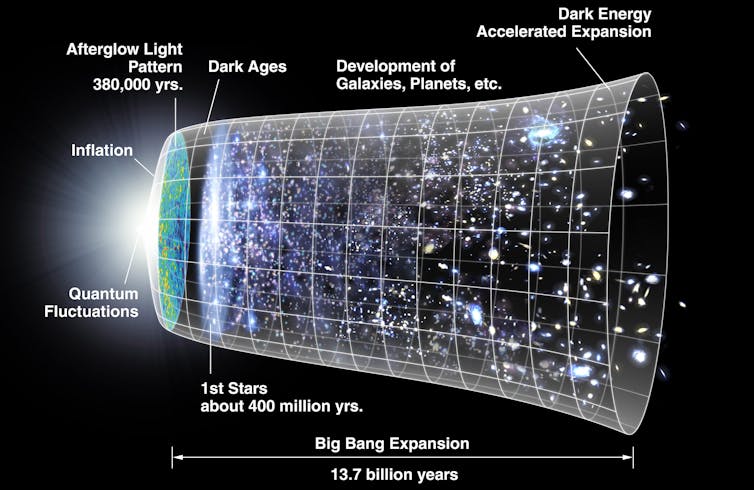
Our current theory for the history of the universe. On the left is the Big Bang roughly 14 billion years ago. The structure and makeup of the universe have changed over time. Image Credit: NASA/WMAP Science Team
Our understanding of the future of the universe is informed by the objects and processes we observe today. As an astrophysicist, I observe objects like distant galaxies, which lets me study how stars and galaxies change over time. By doing so, I develop theories that predict how the universe will change in the future.
Predicting the Future by Studying the Past?
Predicting the future of the universe by extending what we see today is extrapolation. It’s risky, because something unexpected could happen.
Interpolation—connecting the dots within a dataset—is much safer. Imagine you have a picture of yourself when you were 5 years old, and then another when you were 7 years old. Someone could probably guess what you looked like when you were 6. That’s interpolation.

Using a picture of the author when he was 5 years old and 7 years old, you could interpolate what he looked like when he was 6 years old, but you couldn’t predict what he would look like at 29. Image Credit: Stephen DiKerby
Maybe they could extrapolate from the two pictures to what you’d look like when you are 8 or 9 years old, but no one can accurately predict too far into the future. Maybe in a few years you get glasses or suddenly get really tall.
Scientists can predict what the universe will probably look like a few billion years into the future by extrapolating how stars and galaxies change over time, but eventually things could get weird. The universe and the stuff within might once again change, like it has in the past.
How Will Stars Change in the Future?
Good news: The sun, our medium-sized yellow star, is going to continue shining for billions of years. It’s about halfway through its 10 billion-year lifetime. The lifetime of a star depends on its size. Big, hot, blue stars live shorter lives, while tiny, cool, red stars live for much longer.
Today, some galaxies are still producing new stars, but others have depleted their star-forming gas. When a galaxy stops forming stars, the blue stars quickly go “supernova” and disappear, exploding after only a few million years. Then, billions of years later, the yellow stars like the sun eject their outer layers into a nebula, leaving only the red stars puttering along. Eventually, all galaxies throughout the universe will stop producing new stars, and the starlight filling the universe will gradually redden and dim.
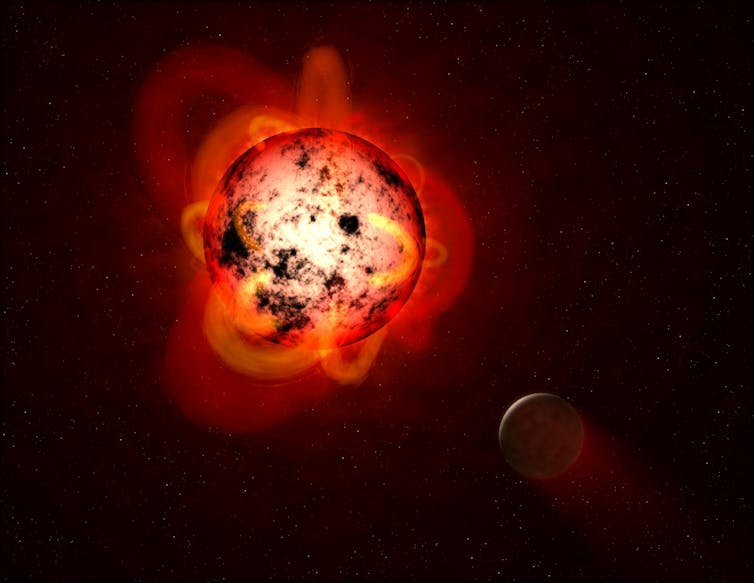
Red dwarf stars are the longest-lived type of stars. Once star formation shuts down throughout the universe, eventually only red stars will be left, gradually fading away over trillions of years. Image Credit: NASA/ESA/STScI/G. Bacon
In trillions of years—hundreds of times longer than the universe’s current age—these red stars will also fade away into darkness. But until then, there will be lots of stars providing light and warmth.
How Will Galaxies Change in the Future?
Think of building a sand castle on the beach. Each bucket of sand makes the castle bigger and bigger. Galaxies grow over time in a similar way by eating up smaller galaxies. These galactic mergers will continue into the future.
In galaxy clusters, hundreds of galaxies fall inward toward their shared center, often resulting in messy collisions. In these mergers, spiral galaxies, which are orderly disks, combine in chaotic ways into disordered blob-shaped clouds of stars. Think of how easy it is to turn a well-constructed sand castle into a big mess by kicking it over.
For this reason, the universe over time will have fewer spiral galaxies and more elliptical galaxies because the spiral galaxies combine into elliptical galaxies.
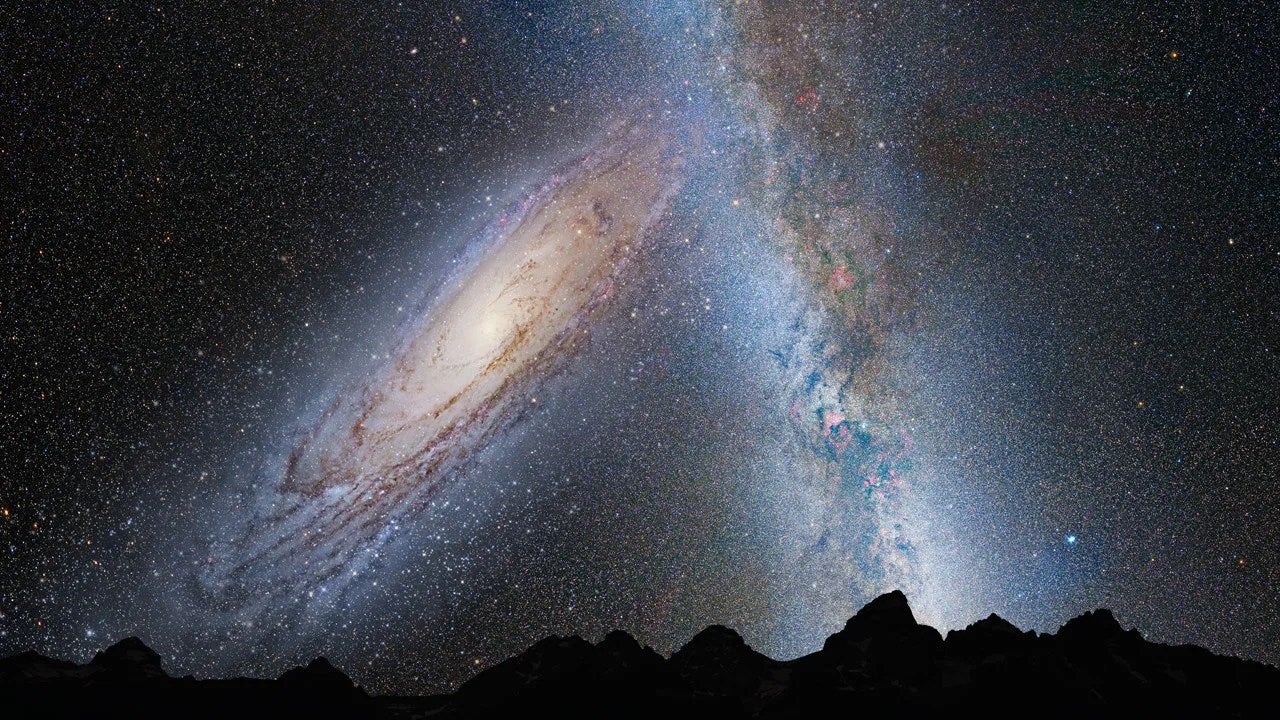
The Milky Way galaxy and the neighboring Andromeda galaxy might combine in this way in a few billion years. Don’t worry: The stars in each galaxy would whiz past each other totally unharmed, and future stargazers would get a fantastic view of the two galaxies merging.
How Will the Universe Itself Change in the Future?
The Big Bang kick-started an expansion that probably will continue in the future. The gravity of all the stuff in the universe—stars, galaxies, gas, dark matter—pulls inward and slows down the expansion, and some theories suggest that the universe’s expansion will coast along or slow to a halt.
However, some evidence suggests that some unknown force is starting to exert a repulsive force, causing expansion to speed up. Scientists call this outward force dark energy, but very little is known about it. Like raisins in a baking cookie, galaxies will zoom away from each other faster and faster. If this continues into the future, other galaxies might be too far apart to observe from the Milky Way.
To summarize the best current prediction of the future: Star formation will shut down, so galaxies will be full of old, red, dim stars gradually cooling into darkness. Each group or cluster of galaxies will merge into a single, massive, elliptical galaxy. The accelerated expansion of the universe will make it impossible to observe other galaxies beyond the local group.
This scenario eventually winds down into a dark eternity, lasting trillions of years. New data might come to light that changes this story, and the next stage in the universe’s history might be something totally different and unexpectedly beautiful. Depending on how you look at it, the universe might not have an “end,” after all. Even if what exists is very different from how the universe is now, it’s hard to envision a distant future where the universe is entirely gone.
How does this scenario make you feel? It sometimes makes me feel wistful, which is a type of sadness, but then I remember we live at a very exciting time in the story of the universe: right at the start, in an era full of exciting stars and galaxies to observe! The cosmos can support human society and curiosity for billions of years into the future, so there’s lots of time to keep exploring and searching for answers.
This article is republished from The Conversation under a Creative Commons license. Read the original article.
