


Standard view treats physics as fundamental — matter, energy, fields — with information as merely a description we lay on top. Google Deepmind Demis Hassabis inverts this. Prior physicists John Wheeler’s “it from bit”, Konrad Zuse’s and Ed Fredkin’s digital physics also view information and computation are the bedrock.
Matter/energy are what information looks like from the inside. The universe, on this view, is not like a computation. The universe is computation. Its evolution over time is the running of some deep informational process, and physical law is the program.
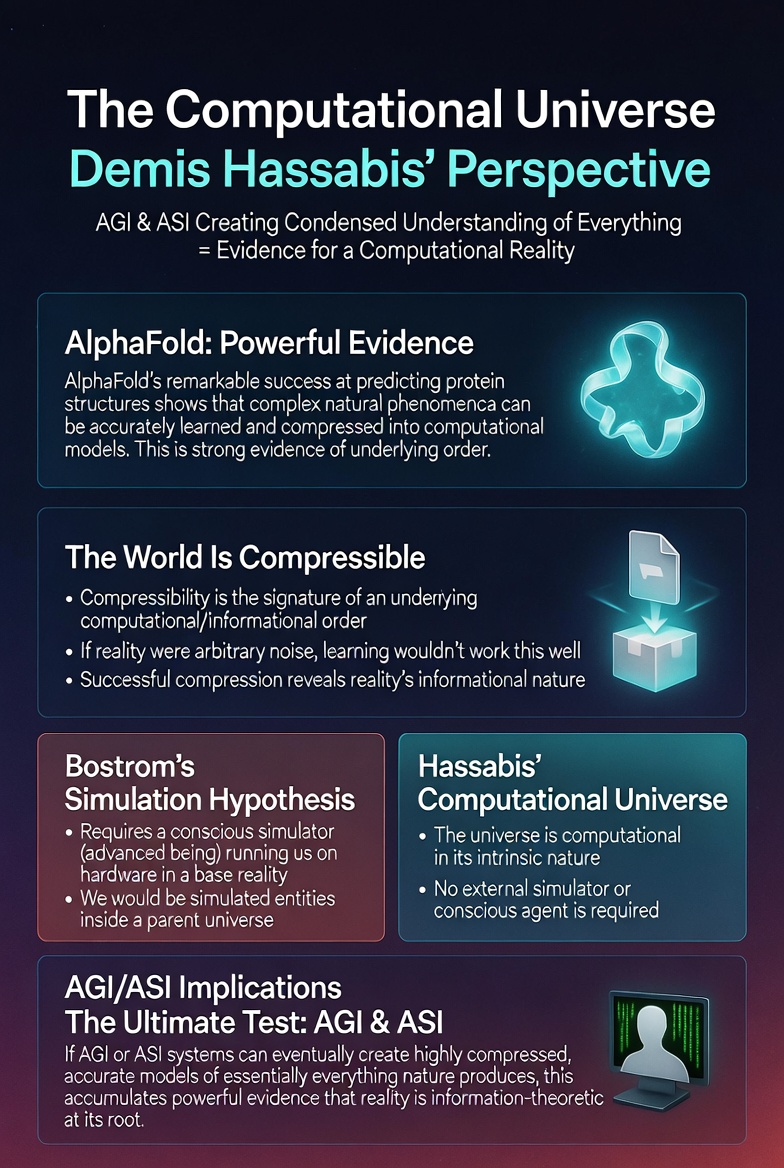
Why does Demis Hassabis believe in the Computational Universe ?
AlphaFold is evidence for the Computational Universe.
The world is compressible, and compressibility is the signature of an underlying computational/informational order.
If reality were arbitrary noise, learning wouldn’t work this well.
This is different from Bostrom’s simulation hypothesis.
Bostrom’s version requires a simulator — a conscious agent running us on hardware in a parent reality.
The universe is computational in its intrinsic nature. Calling it a simulation is like calling the ocean a simulation of water.
IF AGI-level systems can eventually learn compressed models of essentially everything nature produces, that’s accumulating evidence that reality is information-theoretic at root — and if they hit hard walls, that’s evidence too.
AlphaFold is evidence for the Computational Universe rather than metaphor. Protein folding was supposed to be computationally intractable — Levinthal’s paradox says a protein has astronomically many possible configurations, yet nature folds them in milliseconds.
AlphaFold showed that a learned model could predict the folded structure directly, which to Hassabis suggests something profound.
Natural structures that evolved (proteins, and he’d extend this to other evolved or physically-generated structures) occupy a tiny, highly ordered corner of possibility space, and that corner has learnable regularity — a compressed description exists.
In his Nobel lecture framing, any natural pattern that can be generated by a physical process can, he conjectures, be efficiently discovered by a classical learning algorithm. The fact that neural networks keep successfully modeling reality’s structures — protein folds, weather, materials, fluid dynamics — is, to him, a clue about reality itself.
The world is compressible, and compressibility is the signature of an underlying computational/informational order. If reality were arbitrary noise, learning wouldn’t work this well.
This is different from Bostrom’s simulation hypothesis. Bostrom’s argument is anthropic and sociological advanced civilizations would run ancestor simulations, so statistically we’re probably in one — a deliberate artifact, someone’s elaborate video game.
Hassabis rejects that framing explicitly (“I don’t think this is some kind of game, even though I wrote a lot of games”).
The difference is between who made it and what it’s made of. Bostrom’s version requires a simulator — a conscious agent running us on hardware in a parent reality, with all the regress problems that entails. Hassabis’s version requires no simulator at all: the universe is computational in its intrinsic nature, the way it’s “made of” quantum fields on the standard view. There’s no game designer, no server, no outside. Calling it a simulation would be like calling the ocean a simulation of water. It’s closer to a claim about ontology — what the fundamental “stuff” is — than a claim about our cosmic circumstances.
Where it sits philosophically
It is a serious intuition shared in various forms by Wheeler, Fredkin, David Deutsch, Max Tegmark (whose mathematical-universe hypothesis is a more radical cousin), and Stephen Wolfram — but as you note, it’s not a formalized theory.
The honest criticisms are that “the universe is computational” risks being unfalsifiable without a specific model that predicts something the standard model doesn’t. Learnability of nature might just reflect the locality and symmetry of physical law rather than anything deeper and that quantum mechanics complicates naive digital-physics pictures (though quantum information theory arguably strengthens the informational view — Wheeler’s own instinct). Hassabis seems aware of all this, which is why he frames it as something he plans to write about seriously rather than something he’s asserting as settled.
His unique angle is that he’s treating AI itself as the experimental instrument for the question. IF AGI-level systems can eventually learn compressed models of essentially everything nature produces, that’s accumulating evidence that reality is information-theoretic at root — and if they hit hard walls, that’s evidence too.

Brian Wang is a Futurist Thought Leader and a popular Science blogger with 1 million readers per month. His blog Nextbigfuture.com is ranked #1 Science News Blog. It covers many disruptive technology and trends including Space, Robotics, Artificial Intelligence, Medicine, Anti-aging Biotechnology, and Nanotechnology.
Known for identifying cutting edge technologies, he is currently a Co-Founder of a startup and fundraiser for high potential early-stage companies. He is the Head of Research for Allocations for deep technology investments and an Angel Investor at Space Angels.
A frequent speaker at corporations, he has been a TEDx speaker, a Singularity University speaker and guest at numerous interviews for radio and podcasts. He is open to public speaking and advising engagements.
