


Why you can trust TechRadar
We spend hours testing every product or service we review, so you can be sure you’re buying the best. Find out more about how we test.
Beelink EQi Wildcat Lake: 30-second review
The Beelink EQi is essentially an ideal office machine. There’s nothing fancy about the design; in fact, it feels a little lightweight and plasticy; however, the balance of features is far greater than the specifications would initially have you believe.
As ever, this Mini PC is compact with its 126mm-square footprint that enables easy positioning around the desk; however, while the looks may not highlight anything special, it packs in an unusual amount of connectivity for a Mini PC at this price and with this level of CPU.
The major surprise here is that on the back, alongside the usual 2.5GbE LAN port, is a second, ultra-fast 10GbE port, which is the sort of specification you normally find on hardware costing far more, but also ideal if you’re connecting into a UGREEN IDX6011 NAS over a 10GbE network for archiving. Next to this network port are two Thunderbolt 4 ports at 40 Gbps, HDMI 2.0, and triple-display support, meaning that for integration into an office or studio this machine is highly tuned.
It’s also very neat with the dark grey ABS enclosure feeling cheap compared to aluminium rivals. Still, the 85W power supply is built into the chassis, so the only cable at the back is a mains lead, and those going to monitors and accessories, there’s no power brick to get in the way.
Open the base and the interior is exceptionally well organised, with both M.2 slots covered by a substantial metal heatsink that lifts off with two screws. The rear port layout is the odd decision, with the two Type-A ports placed on either side of the HDMI output rather than together, which is awkward if you use a wired keyboard and mouse.
Performance is well balanced by Intel’s Core 3 304, though it has its limitations. It’s quick where it counts when browsing the internet, using office software, or playing media, and I’ve even found myself using it to offload image and video files to the server quickly and to book equipment and locations. Where it does fall is in graphics performance, as highlighted by the benchmarks: great for the office but really a no-go for gaming unless optimised for lower-specification systems.
Storage is also interesting with two M.2 slots. However, they support different lane counts, and a Crucial T710 Gen 5 drive returned 3510.25 MB/s read in slot one but only 1750.42 MB/s in slot two, which is slower than the UFS drive Beelink already fits, but then does enable you to boost the overall internal storage neatly.
Everything else is again well-balanced for office use. This is a nice, quiet machine with Windows 11 Pro pre-installed. The design is nothing flashy, but for dedicated office use with serious network potential it’s one of the best mini PCs I’ve tested.
Beelink EQi Wildcat Lake: Price and availability
- How much does it cost? From $509
- When is it out? Available now
- Where can you get it? Directly from Beelink and retailers such as Amazon
The EQi costs $509 for the 16GB LPDDR5 and 512GB configuration that I’ve looked at in this review. It’s available direct from Beelink here in three configurations – 16GB LPDDR5, 24GB DDR5, and 32GB DDR5 RAM, all with 512GB SSD.
I’m also seeing several models on Amazon.com and Amazon.co.uk for around the same price.

Beelink EQi Wildcat Lake: Specs
CPU: Intel Core 3 304, 5 cores/5 threads, up to 4.3GHz, 6MB cache, 15W TDP
Graphics: Intel Xe3-LPG integrated graphics
RAM: 16GB LPDDR5, or 24GB/32GB DDR5 at 5600MT/s; DDR5 version upgradeable to 64GB
Storage: 512GB UFS 3.1; two M.2 2280 slots (slot 1 PCIe 4.0 x2, slot 2 PCIe 4.0 x1), up to 4TB each
Left Ports: USB 3.2 Type-A, USB 3.2 Type-C, 3.5mm audio jack
Right Ports: 2x Thunderbolt 4, 2x USB 2.0, HDMI 2.0, 10GbE, 2.5GbE, AC input
Connectivity: Wi-Fi 6, Bluetooth 5.2, 10GbE Ethernet, 2.5GbE Ethernet
Audio: 3.5mm combined audio connection
Camera: None
Size: 126 x 126 x 44.2mm,
Weight: 500g
OS Installed: Windows 11 Pro
Accessories: HDMI cable, regional AC lead/power adapter and user manual
Beelink EQi Wildcat Lake: Design
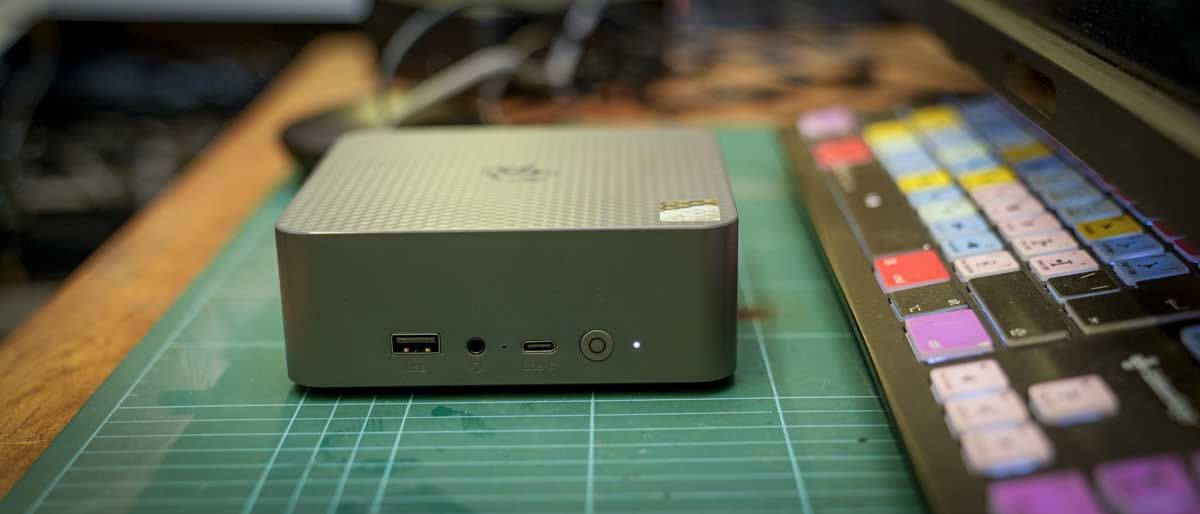
If you’re looking for a machine that blends into the office background, then the Beelink EQi Wildcat Lake is a perfect option. The dark grey finish, rounded corners, and a lightly textured top panel are neat and strike a note that really highlights the machine’s price point and specifications.
The size is also in line with what you’d expect from a standard Office Mini PC, with a relatively small form factor and a compact 126mm x 126mm footprint, at just 500g.
While the design might not be the most inspiring, it is generally well thought out and, surprisingly, has a built-in 85W power supply, so just a single power cable runs to the AC mains, with no need for a power brick.
On the front and back are a good range of ports, highly specified for a machine at this price. There’s also good air ventilation through the base, with airflow entering over the processor and passing through the storage.

Beelink quotes 32dB as the noise in normal use, and this seemed about right, with the ambient noise in the office slightly higher when ideal. This is also one of the neatest laid-out Mini PCs internally that I’ve seen, accessible through the base, which is held in place by four small cross-head screws. A small attention to detail is the small label that just helps to lift the base free, enabling easy access.
Once inside the interior, both M.2 slots are slightly hidden under a single large metal heatsink that lifts off with two screw. Once removed, your choice of M. 2 2280 SSD can be installed. This heatsink shows real consideration as a thermal solution for the installed drives, with the installation process taking no more than a couple of minutes.
The port selection and specification are where things really get interesting. Starting at the back, there are two USB 2.0 Type-A ports on either side of the HDMI Max 4.0 60Hz output rather than together, so a wired keyboard and mouse end up separated by a display cable.
Then there are two LAN ports, a 2.5GbE and a 10GbE, which is very unusual for a machine at this level; also unusual are the two Thunderbolt 4 ports. The front is a little more standard, with a USB 3.2 Type-A, a USB-C 10 Gbps, a 3.5mm audio jack, and finally the power button.

Beelink EQi Wildcat Lake: Features
A quick check through the features highlights the intended audience for this PC. At the heart of the machine is the very respectable Intel Core 3 304; it’s nothing flashy, but this is a new-generation CPU so offers far more than entry-level CPUs in the past, and while not an AI powerhouse, does feature an integrated NPU as well as GPU, handy if you use Copilot on a day-to-day basis for work.
The CPU offers a five-core, five-thread processor with one performance core and four efficiency cores, 6MB of cache and a 15W TDP, turboing to 4.3GHz. Beelink quotes AI performance at 24 TOPS across the CPU, GPU and NPU for local AI processing.
While it’s great to see this entry-level office machine has AI potential, connectivity is what has surprised me about the EQi through this test. On the back are those two Thunderbolt 4 ports that run at 40 Gbps with DisplayPort 1.4, and if you need to connect more monitors, then there’s the more traditional HDMI 2.0, which I used to connect to my monitor for this review.
The two network ports, one 10GbE and one 2.5GbE, are a headline feature and enabled me to connect directly into the 10GbE LAN in the office. This meant that I could quickly offload video and image files through the machine’s Thunderbolt 4 to the network. While this is an office-focused machine, I use an old Intel NUC 9 in the office for this exact task, and its speed over 1GbE and USB3.2 Gen 1 is unmatched by this.
Inside there’s a fixed 16GB LPDDR5 or upgradeable DDR5 at 24GB or 32GB, both at 5600 MT/s, with the DDR5 version supporting up to 64GB. Storage is 512GB of UFS 3.1, again fixed, but there is the option to install two M.2 2280 SSDs, both enabling up to 4TB. One point about these two slots is that they don’t support the same number of PCIe lanes, with one half as fast as the other.
Wireless runs over a MediaTek MT7922 module, with Wi-Fi 6 and Bluetooth 5.2.

Beelink EQi Wildcat Lake: Performance
Benchmark scores
CrystalDiskMark Read: 1977.4
CrystalDiskMark Write: 806.79
Geekbench CPU Multi: 6303
Geekbench CPU Single: 2337
Geekbench GPU: 6182
PCMark Overall: 4733
Cinebench CPU Multi: 4785 (R23)
Cinebench CPU Single: 1696 (R23)
Fire Strike Overall: 1918
Fire Strike Graphics: 1971
Fire Strike Physics: 12379
Fire Strike Combined: 778
Time Spy Overall: 879
Time Spy Graphics: 773
Time Spy CPU: 3963
Wildlife Overall: 5133
Steel Nomad Overall: 127
Windows Experience Overall: 8.1
Procyon AI Computer Vision 2.0: 635
Additional tests
Crucial T710 Gen 5 NVMe, slot 1: Read 3510.25 MB/s, Write 3530.98 MB/s
Crucial T710 Gen 5 NVMe, slot 2: Read 1750.42 MB/s, Write 1766.17 MB/s
Lexar PCIe 3.0 SSD: Read 1631.56 MB/s, Write 1499.14 MB/s
Getting started with the Beelink EQi was extremely straightforward, with a single power cord that plugs in, eliminating the need for the usual power brick. While this may seem small, it actually makes quite a difference, reducing cables and bulk to deal with.
Once the initial setup with the mouse, keyboard, and 4K monitor was complete and Windows 11 Pro was set up, the machine was installed with the usual array of applications. Microsoft Office, Adobe Creative Suite and a few games for good measure.
Starting with the main office applications, performance proved solid, running PowerPoint, Word, and Excel without issue, with Copilot there to support me as I put together a presentation for September. The speed is good, and despite the CPU’s entry-level position, it handled everything impressively.
Checking out the results of the Geekbench 2,337 single-core and 6,303 multi-core results and, more importantly, the PCMark 10 came in at 4,733, showing that while this machine doesn’t excel, it’s where you would want it for a competent everyday computer that won’t get bogged down under heavy processing.
During the test, I edited a few images in Lightroom and Photoshop, and both ran surprisingly well, even with the images stored on the internal UFS 3.1 drive. While this drive isn’t the fastest compared with the latest SSDs, it is fast enough for most office-based work, with CrystalDiskMark results of 1977.4 MB/s read and 806.79 MB/s write.
What’s interesting is that inside there are two PCIe 4.0 slots, one listed as PCIe 4.0 x2 and the other as PCIe 4.0 x1, so I fitted a Micron Crucial T710 Gen 5 NVMe to each in turn to check out the speeds of each, just as a note you can add up to 4TB in each, giving a total of 8.5TB of storage which is impressive.
The first slot recorded 3510.25 MB/s read and 3530.98 MB/s write. The same drive in slot two returned 1750.42 MB/s read and 1766.17 MB/s write. That’s roughly twice the speed in the first compared with the second and still very acceptable for the intended end user. While I used a PCIe 5.0 SSD, a respectable PCIe 4.0 SSD which is far cheaper should gain a similar result.
Switching to the Xe3-LPG graphics, things start to fall slightly. The integrated graphics are ideal for everyday work, watching back multimedia and light photo and video editing.
However, when it comes to gaming, the potential is limited. Hogwarts Legacy ran slowly, and Indiana Jones and the Great Circle was a no-go. Other games ran, but due to the lack of space on the internal storage, I ran all from the faster Crucial in the first of the two spare SSD slots.
After running the Mini PC in the office for a week, using it mainly for Word and research work with some light photo editing, a few features became apparent that set this Mini PC and test apart from most others. The speed of those connections just enabled the EQi to integrate perfectly with the studio; it’s nothing flashy, but it turned out to be the fastest machine for transferring image and video data to the NAS.
After a shoot, I plugged the CFExpress Type-B card reader into the Thunderbolt 4 port and transferred the files at speed over to the Ugreen IDX6011 NAS. The connection speed over the network, due to that 10GbE port, made the transfer speed far exceed that of any other machine I know.
I usually use an old Intel Nuc 9 Ghost Canyon that I can leave for a few hours before network editing on the MacBook Pro; however, here, with this small, inexpensive machine, it handled everything at speed.
While the 24-core TOPS, as quoted by Beelink, is marginal on the AI processing front, and while I was able to use Co-Pilot, running a local LLM was limited to a 3-4B model, I opted for Qwen3. The main issue here was that the RAM is only single-channel, which limits the speed; however, for checking through documents and basic summary tasks, it actually worked surprisingly well.

Beelink EQi Wildcat Lake: Final verdict

The Beelink EQi is an impressive office-focused machine that underwhelms with its design but outperforms in performance. It packs in the usual office-based Mini PC features such as being able to support three displays, 2.5GbE networking, a base level of storage and RAM, but then it surprises by offering more.
The 10GbE networking and Thunderbolt 4 ports are surprising and completely change what’s possible with this machine, and for something with such a small footprint, those two specifications instantly make it interesting.
When you then add in the fact that you can expand the internal storage with two 4TB SSDs, it then becomes even more interesting.
For me, the 10GbE and Thunderbolt ports are what make this Mini PC go from something that would blend into the background to something that’s actually very useful. The speed of those two ports enables me to hook this directly into an existing 10GbE network and to take advantage of the speeds that it offers. The issue, of course, is that you need the network infrastructure in place to make the most of this speed.
That brings me round to who the Beelink EQi is best for? Straight down the line, it would be for Office work. It has excellent single-core performance, runs pretty much silently, supports up to three displays, lets you upgrade the internal storage, and has an ultra-fast network connection that is beyond what most desktops offer. It’s also not really usable for playing games, and, on the surface, if you work in the creative sector, it’s not going to make an impact there either.
However, as I found with a cheapish mini PC that offers solid performance, the Thunderbolt 4 and 10GbE network make it great for offloading large video and image files to the NAS. Realistically, however, this is a Mini PC perfectly suited to anyone whose work involves documents, spreadsheets, browsers, and moving large files across a network; it is one of the more capable small machines I have tested this year.
Should I buy the Beelink EQi Wildcat Lake?
|
Value |
Decent connection options for the money, if you have a 10GbE network to use it |
4 |
|
Design |
Compact, quiet and well laid out inside, let down by plasticy casing |
4 |
|
Features |
Outstanding port selection for a machine this size, focused for the office but with potential |
5 |
|
Performance |
Fast in everyday work, weak in graphics, excellent storage in the right slot |
4 |
|
Overall |
An excellent quiet office machine with workstation connectivity |
4 |
Buy it if…
Don’t buy it if…
For more professional-grade desktops, we’ve tested the best business computers.
