


Why you can trust TechRadar
We spend hours testing every product or service we review, so you can be sure you’re buying the best. Find out more about how we test.
CareerBuilder is a popular job site that aggregates numerous listings and lets job seekers search through them seamlessly. Users can upload resumes and get matched with employers and also receive ongoing job opportunity alerts.
Founded way back in 1995, CareerBuilder is one of the earliest job sites still operating today. It once had the largest market share of job sites in the U.S. but gradually lost ground to rivals like Indeed and Glassdoor. It remains fairly popular, though, with users across the US, Asia, and Europe.
I reviewed CareerBuilder to help you decide if it’s a good option out of the many job sites to choose from. What do you gain from it, what are its pros and cons, and is it better than the competition? I’ve answered these questions in detail, so read on to learn what CareerBuilder offers.
CareerBuilder: Plans and pricing
CareerBuilder follows the pricing model used by most job boards. Job seekers use the site for free, while employers pay to promote job listings and gain access to the resume database. You can check it out by clicking here.
It’s a business model that works well for both parties. Job seekers find opportunities without paying, while businesses pay to connect with qualified job candidates.
Pricing for employers starts at $299 per month. The Lite plan, for $299 per month, allows 1 active job listing and 500 resume views on CareerBuilder’s database. Using algorithms, the job listing is matched with fitting resumes from CareerBuilder’s database, and the employer receives ongoing email alerts about resume matches.
The Standard plan, for $399 per month, allows 3 active job listings per month while other features remain the same. For $599 per month, the Pro plan allows 5 active job listings.
CareerBuilder offers discounted prices for businesses that commit to paying annually instead of monthly. Large enterprises can also negotiate directly with the sales team and secure bulk discounts.
Unlike several job sites I’ve reviewed, CareerBuilder offers no free plan for employers, and I consider this a disadvantage. Some sites allow employers to post 1 or 2 job listings for free, then pay for advanced features like access to the resume database. In this case, there’s no free plan or a standard free trial.
CareerBuilder: Features
CareerBuilder connects job seekers to employers advertising job listings in numerous niches. For job seekers, it’s free to use, but employers pay for promoting job listings.
Anyone can sign up as a job seeker and scour CareerBuilder’s job listings, with filtering by location, type (full-time or part-time), date posted, and specific keywords.
For instance, if you’re looking for a full-time software engineer role in Denver, Colorado, you’ll adjust the search filters to get the exact results matching your query. If you need a part-time job at a local retailer, you can also adjust filters to get exact matches.

You can also upload your resume to CareerBuilder’s database, and employers can find you in this database. This means that you don’t always have to go seeking jobs, but jobs can come to you. If an employer thinks your resume is a very good fit, they’ll contact you for further interviews.

I like that CareerBuilder sends job alerts tailored to users’ resumes and previous searches. Some of the best roles are hiding in plain sight, so you won’t always find them when searching, but CareerBuilder’s email alerts can quickly point you to them.
For some jobs, you can apply with one click, but others can require a multi-step process. Either way, I found the application process as straightforward as it gets.
CareerBuilder provides some profile insights that I found valuable. I received alerts when employers viewed my profile (even if most didn’t send job offers) and when my profile appeared in search results. These insights tell users about the employers and job searches their profiles match, and they can optimize further to get the right roles.
I also like that CareerBuilder offers salary data, though not as detailed as rivals like Glassdoor. This data makes it easy to research pay ranges for expected jobs, based on location, roles, and other data.
I’ve discussed the features job seekers get on CareerBuilder, so let’s now look at what employers get on this platform. First, businesses gain access to a vast resume database from which they can select suitable job candidates. Just as job seekers search for jobs with filters like location and title, you can filter through resumes to find candidates that match your preferences, then contact these candidates with potential offers.
Of course, businesses can create job postings for candidates to view on the CareerBuilder job board. I like that CareerBuilder provides an AI assistant that helps generate compelling job descriptions. With many businesses posting similar roles, a compelling description makes yours stand out to job seekers.
Notably, CareerBuilder offers job syndication, where job listings are published not only on CareerBuilder but also on partner sites and niche job boards. This syndication increases the reach of your job posts and makes finding good candidates easier.
A centralized dashboard makes it simple for businesses to sort and save resumes, monitor applications, and keep tabs on conversations with candidates.
CareerBuilder offers standard features that employers find on rival job boards. My main complaints are the relatively high costs and lack of a free plan, even one with restricted features.
Pricing starts at $299 per month for 1 active job listing and goes up to $599 per month for 5 listings, which I consider steep. Large businesses can negotiate discounts, but the pricing remains relatively high. I’ll advise only medium-sized and large businesses with bigger budgets to get a CareerBuilder employer account, but it doesn’t suit small businesses.
CareerBuilder: Ease of use
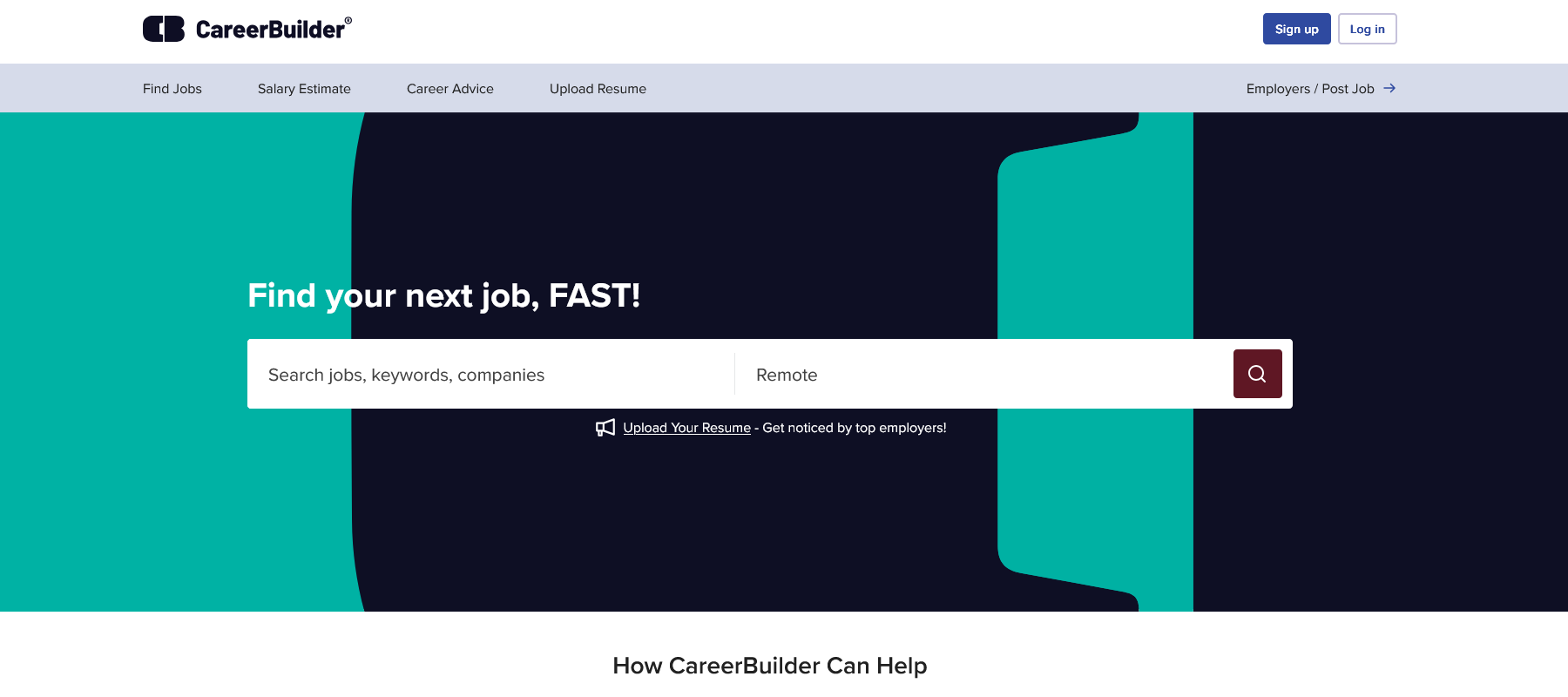
CareerBuilder offers a modern, visually appealing interface that I found easy to navigate. The interface sports a white background and a few bright colors to highlight buttons, icons, and features, giving it a modern, minimalist look.
Filtering job listings, uploading resumes, and scouring resume databases felt noticeably easy. This sleek, easy-to-navigate interface benefits both job seekers and employers.

You can access CareerBuilder from a web browser or download the iOS or Android app. The smartphone app allows for easy, on-the-go access, particularly for browsing job listings and quickly applying to available jobs.
CareerBuilder: Support
You can access CareerBuilder from a web browser or download the iOS or Android app. The smartphone app allows for easy, on-the-go access, particularly for browsing job listings and quickly applying to available jobs.
CareerBuilder: The competition
CareerBuilder has many competitors, as it operates in a crowded job board industry. I’d have mentioned Monster as a rival, but both are owned by the same company. Glassdoor and Snagajob are then the main rivals I’d like to highlight.
Glassdoor operates a job board like CareerBuilder, but its strength lies in massive salary data, company reviews, and interview prep tips for job seekers. CareerBuilder also provides salary data, but its dataset is nowhere as close as what’s available on Glassdoor.
Snagajob is built for a specific niche of hourly, part-time, and seasonal jobs in retail, restaurants, and related industries. You can also find such jobs on CareerBuilder, but I think Snagajob is better for seeking hourly, temporary roles at retail stores, bars, restaurants, warehouses, etc. However, CareerBuilder offers a broad set of jobs, both full-time corporate and hourly roles, that you won’t find on Snagajob.
CareerBuilder: Final verdict
CareerBuilder is good for both people seeking jobs and businesses seeking to connect with the right job candidates, although prices are relatively high for businesses. It’s a reliable platform that connects job seekers with the right opportunities from businesses.
However, I’d note that CareerBuilder doesn’t offer much to differentiate itself from the competition. It feels like just other job boards do. That’s not really a flaw, but just something to note when comparing CareerBuilder against other job boards.
For more picks, we’ve tested the best recruitment platforms and the best job sites.
