

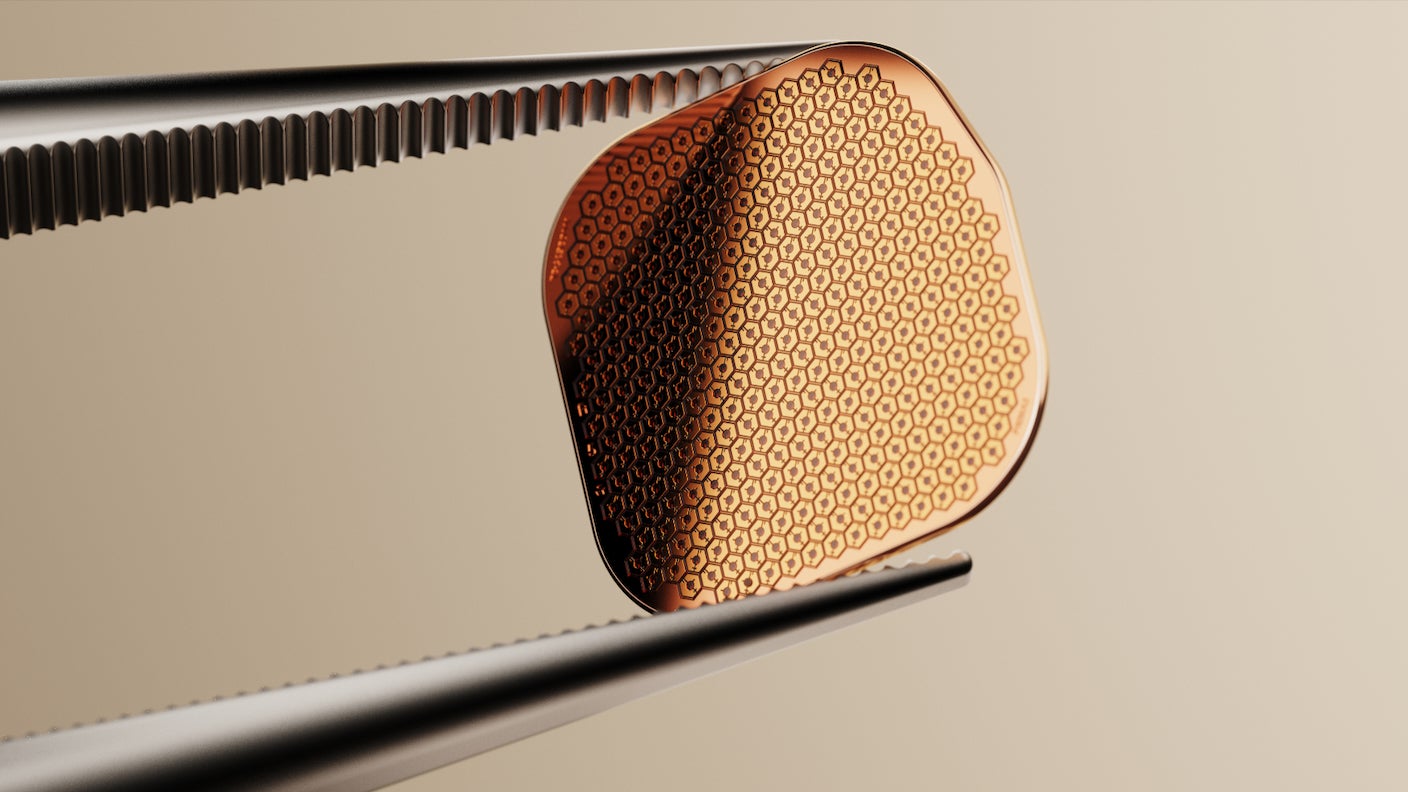

Age-related vision loss affects millions of people, and so far, there has been no way to reverse the damage. A newly approved retinal implant could change that by allowing some people with severe vision loss to regain functional sight.
More than five million people worldwide suffer from geographic atrophy, the late stage of the progressive eye condition dry age-related macular degeneration. The disease destroys the photoreceptors at the center of the retina, known as the macula, which is responsible for the sharp central vision required to read or recognize faces.
In the US, treatment options are limited to two drugs that can be injected into the eye to slow the disease’s progression. But neither can undo the damage. That could be about to change. California neurotech startup Science Corporation recently won European approval for a retinal implant designed to treat the condition.
“For decades, losing central vision to this disease meant losing the ability to read, recognize faces, and ultimately losing independence. There was no viable treatment. Now there is,” Max Hodak, Science’s CEO and co-founder, said in a press release.
The company’s PRIMA system combines an implant smaller than a grain of rice installed underneath the patient’s macula with a pair of camera-mounted glasses that translate incoming visual information into near-infrared light that is then beamed to the retina. The eye can’t detect this wavelength, so the device doesn’t interfere with any natural sight that remains.
The chip, which works on similar principles to a solar panel, converts the incoming light into electrical pulses that stimulate retinal neurons called bipolar cells. These are downstream of the rod and cone photoreceptor cells damaged by macular degeneration and normally spared by the disease.
In a clinical trial involving 38 patients across five countries, which was published in the New England Journal of Medicine last year, the company and its collaborators showed participants gained an average of 25.5 letters—more than five lines—on a standard eye chart after having the device fitted.
And now the device has received a CE mark from the European Union making it possible to sell in 30 European countries. The company says the first commercial implants are expected to be fitted in Germany within weeks, with Italy, the Netherlands, and the UK to follow. In the US, PRIMA holds Breakthrough and Humanitarian Use Device designations from the FDA, but the company is confident it will gain full approval in the near future.
The device is a long way from restoring normal vision. The images it produces are black and white and the field of vision is extremely narrow. Hodak described the experience to the Financial Times as “kind of like looking through a straw in the center of their vision,” though he added that they see a pathway to color vision and higher acuity.
While the implantation procedure is fairly simple, it takes months of training to unlock the device’s full potential. Nonetheless, Hodak told STAT that the company expects to install 20 to 40 devices this year and 200 globally by the end of next if they get US approval in early 2027.
The approval is welcome news for the wider neurotech industry, which has absorbed billions of dollars of investment in recent years with little to show in terms of return.
“Science is showing that brain-computer interface companies have a path to real revenue now,” Jacob Robinson, founder of startup Motif Neuroscience, told STAT. “These companies aren’t all just making a bet on a market that is 10 to 15 years away.”
Hodak told the Financial Times hehopes sales from PRIMA will bankroll Science’s more ambitious work on “biohybrid” interfaces, which use genetically engineered living neurons to connect to the brain rather than metallic wires. “This is the financial backbone,” he said. “This is the thing that pays for the rest.”
Other companies are hot on Science’s heels. Neuralink, which Hodak co-founded with Elon Musk before leaving to start Science, is also working on a vision implant called Blindsight, which is due to enter human trials this year.
While the field remains a long way from the sci-fi vision of seamless two-way communication between humans and machines, this approval is growing evidence the neurotech industry is starting to move out of the lab and into the real world.
