

Close Menu

    Subscribe to Updates

    Get the latest Tech news from SynapseFlow

    What's Hot

    Dell UltraSharp U3226Q 32 4K QD-OLED monitor review

    September 13, 2026

    Just bought a Pixel 11 Pro? Don’t forget to claim this hidden $119 deal

    September 13, 2026

    Ukrainian Conti Ransomware Developer Sentenced to 4 Years in US Prison

    September 13, 2026
    Facebook X (Twitter) Instagram
    • Homepage
    • About Us
    • Contact Us
    • Privacy Policy
    Facebook X (Twitter) Instagram YouTube
    synapseflow.co.uksynapseflow.co.uk
    • AI News & Updates
    • Cybersecurity
    • Future Tech
    • Reviews
    • Software & Apps
    • Tech Gadgets
    synapseflow.co.uksynapseflow.co.uk
    Home»Future Tech»James Webb Spots Strange Structure at Core of Distant Galaxy
    James Webb Spots Strange Structure at Core of Distant Galaxy
    Future Tech

    James Webb Spots Strange Structure at Core of Distant Galaxy

    The Tech GuyBy The Tech GuyMay 18, 2026No Comments3 Mins Read0 Views
    Share
    Facebook Twitter LinkedIn Pinterest Email
    Advertisement


    Sign up to see the future, today

    Advertisement

    Can’t-miss innovations from the bleeding edge of science and tech

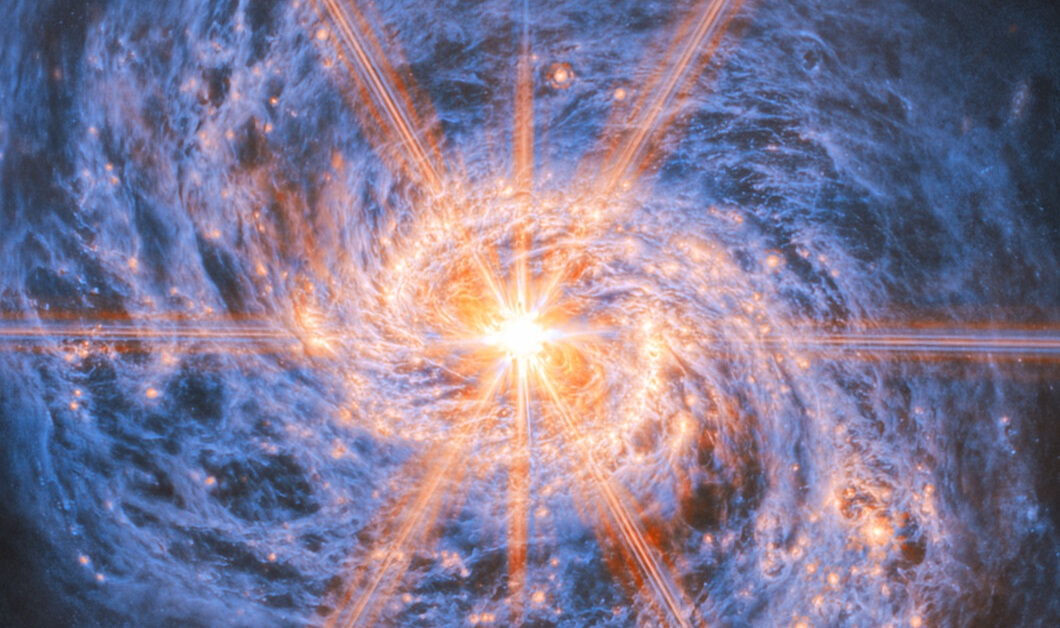
    A stunning new image captured by the James Webb Space Telescope shows a nearby galaxy bursting with light at its center, revealing the distinct but optically invisible structure that underpins the sprawling realm.

    Known as Messier 77, or the Squid Galaxy, it’s located in the constellation Cetus some 45 million light-years from Earth. Like our own Milky Way, it takes the form of a barred spiral galaxy, but its center is far more luminous. That’s because it’s dominated by an active galactic nucleus, a term that describes a supermassive black hole in the midst of a voracious feeding frenzy. At eight million times the mass of the Sun, the black hole is pulling matter towards itself, which begins to swirl around it like water circling a drain, and heating up in the process. That heat is so intense, and the amount of matter captured so enormous, that the light the black hole’s so-called accretion disk produces outshines the entire surrounding galaxy. 

    By contrast, our milky way’s supermassive black hole, Sagittarius A*, is nowhere near as attention-grabbing. While it’s also surrounded by an accretion disk, it isn’t devouring enough matter to be considered an active galactic nucleus.

    🆕 Our ESA/Webb Picture of the Month catches a beacon of light in swirls of dust 🌀

    The barred spiral galaxy Messier 77 (M77) lies 45 million light-years away in the constellation Cetus 🐋. This new image from Webb’s #MIRI highlights the galaxy’s piercingly bright core. 1/3 pic.twitter.com/2tHUwKDM0D

    — ESA Webb Telescope (@ESA_Webb) May 7, 2026

    The new image, taken with Webb’s Mid-Infrared Instrument, also reveals something invisible in optical wavelengths: the Squid Galaxy’s central bar. This is a distinctly straight region, packed with stars, that bisects the outer spiral arms. The Squid Galaxy’s bar is surrounded by a bright band called a starburst ring, where star formation is off the charts.

    Feeding the black hole’s appetite and star formation alike is the galaxy’s preponderance of gas and dust, which the Webb’s MIRI instrument is well-suited to peer through. The cooler dust grains that fill out the galaxy beyond its luminous center are colored in blue.

    The most striking feature in the image are bright orange lines that explode from the galaxy’s center. These are called diffraction spikes, and are a byproduct of the lens technique used to image the galaxy — not actual giant galactic spokes.

    Because the Squid Galaxy is relatively close by for a major galaxy — the closest is the Andromeda galaxy at two million light years away, though a number of smaller dwarf galaxies are just tens of thousands of light years away — and because we can see it face-on, it’s one the best studied cosmic realms out there.

    But it still packs a few mysteries. Astronomers remain puzzled why its black hole barely seems to emit any gamma rays, for instance, which is typically a reliable telltale of these cosmic objects — but does emit an unusually high amount of “ghost particles” called neutrinos.

    More on space: NASA Says Strange Red Dots in Sky Are an Unknown Class of Object That Looks Like a Huge Evil Eye


    Advertisement
    Share. Facebook Twitter Pinterest LinkedIn Tumblr Email
    The Tech Guy
    • Website

    Related Posts

    This Week’s Awesome Tech Stories From Around the Web (Through September 12)

    September 13, 2026

    Aging Congress Is Completely Ill-Equipped to Regulate AI, or Seemingly Even Understand It

    September 12, 2026

    Space Telescope Interferometer to Image Exoplanet Continents – NextBigFuture.com

    September 12, 2026

    Help Refine Data from Space Telescopes with Artifact InSPECtor

    September 12, 2026

    OpenAI Claims Another Huge Mathematical Result Amid Fights Over Credit, Ethics, and Privacy

    September 12, 2026

    Lawyers Already Lining Up to Defend Victims of Cybercab Crashes

    September 11, 2026
    Leave A Reply Cancel Reply

    Advertisement
    Top Posts

    You don’t need a NAS to self-host — I proved it with hardware from my closet

    June 7, 2026391 Views

    Spotify is giving one of its best playlists a big visual upgrade to give subscribers ‘a closer connection’ to its New Music Friday curators — and I think it could be the update it’s always needed

    June 12, 2026210 Views

    The iPad Air brand makes no sense – it needs a rethink

    October 12, 202517 Views
    Stay In Touch
    • Facebook
    • YouTube
    • TikTok
    • WhatsApp
    • Twitter
    • Instagram
    Advertisement
    About Us
    About Us

    SynapseFlow brings you the latest updates in Technology, AI, and Gadgets from innovations and reviews to future trends. Stay smart, stay updated with the tech world every day!

    Our Picks

    Dell UltraSharp U3226Q 32 4K QD-OLED monitor review

    September 13, 2026

    Just bought a Pixel 11 Pro? Don’t forget to claim this hidden $119 deal

    September 13, 2026

    Ukrainian Conti Ransomware Developer Sentenced to 4 Years in US Prison

    September 13, 2026
    categories
    • AI News & Updates
    • Cybersecurity
    • Future Tech
    • Reviews
    • Software & Apps
    • Tech Gadgets
    Facebook X (Twitter) Instagram Pinterest YouTube Dribbble
    • Homepage
    • About Us
    • Contact Us
    • Privacy Policy
    © 2026 SynapseFlow All Rights Reserved.

    Type above and press Enter to search. Press Esc to cancel.

    Ad Blocker Enabled!
    Ad Blocker Enabled!
    Our website is made possible by displaying online advertisements to our visitors. Please support us by disabling your Ad Blocker.