

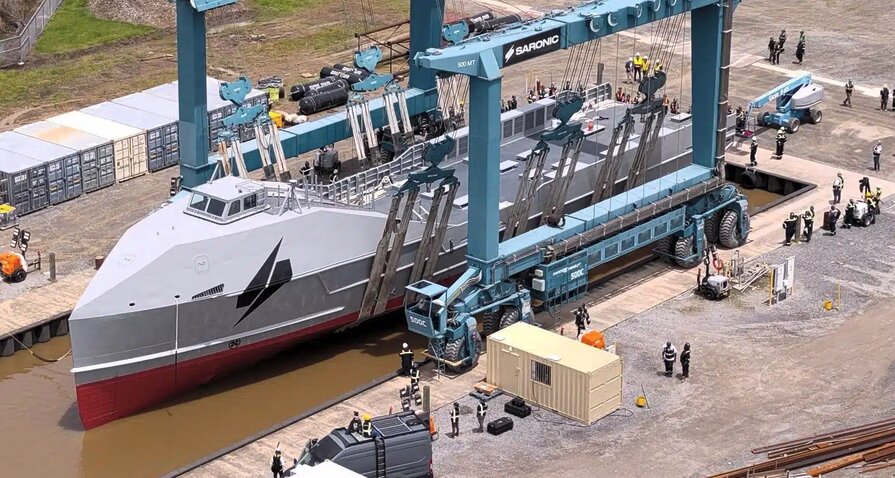

Drone ship maker Saronic’s next-generation 180-foot (≈55 m) Marauder medium unmanned surface vessel (MUSV) entered the water for trials in 2026. It represents a major leap in size and capability. It has a payload of up to 150 metric tons.
New containerized weapon payloads will be used on the Marauder. One potential configurations would carry multiple missile launchers (systems like Anduril Barracuda). One drone ship could carry around 128 long-range cruise missiles (hundreds of miles range, significantly more explosive power than Hellfires per missile). A single Marauder could theoretically deliver more strike capacity than a traditional cruiser in certain scenarios, while staying far from shore and keeping crews safe. It could also serve logistics, ISR, or resupply roles.
Saraonic closed a $1.75 billion funding round at a $9.25 billion valuation.
Marauder container capacity is configurable for up to 4× 40-ft or 8× 20-ft ISO containers.
The range is up to 5,400+ nautical miles (unrefueled) with speed of up to 25+ knots.
The Marauder is expected to cost in the low-to-mid tens of millions of dollars per unit once in series production (potentially $10–60+ million range, heavily dependent on exact configuration, sensors, weapons integration, and order volume). This is still far cheaper than a crewed warship of similar capability because there are no crew accommodations, life-support systems, or extensive habitability features.
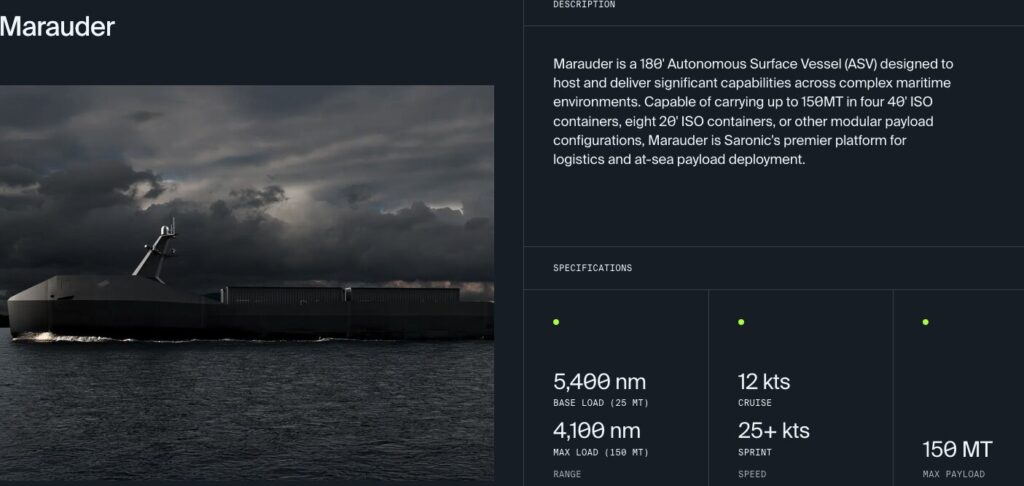
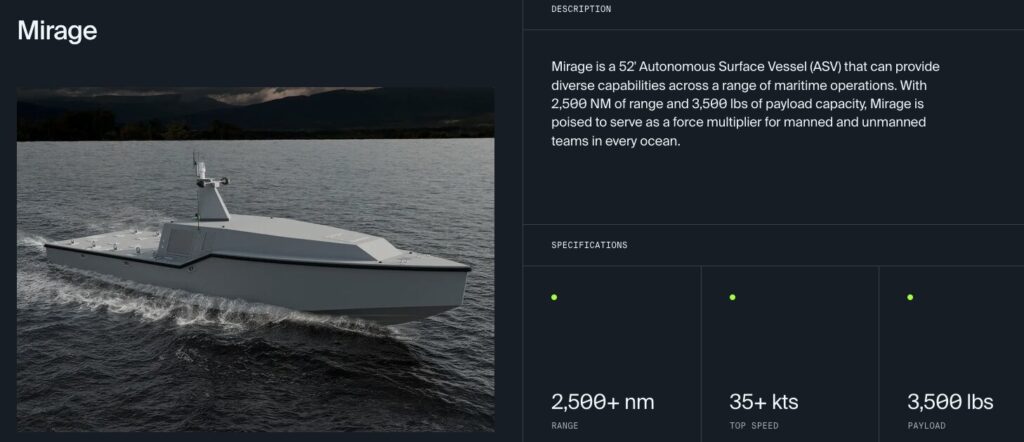
A crewed warship with capabilities similar to the Saronic Marauder (≈180 ft / 55 m, up to 150 metric tons payload in containers, long range, 25+ knots) would likely cost significantly more than the unmanned version—roughly in the $50–200+ million range per ship, depending on exact configuration, armament, sensors, and survivability features.
Large or Heavy Drone Ships (Beyond Medium/MUSV)
The Marauder is classified as a Medium Unmanned Surface Vessel (MUSV) — focused on modular payloads (logistics, ISR, containerized effects), long endurance, and attritable/low-cost operations in a “truck” or support role alongside manned ships. Large Unmanned Surface Vessels (LUSVs) represent the next tier up and would be 200–300+ ft (sometimes larger concepts), with displacements of 1,000–2,000+ tons (corvette-sized or bigger).
The heavier drone ship strike focus (16–32 Vertical Launch System / VLS cells for missiles), higher payload endurance, and roles like arsenal/magazine ships, scouts, or multi-mission platforms. They can be optionally or lightly manned in early concepts.
US Navy LUSV programs envision reconfigurable ships for anti-surface warfare and strike, often based on commercial hull forms for cost control. They complement (or partially replace) manned combatants in distributed operations.
Navy budget projections would see first units around $300–500 million, with follow-on ships averaging $240–330 million each (lower than equivalent manned ships due to no crew systems).
A new manned frigate can exceed $1 billion and destroyers $2+ billion.
The drone ships are three to twenty times lower cost than the manned versions.
Even larger/heavier concepts (sometimes called extra-large or heavy drone ships) could push toward 300–400+ ft with thousands of tons displacement, massive containerized or integrated missile capacity, or heavy logistics roles. Costs would scale up accordingly—potentially $400–800+ million+ per unit—but remain lower than manned warships of similar size due to the absence of crew-related expenses.
Brian Wang is a Futurist Thought Leader and a popular Science blogger with 1 million readers per month. His blog Nextbigfuture.com is ranked #1 Science News Blog. It covers many disruptive technology and trends including Space, Robotics, Artificial Intelligence, Medicine, Anti-aging Biotechnology, and Nanotechnology.
Known for identifying cutting edge technologies, he is currently a Co-Founder of a startup and fundraiser for high potential early-stage companies. He is the Head of Research for Allocations for deep technology investments and an Angel Investor at Space Angels.
A frequent speaker at corporations, he has been a TEDx speaker, a Singularity University speaker and guest at numerous interviews for radio and podcasts. He is open to public speaking and advising engagements.
