


Why you can trust TechRadar
We spend hours testing every product or service we review, so you can be sure you’re buying the best. Find out more about how we test.
Sony Bravia 9 II review: Two-minute review
RGB TVs, called ‘True RGB LED’ here by Sony, are still in their infancy, with RGB regularly touted as the technology that will topple OLED at the top of the TV mountain — and of the few I’ve tested so far, the Sony Bravia 9 II is the one that comes closest to succeeding. It takes everything I liked about the step-down Sony Bravia 7 II (also True RGB LED) and levels it up, including picture quality, sound and gaming performance, all of which are up there with the best TVs of 2026.
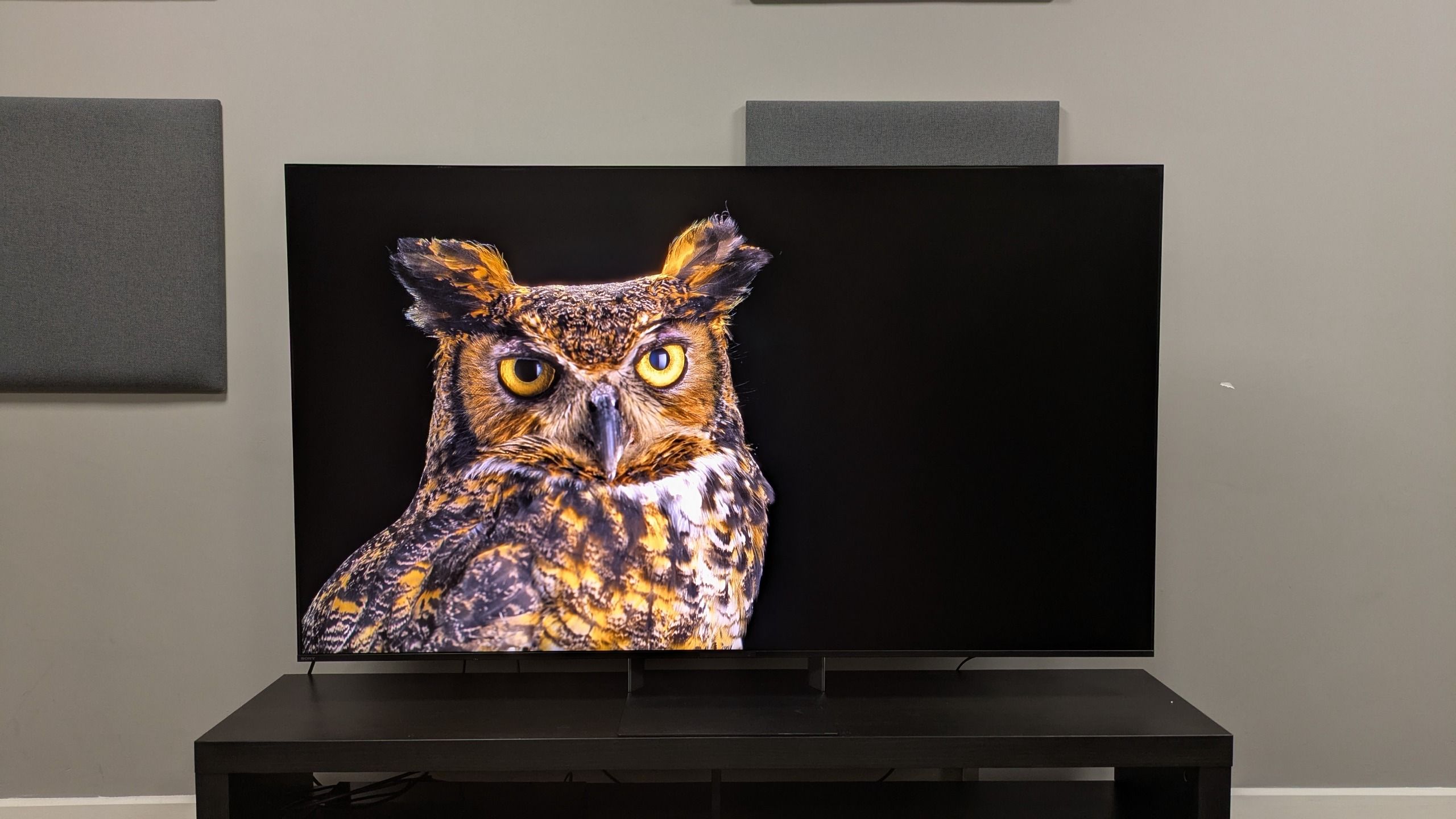
The Bravia 9 II’s picture quality is its crowning achievement. It delivers vibrant yet accurate-looking colors which make movies pop, fluid motion that’s great for sports and, with its anti-glare matte screen, it’s perfect for bright-room viewing too. Its most impressive elements, though, are its contrast and reproduction of dark tones, which are arguably the best I’ve seen from a backlit TV — if this is what RGB is capable of now, then expect it to rival the very best OLED TVs. While viewing angles could still be better, and some blooming exists, this is an excellent backlit TV.
The Bravia 9 II’s built-in sound is strong overall. Its speakers deliver remarkable detail, with a good sense of space that fills a room more than most TV speakers, and it delivers clear speech. I did find its bass and low-end lacking however, and it didn’t deliver the power I expected; so while the speakers are good enough that you don’t necessarily need one of the best soundbars, cinephiles may want to invest.
Latest Videos FromTechRadar
Gaming is another of the Bravia 9 II’s strong suits. It comes with a comprehensive set of features, (though sadly only has two HDMI 2.1 ports out of its four HDMIs available), and delivers great overall performance that handles even the fastest-paced games well.
The Bravia 9 II’s major downside is its price. At $3,599 / £3,499 / AU$5,995 for the 65-inch model I tested, this is one of the most expensive TVs on the market, at around a full $500 / £500 / AU$750-1000 dollars more than both rival OLEDs and other RGB TVs. And prices are unlikely to drop, as Sony doesn’t often discount its TVs, so if you’re looking for the best value you may want to go elsewhere, despite this TV’s excellent performance.
Sony Bravia 9 II review: Prices & release date

- Release date: August 2026
- 65-inch: $3,599.99 / £3,499.99 / AU$5,995
- 75-inch: $4,599.99 / £4,299.99 / AU$7,495
- 85-inch: $6,499.99 / £5,499.99 / AU$9,995
- 115-inch: $30,999.99 / £22,999.99 / AU$44,995
The Bravia 9 II is Sony’s flagship RGB LED TV for 2026, sitting above the Sony Bravia 7 II. It’s available in 65, 75, 85 and 115-inch sizes. The 65-inch model I tested launched for $3,599.99 / £3,499.99 / AU$5,995, putting it at the premium end of the market.
At the time of writing (October 2026), the Bravia 9 II’s prices remain unchanged in the US and UK, but in Australia prices have dropped across the 65-85-inch sizes, with the 65-inch now available for AU$4,795.
Sony Bravia 9 II review: Specs
|
Screen type: |
RGB LED |
|
Refresh rate: |
120Hz |
|
HDR support: |
Dolby Vision, HDR10, HLG |
|
Audio support: |
Dolby Atmos, DTS:X |
|
Smart TV: |
Google TV |
|
HDMI ports: |
4 (2x HDMI 2.1) |
|
Built-in tuner: |
ATSC 1.0 (US) |
Sony Bravia 9 II review: Benchmark results
Brightness Measurements
Taken using a colorimeter and test pattern generator. Click the test name for measurements and select the chosen test from the dropdown menu.
01,5003,0004,5006,000
nits
| Product | HDR Filmmaker Mode (10% window) (nits) | HDR Filmmaker Mode (Fullscreen) (nits) |
|---|---|---|
| Sony Bravia 9 II | 4416 | 974 |
| Samsung R95H | 1977 | 612 |
| Sony Bravia 7 II | 1114 | 829 |


(Image credit: Future)


(Image credit: Future)


Sony Bravia 9 II review: Features

- RGB LED panel
- XR processor with AI features
- Google TV interface
The Bravia 9 II uses an RGB mini-LED panel (dubbed True RGB LED by Sony), which uses red, green and blue mini-LEDs, rather than the standard white you’ll find in regular mini-LED panels, to boost color reproduction.
It uses Sony’s XR Processor, which powers several AI picture features such as XR Clear Image AI for upscaling, as well as XR Motion Clarity, which analyzes movement on screen to produce a clearer, judder-free image.
In terms of HDR support, the Bravia 9 II supports Dolby Vision, but there’s no support for HDR10+. If you’re looking for a TV that supports both you’ll need to look at Hisense, TCL and Philips models. The Bravia 9 II also supports IMAX Enhanced content.
For audio, the Bravia 9 II has an 80W speaker system, consisting of two tweeters, two full-range speakers, two subwoofers and two beam tweeters. Several audio features, such as Voice Zoom 3, Auto Calibration and Acoustic Multi-Audio+, are included. There’s support for Dolby Atmos and DTS:X formats too.
The Bravia 9 II has two fully-specced HDMI 2.1 ports set for gaming, with 4K 120Hz, VRR and ALLM support. Perfect For PS5 features are also present, including Auto HDR Tone Mapping and Auto Genre Picture Mode.
Like all Sony TVs, the Bravia 9 II uses Google TV as its smart TV interface. This gives you access to all major apps such as Netflix, Prime Video and Disney Plus, and, in the UK, BBC iPlayer and ITVX. Google TV with Gemini is included, which can be controlled hands-free and recommend content.
Sony Bravia 9 II review: Picture quality

- Excellent color reproduction
- Accurate, OLED-level blacks
- Some mild blooming off-axis
The Bravia 9 II’s measured brightness is fantastic. In Cinema and Professional mode (the latter is the closest to Filmmaker Mode) it hit 4,180 nits and 4,416 nits peak HDR brightness respectively. This puts it at double what rival flagship RGB TVs like the Samsung R95H hit (1,977 nits in its own Filmmaker Mode).
It also delivers superb fullscreen brightness, hitting 974 nits HDR brightness in Cinema and Professional modes. It even delivers big SDR numbers, hitting 703 nits fullscreen SDR brightness in Standard and 656 nits in Cinema, making it a great choice for broadcast TV in bright rooms.
Speaking of bright rooms, the Bravia 9 II demonstrates much better handling of mirror-like reflections than the step-down Sony Bravia 7 II, which I found quite reflective in our testing lab. When I viewed the Bravia 9 II and Samsung R95H side-by-side, the Bravia 9 II’s own matte screen was seriously effective.
The Bravia 9 II did a good job of upscaling SDR/HD content. Watching videos on YouTube, textures did look sharper, and although it wasn’t to a 4K-level, it was improved. Watching HD movies like Fight Club on Disney Plus, textures looked crisp and contrast was improved.
The Bravia 9 II, also demonstrated excellent picture quality with 4K Blu-ray reference discs. Its color reproduction during The Super Mario Galaxy Movie was gorgeous, with deep, rich colors that really popped on-screen. Any time the Lumas appeared, they had a sense of depth to them, thanks to how bold their colors were.

Colors in live-action content looked similarly great. In Speed Racer, the bold aesthetic of the Racer family home, with orange doors, green and purple walls and yellow furnishings, not only looked vivid to suit the movie’s cartoon-ish nature, but also had a nice accuracy to them.
The Bravia 9 II’s HDR color gamut results were fantastic overall. It clocked 98.6% UHDA-P3 coverage, a number consistent with other mini-LED and OLED TVs, but most impressive was its 86.7% BT.2020 coverage. While I’ve tested higher on some RGB TVs, this puts the Bravia 9 II in line with QD-OLED models.

Another area where the Bravia 9 II impressed was its contrast and black-tone reproduction. In The Batman, as Bruce works in the Batcave, the monitors on his desk were bright, and contrasted well with the dark tones in the surrounding walls and crevices. The Bravia 9 II’s peak brightness meant HDR highlights, such as overhead lamps, really dazzled on screen, and this didn’t come at the expense of dark tones.
In Project Hail Mary, scenes of space demonstrated just how good the Bravia 9 II’s black levels were, especially for a backlit-TV. In theory, OLED has an advantage when it comes to reproducing deep blacks, in that it uses individually controlled pixels, but I found that the Bravia 9 II rivalled most OLEDs. Not only were black levels deep, but there were few signs of blooming when viewing head-on, with the Bravia 9 II showing superb backlight control.
It’s no surprise that the Bravia 9 II’s black tones were good, as when I measured its out-of-the-box grayscale accuracy, it hit a staggering 0.92 in Cinema mode. Anything below 3 is indiscernible to the human eye, and a number like this rivals most OLEDs.
The Bravia 9 II delivers great motion as well. Watching soccer with the TV set to Standard mode, it was able to handle the fast-paced action with minimal signs of judder, though it’s best to set the motion settings to Custom and set Smoothness and Clearness to 1, as at the full 2 the TV could sometimes be aggressive with its processing. For movies, with the TV set to Cinema, action always looked smooth. Watching Speed Racer, the Bravia 9 II handled the swerving cars, and even the commentators panning across the screen, well.
It wasn’t all plain sailing for the Bravia 9 II, however. Viewed off-center, signs of blooming crept back in, with halos of light appearing around bright objects on dark backgrounds. Although there was still significantly less blooming than you’d find on other mini-LEDs, OLED still takes the crown for off-angle viewing.
- Picture quality score: 5 / 5
Sony Bravia 9 II review: Sound quality

(Image credit: Future)


- Excellent detail
- Great virtual surround-sound processing
- Bass could be better
Sony’s TVs are often among the very best for built-in sound, so I had high expectations for the Bravia 9 II and spoiler alert, it mostly lived up to them. The Bravia 9 II 65-inch I tested uses a multi-speaker array consisting of two beam tweeters, two frame tweeters, two mid-range drivers and two subwoofers.
Watching the Penguin/Batmobile chase from The Batman, I was impressed most of all by the Bravia 9 II’s detail. As the Batmobile glides in and out of traffic, there were lots of effects I’d not been able to hear when watching the movie on other TVs, such as the creaking of tall lorries, the wind whipping past the Batmobile as debris fell around it, and the clattering of metal. The same was true with effects you’d hear in height channels, such as rain, which wasn’t crystal clear, but was still audible — no mean feat for TV speakers.
The Bravia 9 II also showcased very good virtual spatial sound, with the sound extending beyond the screen to create a somewhat immersive experience. Speech was also clear throughout, with the Penguin’s shouting audible even amid the chaos of the scene.
One area where the Bravia 9 II is lacking, however, is its bass. For such a large-framed TV with two subwoofers, I expected more punch in the lower tone range. The Batmobile’s engines had some heft to them, but it didn’t have the rumble I was looking for. This isn’t uncommon for a TV, but I was surprised that in this case it was one of Sony’s models that was lacking.
- Sound quality score: 4.5 / 5
Sony Bravia 9 II review: Design

(Image credit: Future)


- Sturdy but weighty build
- Thicker than other TVs
- Looks premium
Like several other RGB models I’ve tested, the Bravia 9 II is bulkier than a lot of other TVs. The Bravia 9 II’s frame is chunkier and deeper than you’d expect for a modern TV, so this is something to bear in mind if you’re going to be fitting it into a tight space. It’s weighty as well — this 65-inch TV is easily one of the heaviest I’ve set up.
That said, the Bravia 9 II still looks like a premium TV, with a central pedestal stand consisting of three metal components that feel and look appropriate for a TV of this price. The stand also comes with a clear bit of plastic that can be attached to the rear of the stand to create what the brand calls a ‘mirage effect’, where the stand seemingly disappears when viewed head-on, to give the TV a floating effect.
The Bravia 9 II’s supplied remote is perfectly serviceable, with shortcut buttons to major apps like Netflix and buttons laid out in a standard format. However, it feels lightweight and cheap, which is disappointing for a TV in this price range. It does however use USB-C charging, similar to Samsung and Hisense’s remotes, which is a nice touch.
Sony Bravia 9 II review: Smart TV & menus

- Google TV interface
- Tons of picture settings
- Google home page quite cluttered
The Bravia 9 II uses Google TV as its smart TV platform, with access to major apps including Netflix and Disney Plus, and, in the UK, to major UK apps like BBC iPlayer and ITVX. There’s also the option of hands-free control via Google Assistant, and the TV is compatible with Google Cast, Alexa and Apple Airplay2.
Google TV’s home page is a good hub for recommending relevant content, as well making content you’re watching easy to find, particularly on YouTube. One issue with the home page, which Google TV has had for a while, is that its large banner ads can make the screen look cluttered, and push your apps further down the screen.
The Bravia 9 II has a comprehensive suite of settings, especially for adjusting the picture. There are plentiful settings to enable you to tailor the picture to your liking, and while some of these are a little hidden (the ambient light sensor is in a totally separate menu for example), the menus are mostly easy to navigate and use. While I don’t find Google TV as aesthetically pleasing or easy to use as LG’s webOS, Samsung’s One UI Tizen, or Roku, it’s a perfectly fine smart TV system.
- Smart TV & menus score: 4 / 5
Sony Bravia 9 II review: Gaming

- 9.8ms input lag time
- Good performance overall
- Only two HDMI 2.1 ports
The Bravia 9 II has a good array of gaming features, supporting 4K 120Hz, VRR, Dolby Vision gaming and ALLM, as well as Perfect for PS5 features including Auto HDR Tone Mapping. Sadly, only two of its four HDMI ports are 2.1 compatible for gaming, which is still a step behind a lot of other rival TVs from LG, Samsung, Hisense, and TCL.
I measured the Bravia 9 II’s input lag at 9.8ms (4K 60Hz), which is a nice improvement over other Sony TVs I’ve tested, including the brand’s Bravia 8 II flagship OLED, which registered 16.8ms (also in 4K 60Hz).
Actual gameplay on the Bravia 9 II is very smooth. When I played Battlefield V, movement felt fluid and responsive, with the Bravia 9 II showing no judder during a chaotic desert mission where I dodged enemy fire while jumping in and out of vehicles. I did notice that during some particularly fast-paced action, where I sprinted across the battlefield, there was a slight blurring of finer details, but overall the game looked great, with the Bravia 9 II’s excellent picture quality for movies translating over to games.
Sony Bravia 9 II review: Value

- Premium price
- Pricier than rival RGBs and OLEDs
- Great performance for the money
There’s no denying that the Bravia 9 II is a premium-priced TV. It sits at the top end of the market and is pricier than most, if not all, of its major rivals. The 65-inch model I tested costs $3,599 / £3,499 / AU$5,999, which is pricier than a flagship OLED like the LG G6, the 65-inch model of which costs $2,499 / £2,699 / AU$4,999. It’s pricier than even the Samsung R95H, that brand’s flagship RGB TV, with its 65-inch costing $2,799 / £2,899 / AU$4,499.
Both those rival TVs have more features than the Bravia 9 II, especially for gaming, and they deliver very good performance in their own right. That being said, the Bravia 9 II is easily the most impressive RGB TV I’ve tested, delivering superb performance that exceeded my expectations. It’s just a shame that you’re paying a premium for that performance — and based on Sony’s history when it comes to pricing, it’s unlikely that the Bravia 9 II’s price will fall into line with competitors.
Should you buy the Sony Bravia 9 II?

|
Attributes |
Notes |
Rating |
|---|---|---|
|
Features |
Impressive anti-glare screen, RGB panel and good gaming features |
4.5/5 |
|
Picture quality |
Stunning colors, impressive contrast and black tones, excellent backlight control and reflection handling. Some blooming when viewed off-center |
5/5 |
|
Sound quality |
Very good overall sound quality with exceptional detail and accuracy, along with a wide soundstage, but bass is lacking. |
4.5/5 |
|
Design |
Premium build with sturdy feel, but thicker and weightier than a lot of other TVs |
4.5/5 |
|
Smart TV and menus |
Google TV has good app recommendations, but banner ads are distracting. Good amount of picture settings; sound settings could be confusing for some |
4/5 |
|
Gaming |
Fantastic gaming performance with a good array of features, but only two HDMI 2.1 ports. |
4.5/5 |
|
Value |
Pricier than most rival RGB and OLED TVs, and beyond the budgets of many potential buyers. Very good performance for the price, however |
3.5/5 |
Buy it if…
Don’t buy it if…
Also Consider
| Header Cell – Column 0 |
Sony Bravia 9 II |
Samsung R95H |
Sony Bravia 7 II |
LG G6 |
|---|---|---|---|---|
|
Price (65-inch) |
$3,599 / £3,499 / AU$5,995 |
$2,799 / £2,899 / AU$4,495 |
$2,599 / £2,299 / AU$3,299 |
$2,499 / £2,699 / AU$4,995 |
|
Screen type |
RGB LED |
Micro RGB |
RGB LED |
OLED |
|
Refresh rate |
120Hz |
165Hz |
120Hz |
165Hz |
|
HDR support |
Dolby Vision, HDR10, HLG |
HDR10+, HDR10, HLG |
Dolby Vision, HDR10, HLG |
Dolby Vision, HDR10, HLG |
|
Smart TV |
Google TV |
One UI Tizen |
Google TV |
webOS 26 |
|
HDMI ports |
4 (2x HDMI 2.1) |
4 x HDMI 2.1 |
4 (2x HDMI 2.1) |
4x HDMI 2.1 |
How I tested the Sony Bravia 9 II

- Tested over several weeks
- Tested using different SDR and HDR sources and in varying lighting conditions
- Measurements taken using Portrait Displays’ Calman color calibration software
After spending a few days establishing the Bravia 9 II’s best pictures modes (Cinema for brighter rooms and HDR content, Professional for dark-room viewing, and Standard for sport and SDR TV), I watched reference movies and TV shows to test its picture and sound quality.
I used 4K Blu-rays to analyze its color, contrast, detail, motion and backlight control. I also used 4K Blu-rays to analyze its built-in sound quality, in particular using a scene from The Batman.
For gaming, I used an Xbox Series X and played Battlefield V.
Once these tests were complete, I took measurements using a Murideo Six G 8K test pattern generator, Jeti Spectral 15VA Spectroradiometer and Klein K-10A colorimeter (profiled together) and used Portrait Displays’ Calman color calibration software to take said measurements.
Brightness measurements were taken using white window patterns in both SDR and HDR, noting results for windows 1-100% in size. These were taken in the TV’s Professional, Cinema and Standard modes.
Next, I analyzed its HDR color gamut coverage using both the UHDA-P3 (the standard used to master 4K Blu-ray and digital cinema releases) and BT.2020 ( a wide color-gamut format) color spaces.
After this, I measured the Bravia 9 II’s color and grayscale accuracy using the Delta-E averages, which measures the difference between the source test pattern and what’s shown on screen.
Finally, I analyzed its input lag in both 4K 60Hz and 1080p 120Hz using a Leo Bodnar 4K HMDI Input Lag Tester.
Read our in-depth overview of how we test TVs at TechRadar.
