


The SpaceX AI1 design work. This should not be a surprise. The leading satellite and space and AI engineers it the world at SpaceX and XAI designed satellites and AI systems that will work. They have made 80% of all satellites in space. The other XAI engineers have been involved in making about 10% and soon 30% of all earth based AI data centers.
The space radiator is too small objection usually treats space as a room-temperature heat sink and forgets that rejection scales with T^4 and that the 110 m² panel radiates from both sides.
The knife-edge radiator is between the two solar wings. Mach33 / Vlad Saigau reconstructed the same diagram from first principles and got the same thermal story SpaceX is describing. A ~2.1 ton satellite, ~532 kg in the thermal system (~25% of mass), 110 m² radiator at a proven 2.5–5 kg/m² areal density, and Musk’s 1,400 W/m² figure implying chips near 95 °C.
Deep space is ~2.7 K, but a sun-synchronous LEO satellite also sees
• Direct sun (~1,361 W/m²)
• Earth infrared (~200–240 W/m² on the Earth-facing side)
• Albedo (small if the orbit is dawn-dusk / high β)
The radiator is flown knife-edge to the Sun. Almost no solar area, both faces emit IR, one face still picks up some Earth shine.
There is no single Sun Synchronous Orbit (SSO) temperature. The useful number is the effective sink after coatings and attitude, not 3 K.
Simplified the 110 m² will radiate 1,400 W per square meter and this is 154 kW — sized to the 150 kW peak on purpose. If they make a satellite with 250 KW then the radiator increases to 183 square maters. The solar panel is about 5.5 times bigger.
Launching it with Starship will work at low cost.
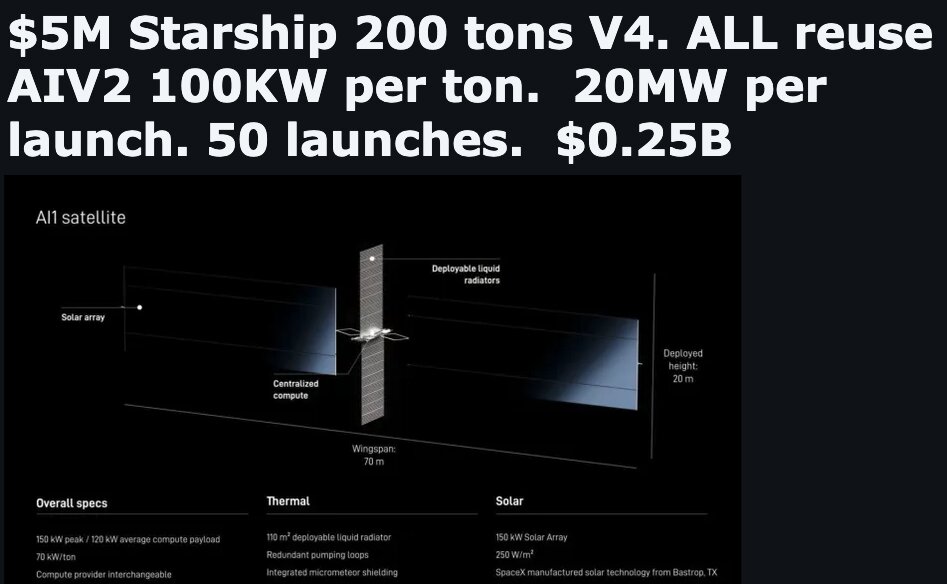
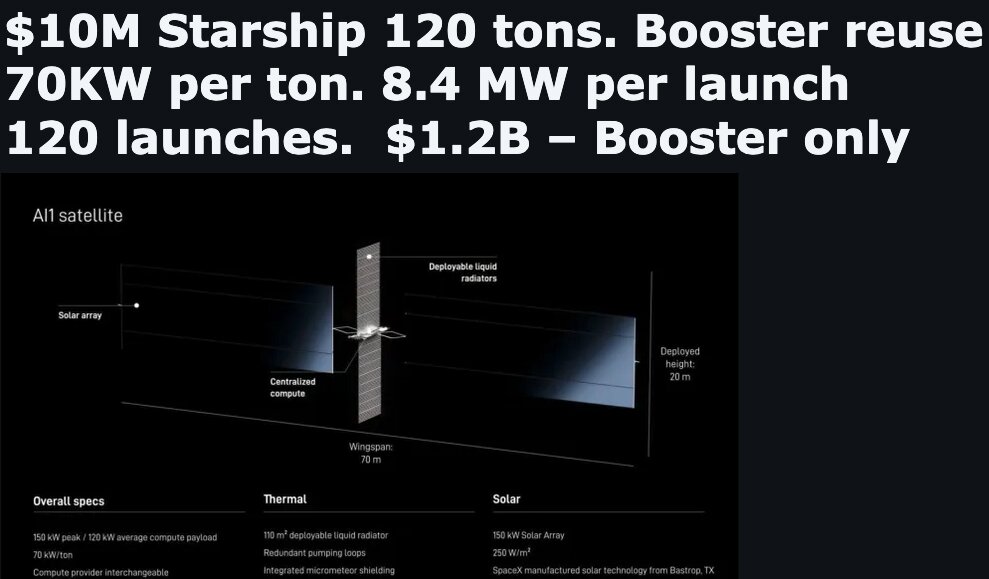
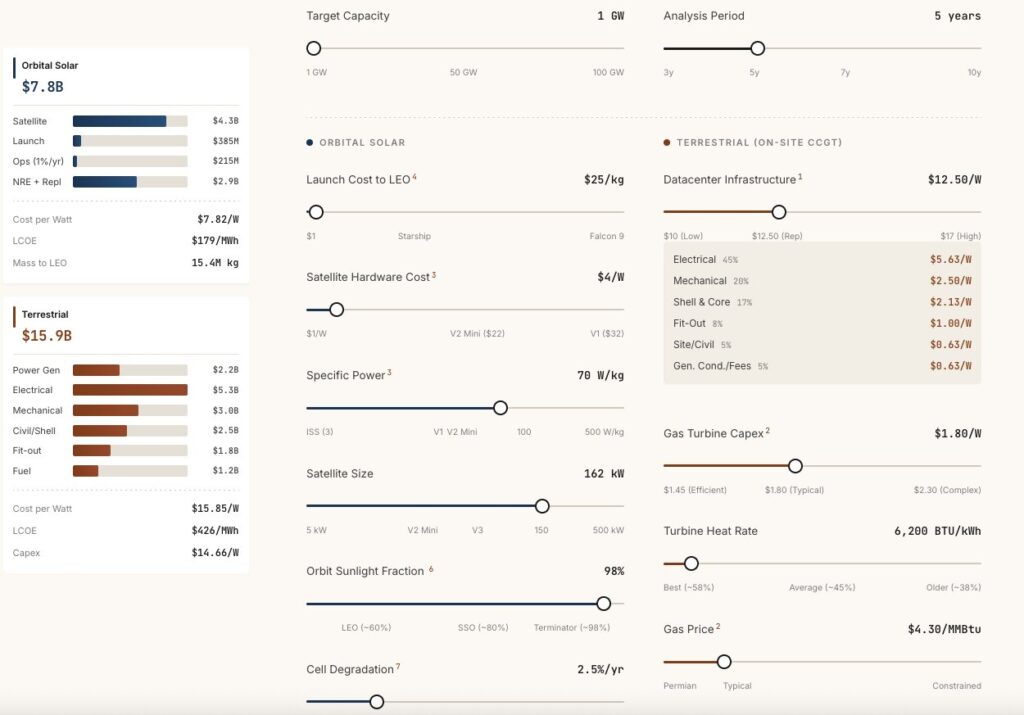
Using an online estimator AI in Space versus Earth based data center without including GPU chips. GPU chips same in both situations.
Brian Wang is a Futurist Thought Leader and a popular Science blogger with 1 million readers per month. His blog Nextbigfuture.com is ranked #1 Science News Blog. It covers many disruptive technology and trends including Space, Robotics, Artificial Intelligence, Medicine, Anti-aging Biotechnology, and Nanotechnology.
Known for identifying cutting edge technologies, he is currently a Co-Founder of a startup and fundraiser for high potential early-stage companies. He is the Head of Research for Allocations for deep technology investments and an Angel Investor at Space Angels.
A frequent speaker at corporations, he has been a TEDx speaker, a Singularity University speaker and guest at numerous interviews for radio and podcasts. He is open to public speaking and advising engagements.
