

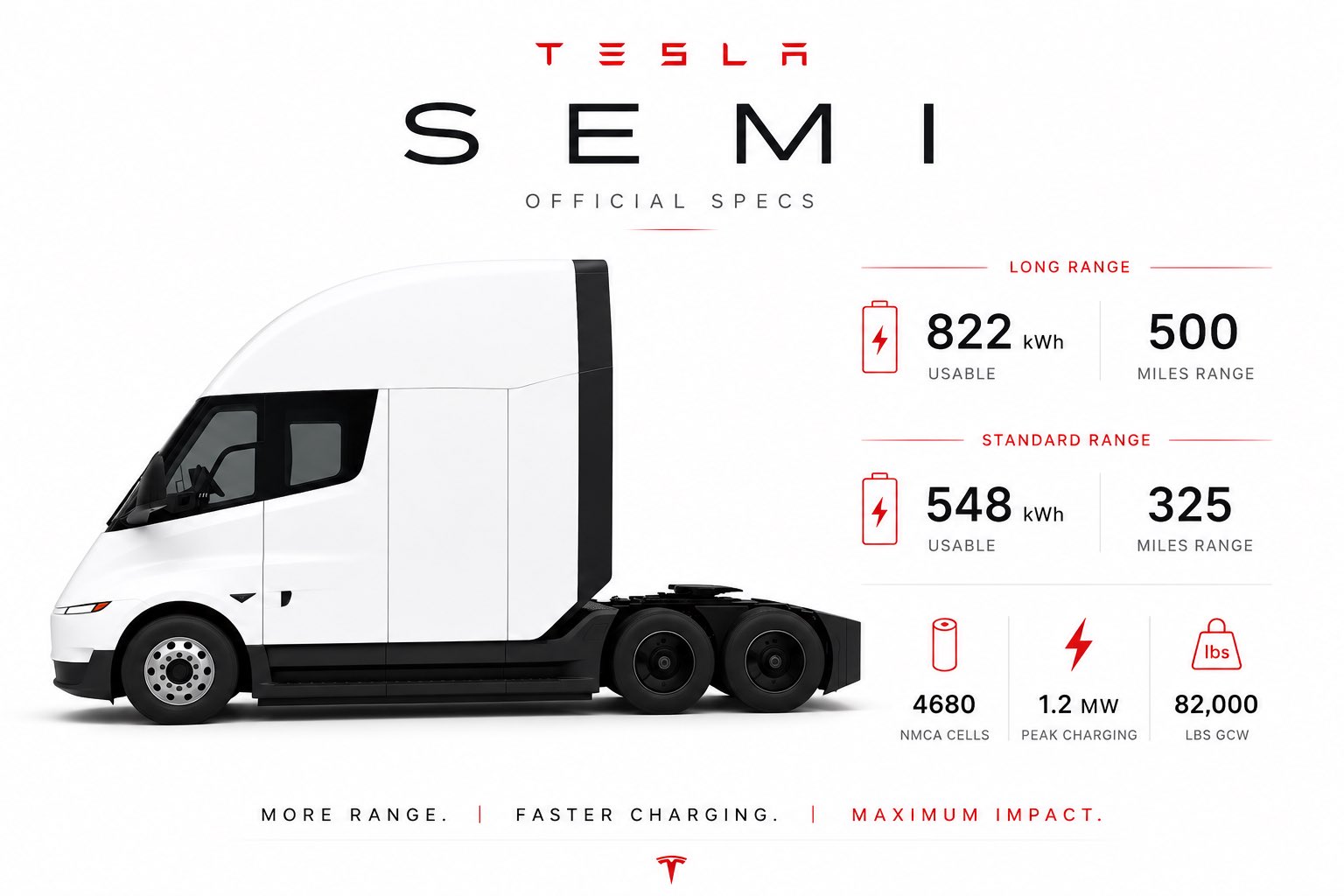

The economics of Tesla Semi versus Diesel Trucks.
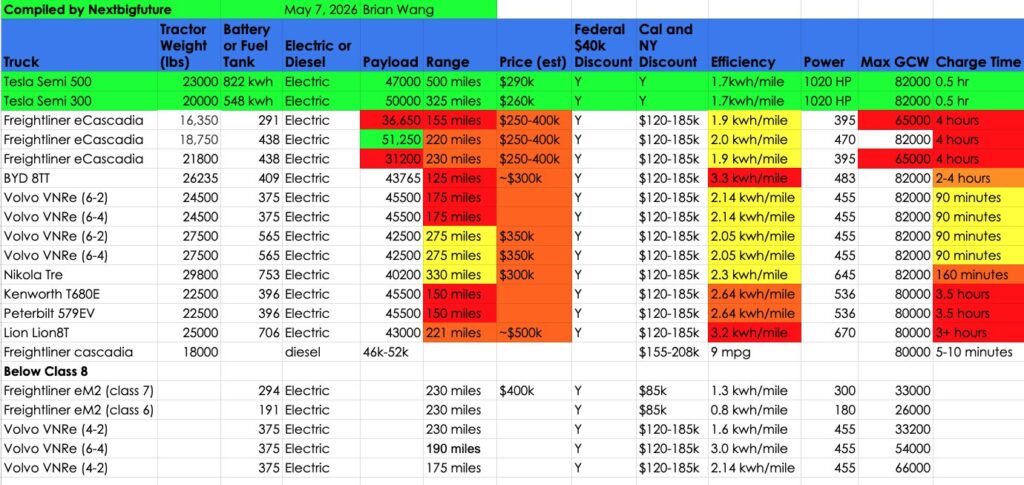
It is $40000 for two overnight chargers or $188000 for two chargers for 30 minute charging.
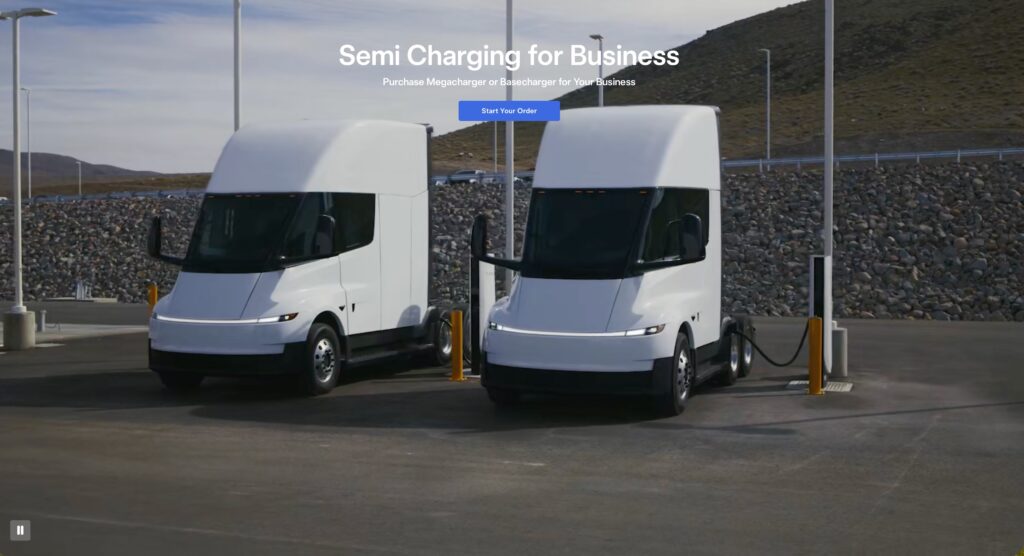
Tesla has just introduced Semi Charging for Businesses. Pricing starts at $40,000 for 2 Basechargers or $188,000 for two Megachargers.
Options:
Megacharger Cabinet With Megacharger Post:
• Max DC output: Up to 1200 kW (shared by 2 posts)
• Output voltage range (DC): 180–1000 VDC
• Cabinet-to-post cable distance: Up to 100 m
• Size (H × W × D): 1175 × 1390 × 1925 mm
• Weight: 1,100 kg
• Efficiency: >96%
• Cooling: High efficiency, low noise; ventilation not required
Basecharger:
• 125 kW charging speed
• Adds up to 60% of range in four hours
• Deliveries begin in early 2027
• “Home charging” for heavy-duty fleets
• 180–1000 VDC
• Cable length: 6 meters
• Continuous output: 150 A
• Size and weight: H x W x D: 340 x 1200 x 2000 mm, 100 kg
• Fully integrated design that eliminates the need for a separate AC-to-DC cabinet
• Supports open protocols, ISO15118-2, OCPI capable
• Charging standard: MCS 3.2
Cost breakdown for Megacharger:
• Est. Taxes and installation not included
• 1 Megacharger Cabinet, 2 Posts: $179,000
• Services: $6,000
• Shipping: $3,000
Subtotal: $188,000
You can buy up to 100 Megacharger posts for $9.4M
Cost breakdown for Basecharger:
• Est. Taxes and installation not included
• 2 Basechargers: $31,000
• Services: $6,000
• Shipping: $3,000
Subtotal: $40,000
You can buy up to 100 Basechargers for $2M
Tesla Semi fleet upfront costs (hardware only, excluding taxes/installation): Two Megachargers cost $188,000 total (1 cabinet + 2 posts, up to 1.2 MW shared output; confirmed from Tesla’s May 2026 Semi Charging for Business configurator).
4 trucks (325 mi range @ $260k each): 4 × $260,000 = $1,040,000 + $188,000 chargers = $1,228,000 total.
4 trucks (500 mi range @ $290k each): 4 × $290,000 = $1,160,000 + $188,000 chargers = $1,348,000 total.
10 trucks (325 mi range): 10 × $260,000 = $2,600,000 + $188,000 = $2,788,000 total.
10 trucks (500 mi range): 10 × $290,000 = $2,900,000 + $188,000 = $3,088,000 total.
Diesel Cascadia comparison (upfront, approximate): New 2026 Freightliner Cascadia diesels typically list in the $170k–$195k range (recent dealer examples ~$166k–$194k). Using ~$190k average per truck.
4 diesels: ~$760,000.
10 diesels: ~$1,900,000.
Tesla fleet is $468k–$588k more expensive upfront for 4 trucks.
Operating cost comparison over 100,000 miles per truck (using your numbers: diesel 9 mpg, Tesla Semi 1.7 kWh/mi; excludes maintenance, driver pay, insurance, depreciation, etc.):Diesel per truck: 100,000 mi ÷ 9 mpg = 11,111 gallons.
Tesla Semi per truck: 100,000 mi × 1.7 kWh/mi = 170,000 kWh.
Using current 2026 U.S. averages (on-highway diesel ~$3.70/gal; commercial electricity ~$0.14/kWh).
Diesel fuel cost per truck: 11,111 gal × $3.70 ≈ $41,100.
Tesla electricity cost per truck: 170,000 kWh × $0.14 ≈ $23,800.
Savings per truck over 100k miles: ~$17,300 (about 42% lower energy cost).
Fleet totals for 100k miles:4 trucks: Diesel fuel $164,400 vs. Tesla ~$95,200 → $69,200 savings.
10 trucks: Diesel fuel $411,000 vs. Tesla ~$238,000 → $173,000 savings.
The extra upfront cost for a 4-truck 500 mi Tesla fleet (~$588k more than diesels) would take roughly 8–9 years to recover at 100k miles/truck/year (or longer if trucks drive fewer miles). At higher diesel prices ($5/gal) or lower electricity rates (common for large commercial contracts or with solar, 10 cents per kWh in Texas), savings jump and payback shortens to 4–6 years. Real-world Semi tests often beat 1.7 kWh/mi (1.55–1.64 kWh/mi reported), improving economics further.
Diesel MPG: Many real-world averages are lower (7–8 mpg), which would widen Tesla’s advantage.
Full TCO: Tesla wins long-term on maintenance (far fewer moving parts, regenerative braking, no oil changes) and uptime, but diesels have lower initial purchase price and established service networks. Incentives (IRA tax credits for EVs/infra) could cut Tesla’s effective cost significantly.

Brian Wang is a Futurist Thought Leader and a popular Science blogger with 1 million readers per month. His blog Nextbigfuture.com is ranked #1 Science News Blog. It covers many disruptive technology and trends including Space, Robotics, Artificial Intelligence, Medicine, Anti-aging Biotechnology, and Nanotechnology.
Known for identifying cutting edge technologies, he is currently a Co-Founder of a startup and fundraiser for high potential early-stage companies. He is the Head of Research for Allocations for deep technology investments and an Angel Investor at Space Angels.
A frequent speaker at corporations, he has been a TEDx speaker, a Singularity University speaker and guest at numerous interviews for radio and podcasts. He is open to public speaking and advising engagements.
