

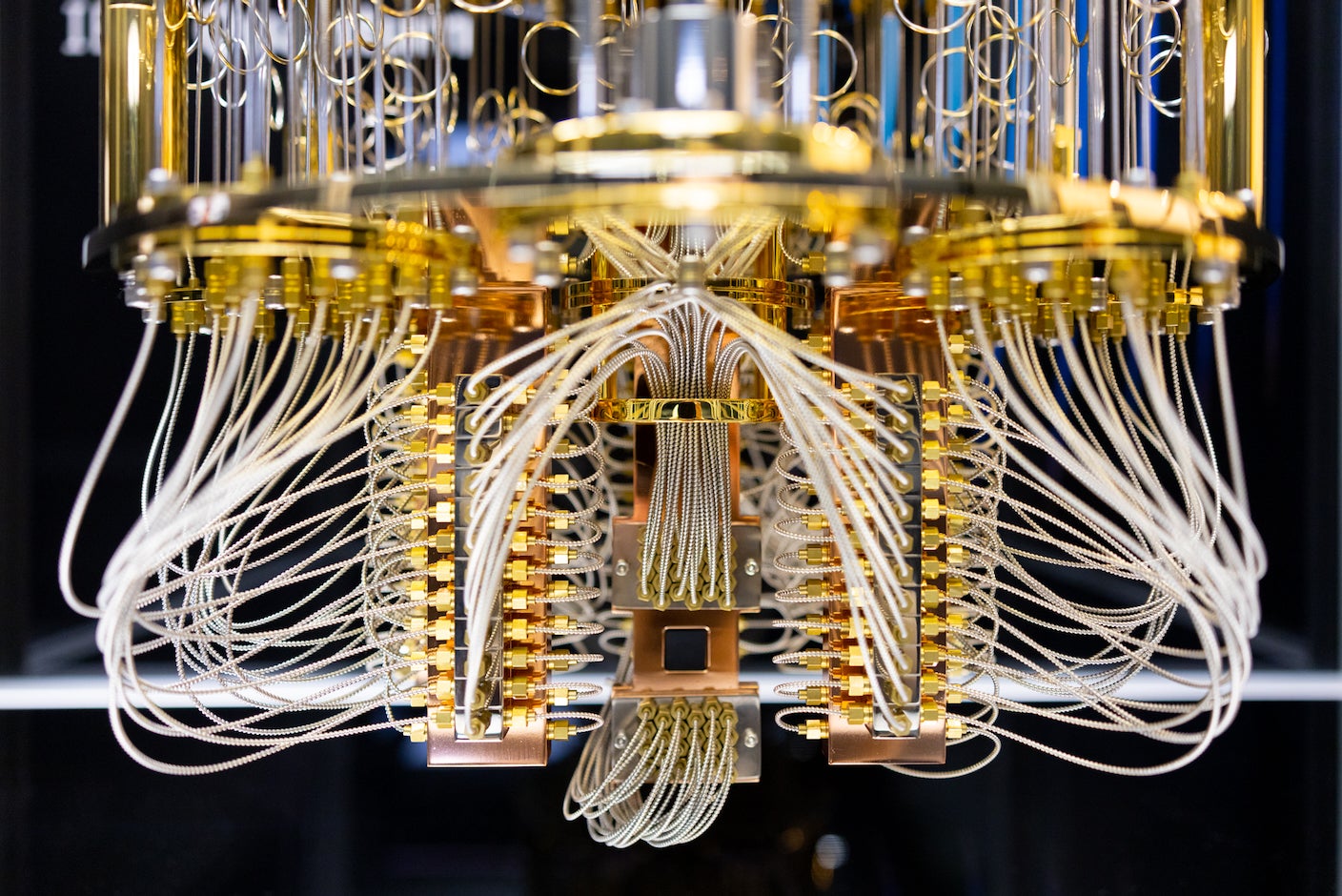

Quantum computers could eventually solve scientific problems beyond the reach of conventional supercomputers, but today’s machines are too error-prone for practical work. The US Department of Energy has now launched a $215 million competition challenging teams to build a scientifically useful, fault-tolerant quantum computer by 2028.
In recent years, both governments and companies have ploughed huge sums of money into quantum computing in the hope of cracking problems in fields like chemistry and materials science. But despite significant progress, the qubits these machines rely on remain fragile and prone to errors that can quickly derail calculations.
This means the technology has so far remained confined to tackling toy problems, and it’s now widely agreed that they won’t be of practical use until they achieve full fault-tolerance. But error-correction schemes rely on spreading information across many qubits to create so-called “logical qubits,” which requires much larger devices than have been demonstrated so far.
Now, the Department of Energy hopes to accelerate the advent of fault-tolerant quantum computers with the Quantum Genesis Q Competition. With a total prize pot of $215 million, the contest challenges private companies to deliver a machine with at least 100 logical qubits that can tackle scientifically relevant calculations by 2028.
“This competition will enable new quantum computing capabilities and unleash new computational frontiers, driving new scientific and technological discoveries that have previously only been theorized,” Darío Gil, the department’s under secretary for science, said in a statement.
The competition fleshes out a goal Gil first announced in March, when he told the inaugural meeting of the agency’s Office of Science Advisory Committee that the government would partner with industry to deliver the first generation of fault-tolerant quantum computers within three years.
The latest announcement spells out how the department plans to meet that ambitious target by providing companies with a roadmap and financial incentives. In the first phase of the competition, applicants can receive fixed awards of up to $1.5 million each for hitting early milestones, though those milestones have not been announced yet.
But the bulk of the money will be distributed in the second phase, with a $100 million to be split among teams that demonstrate a first-generation machine with at least 100 logical qubits. Two additional $50 million bonus pools will be divided between those that reach 150 and 200 logical qubits.
In a recent press call, the agency said it expects to back somewhere between 3 and 10 teams, according to Science. But to get a slice of the cash, companies will need to show they can verify their machine’s quantum performance, build a prototype, and then scale it up to carry out a genuinely useful scientific calculation. The agency is targeting problems in chemistry, materials science, physics, and applied mathematics.
“Our goal is not to have a bunch of qubits that can’t do much,” Tanner Crowder, quantum information science lead in the department’s Office of Science, told journalists. “We want to be able to see meaningful scientific calculations done on these quantum computers.”
To check that competitors deliver on their promises, the energy department has also created a $45 million fund to help its national laboratories build testbeds to validate every layer of a quantum system, from the hardware to the algorithms.
Still, achieving the agency’s ambitious target will be a stretch. By most estimates, qubit counts will need to jump by orders of magnitude to reach fault tolerance, and the 2028 target is at the most aspirational end of the industry’s own roadmaps.
And given that private investors have already sunk billions into the quantum race, it’s questionable how much the prospect of $100 million from the government will impact the development trajectories of private players. What’s more, only $2.5 million of the total is guaranteed from this year’s budget, with the rest dependent on future approval from Congress.
Nonetheless, the competition could spur greater confidence in the industry and help it coalesce around a common set of goals and benchmarks. Whether anyone will cross the finish line in time is an open question, but the prize money at least gives the field a clear target.
