

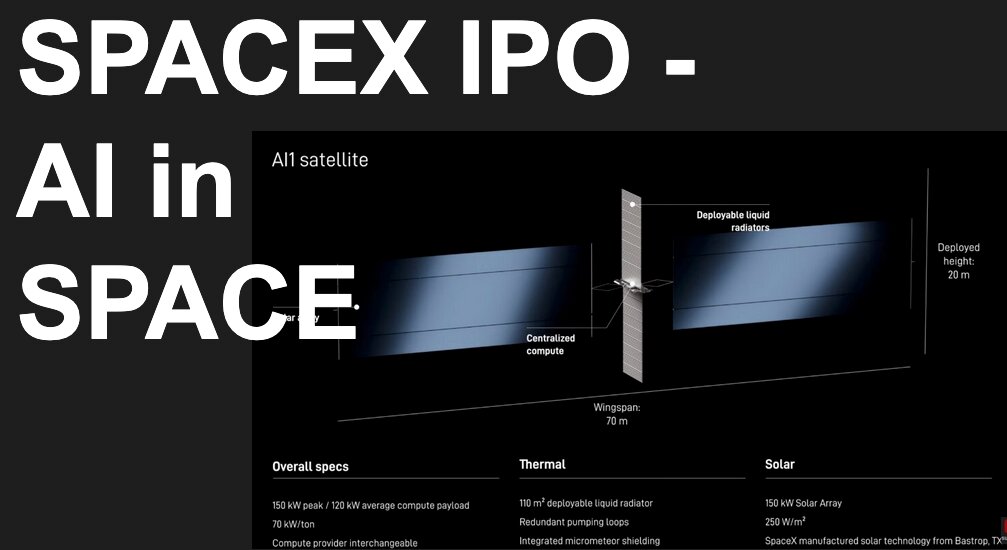

SpaceX was going to launch about 5,000 to 8,000 Version 3 communications satellites in 2027 and then another 20,000 Version 3 communication satellites in 2028. This was the old plan until it was confirmed that AI data centers in space would work and would be easier to build.
They are raising $75 billion or may $85 billion from the IPO and they will speed up launch plans and satellite build.
They will sacrifice and slightly slowdown deployment of V3 communication (high speed internet) and direct to cellphone communications.
— nextbigfuture (@nextbigfuture) June 11, 2026
Adding 5,000 V3 satellites is like adding 60,000 V2 mini satellites. This enables them to add six times as many customers. They can already go to 30-50 million customers from the 12 million they have today. The FCC permitted an increase in power flux density which as increase in transmission power. This lets more customers get better service. They also bought more spectrum from Echostar which can be used for direct to cellphone and is critical for direct to cellphone. The Echostar midband spectrum also improves high speed internet service and capacity.
SpaceX can get by adding 2000 V3 satellites for high speed internet and 2000 satellites for direct to cellphone. By pushing hard with the $75 billion they can add more launch towers and launch sites and upgrade launch facilities to get two to three times the Starship launches in 2027 and in 2028.
They can get to $30 billion per year of Starlink high speed even without adding new satellites and a moderate increase in V3 satellites ensures they can get to 200 million customer capacity globally for $90-120 billion per year in high speed internet and $40-100 billion in direct to cellphone annual revenue.
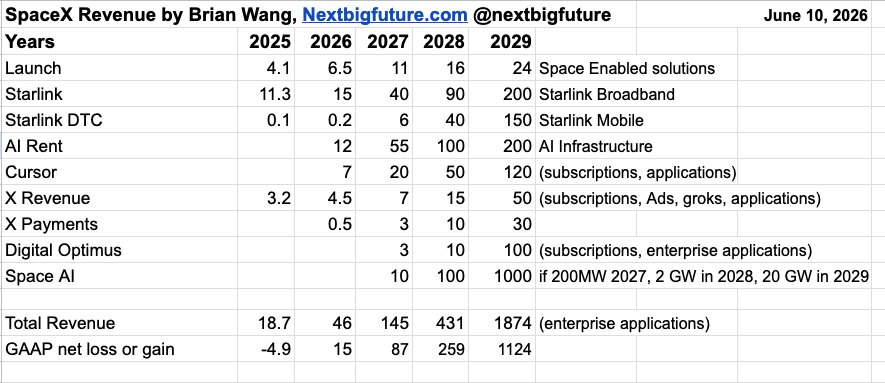
1.5 Gigawatt of AI data center revenue and data center revenue on Earth with Rubin chips can be twice as much as the Colussus 2 revenue potential using B200. The Rubin chips have ten times the AI inference capacity. This should rent for twice as much. 550K B300 chips using 1.3 Gigawatts of energy and at google rental rates of $11 billion per year for 110k B200 chips is $55 billion per year for all of colossus 2. It would be $110 billion per year for a Rubin chip version of Colossus 2 or about $75 billion per year per gigawatt. IF SpaceX could sell its own AI via XAI Grok Code and Cursor, then they could fully use and monetize 10X the inference for $440+ billion per year for each gigawatt of ground AI data center or Space data center.
ONCE SPACEX IS PUTTING 4-10+ GW PER YEAR OF AI DATA CENTER ON THE GROUND OR IN SPACE IT IS GAME OVER – $400 Billion to Trillions per Year
130 V3 Starship launches is enough for launches for 1 gigawatt of Version 1 AI satellite and that would be $75 billion per year or more in revenue. It would be $400 billion per year if they can get Cursor and Grok Code competitive or leading. This is about 2 to 3 times the incremental communication revenue even when they are renting out the AI to others. It is over 10 times the revenue if they get their own coding and AI agent systems competitive. The first dozen or so launches of communication add more critical incremental capability. But it also takes time to make the dishes and sell them. Customers for communications can only be added so quickly.
1 GW PER YEAR WAS ALREADY 20% OF ALL AI DATA CENTER IN 2025 and 2026
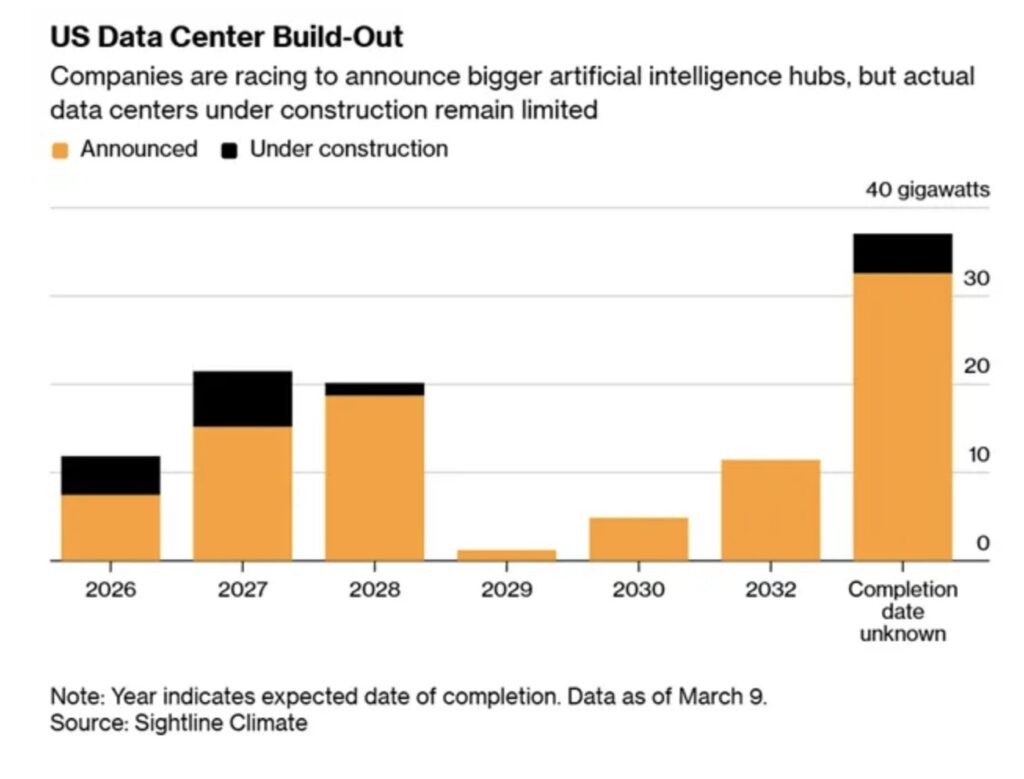
4-10 GW PER YEAR will 50-80% of ALL AI DATA CENTER.
Using newest Rubin Chips will make those insanely valuable and even more with the later Feynman chips.
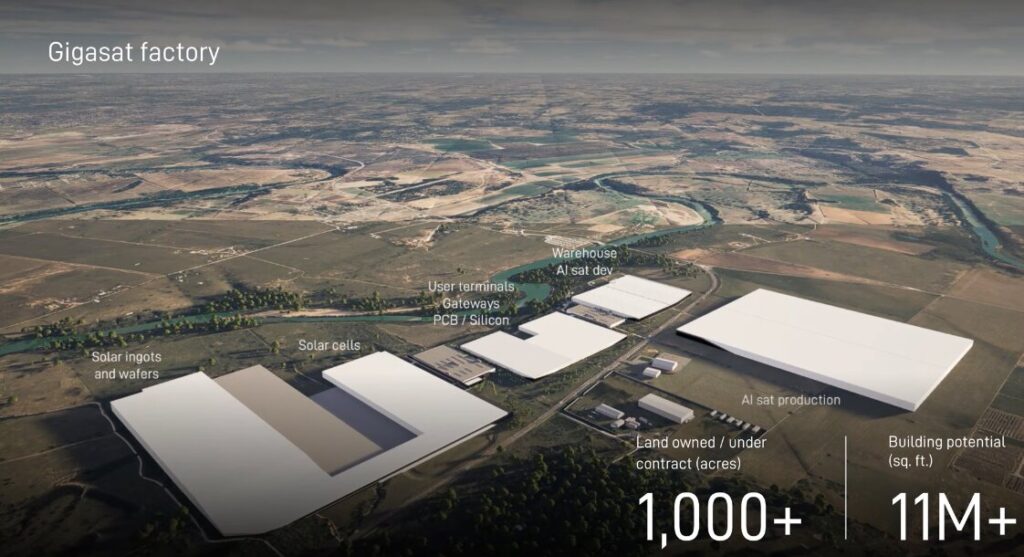
Expanded factories will use the IPO money.
The new Version 5 dishes are game changers. There is a near term global market for a few hundred million of the terminals – aka flat dishes aka high speed internet subscribers. the Version 5 dishes and new spectrum will make them fully competitive and superior to fiber internet.
Flat screen monitor economics is less then $50 cost per dish.
The New V5 dish, thinner and includes new mini. They are able to handle military customers and have superior. GPS.
NO REGULAR GPS ELECTRONICS . STARLINK LOCATION BETTER THAN GPS.
Do More. Less Power. 1-2hr battery. Router included. USBC for regular power links.
Can go fully symmetrical.
100 mbps, 300 mbps, 500 mbps uploads. Even gbps or multi-gbps.
FASTER and SYMMETRICAL
20 MS latency.
Golden Dome Money $20-40 Billion Per Year
Golden Dome’s objective architecture at approximately $185 billion within 3 years. 60% of this will be in space for about 1200 satellites and then scaling to 7500 interceptors and then replacements every five years.
SpaceX just got about $6.4 billion for one of the the first parts of the Golden Dome projects. SpaceX was awarded a $4.16 billion contract from the Space Force. $2.29 billion for the Space Data Network (SDN) Backbone military communications mesh in LEO (also Starshield-based) to link sensors, weapons, and command systems. Fully operational prototype by end of 2027.
If SpaceX captures 40% of the ~$600–700 billion in satellite-related acquisition costs across SBI + sensing layers (buses/platforms, integration, where it has Starshield heritage and vertical integration advantage), that alone is $240 billion. 30% of the first $185 billion for the next three years or so would be $60 billion for three years or $20 billion per year.

Brian Wang is a Futurist Thought Leader and a popular Science blogger with 1 million readers per month. His blog Nextbigfuture.com is ranked #1 Science News Blog. It covers many disruptive technology and trends including Space, Robotics, Artificial Intelligence, Medicine, Anti-aging Biotechnology, and Nanotechnology.
Known for identifying cutting edge technologies, he is currently a Co-Founder of a startup and fundraiser for high potential early-stage companies. He is the Head of Research for Allocations for deep technology investments and an Angel Investor at Space Angels.
A frequent speaker at corporations, he has been a TEDx speaker, a Singularity University speaker and guest at numerous interviews for radio and podcasts. He is open to public speaking and advising engagements.
