


Theo’s Take
Theo tested Grok 4.5 extensively the day before launch and called it “pretty damn good and REALLY well priced.” He said it’s good enough that he has to make a video on it. He also noted the crowded frontier (“GLM-5.2 is close to Opus, Grok 4.5 allegedly beats Opus and GPT-5.5… Feels like it barely matters now”), but the strong real-world performance + pricing stood out to him.
Grok 4.5 is good enough that I think I have to do a video on it…
— Theo – t3.gg (@theo) July 9, 2026
Best bang-for-buck frontier model: Miles Deutscher (@milesdeutscher
) said it’s “the first xAI model to impress me in over a year” and called it “officially the best bang for buck LLM on the market,” noting some benchmarks put it near Fable-level intelligence at ~1/10th the cost.
Grok 4.5 is the first xAI model to impress me in over a year.
This is officially the best bang for buck LLM on the market.
Some benchmarks even conclude Fable-intelligence at 1/10th the cost.
Real use cases, how to set it up (free), getting the most out of Grok 4.5, and more: https://t.co/RKX7rSbUWy
— Miles Deutscher (@milesdeutscher) July 8, 2026
Breaks the old tradeoffs: Many highlight that it delivers Opus-class (or close) intelligence at fast-model speeds (~80 TPS) with much better token efficiency (often 2–4× fewer tokens per task) and low pricing ($2/M input, $6/M output). One popular take: “Grok 4.5 refuses to choose” between smart/slow or fast/dumb.
For two years, the AI industry made you choose: a smart model that’s slow, or a fast model that’s dumb. The implicit tradeoff behind every benchmark.
Grok 4.5 refuses to choose.
80 tokens per second. Opus-class quality. And 4× fewer tokens to solve the same task as the outgoing… https://t.co/gomAMxReba
— Julien Talbot (@julientalbot974) July 8, 2026
Coding & agentic strengths
Trained alongside Cursor, it’s praised as a strong coding/agent model. It performs well on agentic evals (e.g., high on DeepSWE, Terminal Bench, SWE-Bench variants, and #1 on some like Harvey legal agent benchmark). Users report it handles complex, long-running engineering tasks effectively.
Real-world/professional work
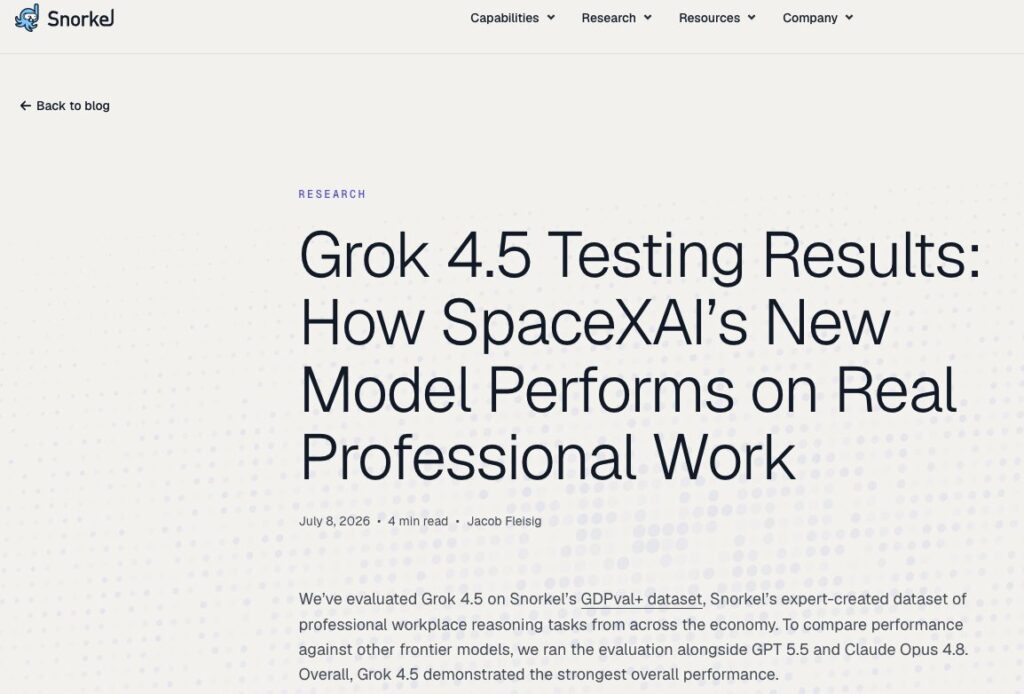
Snorkel AI’s GDPval+ benchmark (real professional deliverables) showed Grok 4.5 at 29% mean pass rate, beating GPT-5.5 (22%) and Opus 4.8 (21%), especially in legal, education, healthcare, etc.
Efficiency & cost wins
Artificial Analysis ranks it #4 on their Intelligence Index but notes it’s on the Pareto frontier for cost vs. performance in coding/agent tasks, with strong token efficiency.
General vibe “Like Opus 4.7 on fast mode but cheaper” and strong clear communication/reduced cognitive load for users. Early users in Grok Build/Cursor report solid app-building and agentic performance.
Quick Summary of Sentiment
Strengths
Coding/agents, speed + intelligence combo, token efficiency, price, real-world usefulness (especially engineering/knowledge work).
Positioning
Opus/GPT-5.5-class capability but more practical and cost-effective. Not always #1 on every benchmark, but excels where it matters for developers and power users.
Rollout is phased (API/Grok Build/Cursor first, chat apps soon).
Overall, the early consensus from Theo and other AI voices (developers, benchmark analysts, YouTubers) is enthusiastic about its practicality and value proposition — it’s seen as xAI making a real push into the frontier with a model that’s actually useful day-to-day rather than just benchmark-optimized.
Brian Wang is a Futurist Thought Leader and a popular Science blogger with 1 million readers per month. His blog Nextbigfuture.com is ranked #1 Science News Blog. It covers many disruptive technology and trends including Space, Robotics, Artificial Intelligence, Medicine, Anti-aging Biotechnology, and Nanotechnology.
Known for identifying cutting edge technologies, he is currently a Co-Founder of a startup and fundraiser for high potential early-stage companies. He is the Head of Research for Allocations for deep technology investments and an Angel Investor at Space Angels.
A frequent speaker at corporations, he has been a TEDx speaker, a Singularity University speaker and guest at numerous interviews for radio and podcasts. He is open to public speaking and advising engagements.
