

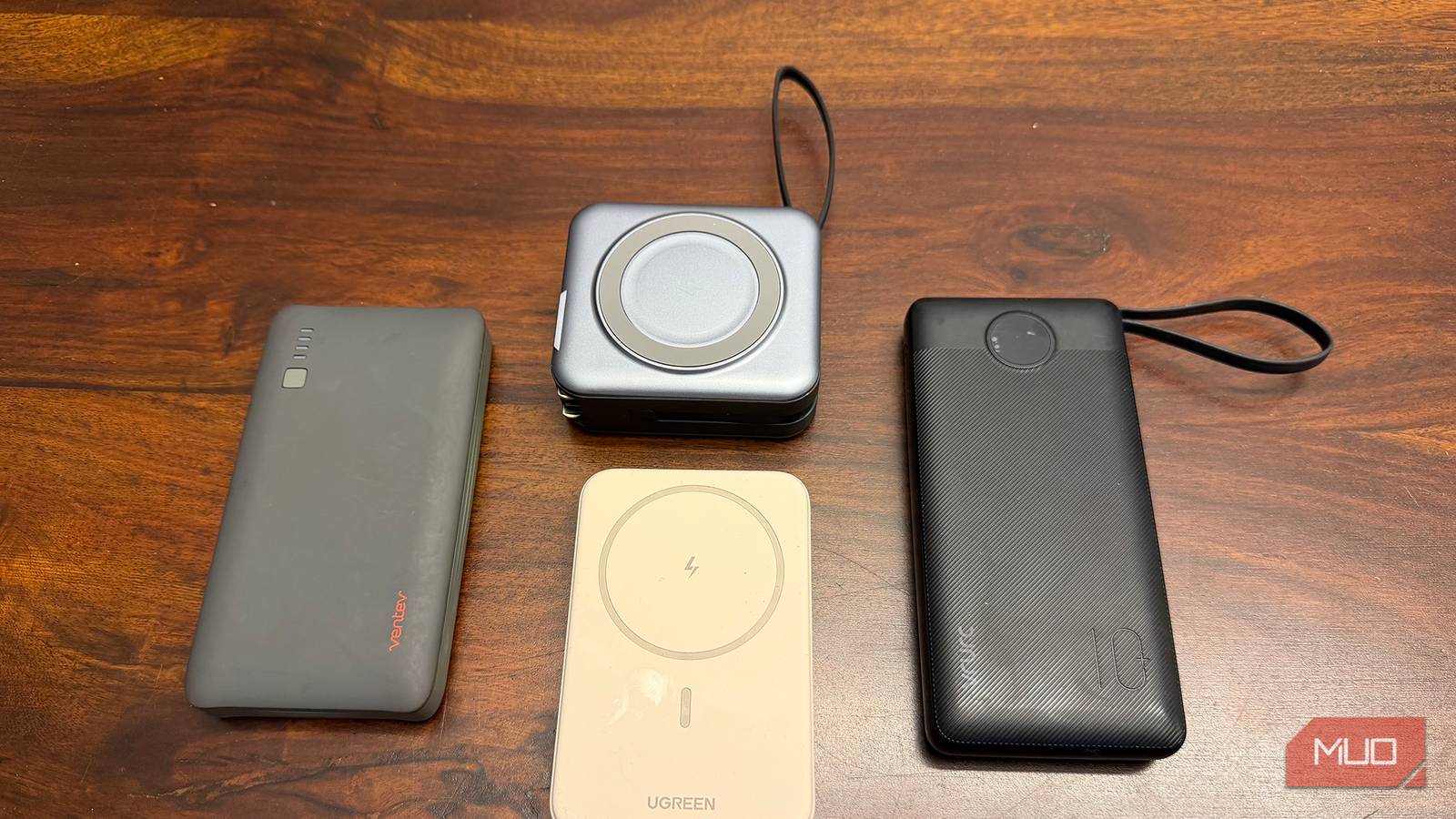

A portable power bank is one of those mobile accessories everyone should have in their backpack. From professionals to travelers and students, they provide a boost of power on the go for your smartphone, tablet, wireless earbuds and headphones, even laptops with more powerful models. There are so many options available, but the best one, in my opinion, should have a specific set of features.
I always, for example, look for a portable power bank that has at least one built-in cable so I don’t have to remember to bring one with me. Lately, wireless charging capability is useful, so cables, built-in or otherwise, aren’t even needed. I would never get anything without at least 10,000mAh power, which should provide at least one full charge of most phones. It should also be pocketable, slim, and lightweight. Extra ports are useful, too. Overall, there are a few key features I won’t go without.
Qi2 wireless charging
25W is fastest, but 15W will do
Wireless charging is generally slower than traditional wired charging, but it’s getting faster. Qi2 is a step-up from Qi charging. A standard based on Apple’s MagSafe, you can charge mobile devices at a rate of 15W versus 5W or 7.5W with Qi charging (Qi does offer up to 15W with some devices). Qi2 charging affords better magnetic alignment as well for reliable and consistent charging. It works with compatible devices like Apple iPhone 12 and up models and Google Pixel 10 series devices, or when using compatible wireless charging cases.
The latest version of Qi2 charging from the Wireless Power Consortium (WPC) is Qi2 25W, which allows for even faster wireless charging. In some cases, this is as fast, if not faster, than wired charging, depending on the cable, adapter, and device capability. With a Qi2 25W power bank, you can get a compatible phone up to about 50 percent charge in just half an hour, versus Qi or Qi2, which would be much slower. That adds tremendous value, making wireless chargers good for more than just quick on-the-go top-ups. Plus, with the charger attached securely to the back of the phone without dangling cables, it’s easier to continue to use your phone while it’s charging.
Built-in cables
Ultra-convenient and tidy
Even if a power bank has wireless charging capabilities, built-in cables are great for a secondary charging option. They’re also useful for charging a second device or devices that don’t support Qi charging, like your headphones, wireless headphones case, or tablet. I never buy power banks without built-in cables because there’s nothing more annoying than pulling out a fully charged power bank only to realize you forgot a loose cable to use with it.
These are generally more expensive, but it’s worth it for the convenience, especially as a power bank for travel. Some come with a single cable, typically USB-C, which is quickly becoming a universal standard. But you can also find ones with built-in USB-A cables, even Apple Lightning for older iPhones and iPads. I find the more cables, the better, as it gives you options to charge all types of devices. But even a single built-in USB-C cable makes a huge difference.
Built-in foldable AC prongs
Easy recharging on the go
Along with built-in cables, built-in foldable AC prongs can be a lifesaver in a pinch. With these, you can pop the power bank into a power outlet at the airport, local coffee shop, or even a wall outlet in a meeting room so its battery is topped up for when you need it again. I use this feature often on the train when I travel into the city for work events, and in outlets at the airport while I’m relaxing before a flight. This way, I know my emergency power bank is always powered up.
A foldable design for the prongs is important so that they don’t stick out and the power bank remains compact and pocketable. Pop them out when you need them, flip them back in when you don’t. While you’ll find USB-A outlets in most places nowadays, AC outlets are still far more common. So, a power bank that has prongs built in means you don’t have to go searching for one to recharge, and can boost the bank’s battery more easily, in more places.
Pass-through charging
Keep charging going

Not every power bank has pass-through charging, but this is an important feature. With pass-through charging, you can recharge your phone or other mobile device while the power bank itself is recharging at the same time. This is important so you don’t have to frantically rush to charge the power bank when the battery is dead and wait anxiously for it to get enough power to boost your device before you unplug it and plug your device in. Instead, plug the charger into the wall, plug your device into it, and let it do its thing.
With pass-through charging, the unit will charge at the same time it charges your device. Well, sort it. Power is prioritized to the device that’s connected, then it will pause as the power bank recharges as needed to continue to recharge your device(s). It’s useful to keep everything charged at once, even if this means both will charge more slowly. It also helps when you only have a single wall outlet available, like on a plane, or when there’s only one accessible in a desired spot, like within reach on the bedside table in a hotel room.
The perfect charger does exist
Plenty of brands have options
It might sound like this is asking too much, but plenty of power banks from top brands like Anker, UGREEN, and Belkin incorporate wireless charging, built-in cables, AC prongs, and pass-through charging. With Qi2 25W charging set to be the next evolution, we can expect to see options that add this upgrade coming in 2026. For now, you will find power banks with these features and at least Qi2 15W charging, and they’re still worth getting since most smartphones tap out at 15W wireless charging support anyway. Right now, only the iPhone 16 and 17 series phones and the Google Pixel 10 Pro XL support Qi2 25W charging. (Phones from other brands like OnePlus offer even faster wireless charging, but through their own proprietary technology).
Lots of the best power banks have at least some of these features, like the UGREEN MagFlow 10,000mAh battery pack that has all but the built-in AC prongs. The POAQCIF charger, which I just picked up, employs a square versus rectangular design, but has all the aforementioned features with 15W Qi charging, however, versus Qi2. Three out of four of these features aren’t bad. I’m still on the hunt for the perfect portable power bank. For now, I’d even recommend getting two and using the one that best suits your needs, depending on the occasion: a large-capacity model with a built-in cable for long-term power and Qi2 wireless for emergency backup power.
