

Close Menu

    Subscribe to Updates

    Get the latest Tech news from SynapseFlow

    What's Hot

    Check Point Patches Critical VPN Vulnerabilities

    September 13, 2026

    APOD: 2026 September 13 – Comet NEOWISE Rising over the Adriatic Sea

    September 13, 2026

    Dell UltraSharp U3226Q 32 4K QD-OLED monitor review

    September 13, 2026
    Facebook X (Twitter) Instagram
    • Homepage
    • About Us
    • Contact Us
    • Privacy Policy
    Facebook X (Twitter) Instagram YouTube
    synapseflow.co.uksynapseflow.co.uk
    • AI News & Updates
    • Cybersecurity
    • Future Tech
    • Reviews
    • Software & Apps
    • Tech Gadgets
    synapseflow.co.uksynapseflow.co.uk
    Home»Future Tech»A Sea of Spinning Clouds
    A Sea of Spinning Clouds
    Future Tech

    A Sea of Spinning Clouds

    The Tech GuyBy The Tech GuyMay 7, 2026No Comments3 Mins Read0 Views
    Share
    Facebook Twitter LinkedIn Pinterest Email
    Advertisement


    Over the Southern Ocean surrounding Antarctica, winds can whip around the globe relatively unimpeded by land. Intrepid sailors termed these southern latitudes the Roaring Forties, Furious Fifties, and Screaming Sixties on account of the strong prevailing winds.

    Advertisement

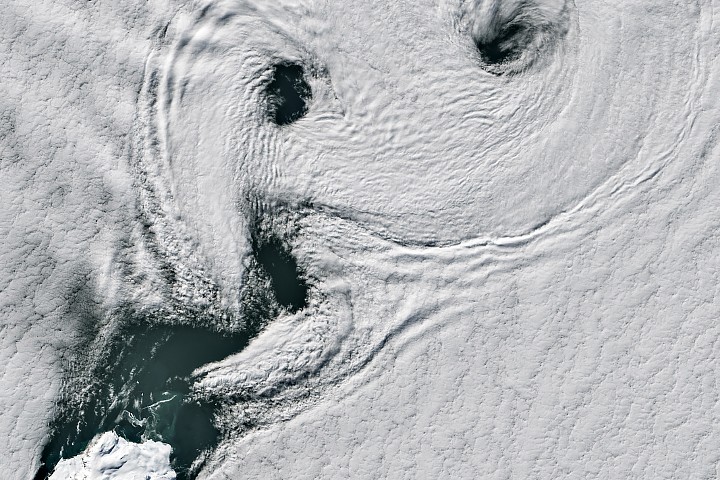
    When those winds encounter a barrier like an island, the disruption in airflow can be beautiful. One impediment, shown here, is remote Peter I Island. This ice-cloaked volcano lies at 68.86 degrees south latitude in the Bellingshausen Sea, some 400 kilometers (250 miles) off the coast of West Antarctica and more than 1,800 kilometers (1,100 miles) from Cape Horn, Chile.

    On an austral summer day in 2026, the Landsat 8 satellite captured this image of von Kármán vortex streets downwind of the island. These counterrotating spirals form as flowing air is deflected, slows, and spins into eddies. A stiff, but perhaps not quite “screaming,” wind was likely blowing that day. Wind speeds typically need to be 18 to 54 kilometers (11 to 34 miles) per hour for vortices to form. With stronger gales, the eddies cannot maintain their shape. The following day, vortex streets appeared within a complex array of cloud types near the island.

    Where the clouds parted around the island, some of its icy edifice became visible to the satellite. A 100-meter-wide circular crater sits at its summit, 1,640 meters (5,380 feet) above sea level. The Smithsonian Institution’s Global Volcanism Program describes the island as a “shield-like volcano,” but there are no records of recent eruptions.

    Scientific research on Peter I Island has been limited due to its remote location and the challenging ice conditions surrounding it. The island was discovered in 1821 by the Russian explorer Fabian Gottlieb von Bellingshausen and named for a tsar, but no one landed on it until 1929. The relatively few studies since have focused on geology, biodiversity, and the climate history recorded in its ice.

    NASA surveyed the island during an Operation IceBridge campaign in 2011. This airborne science mission collected a suite of measurements over Earth’s polar ice in the period between the ICESat and ICESat-2 satellite missions to sustain the record of observations in these regions. While NASA’s DC-8 aircraft flew back to Chile from Antarctica, where teams spent the day measuring the Getz Ice Shelf and Thwaites Glacier from the air, the crew on board caught a rare glimpse (above) of the remote island.

    NASA Earth Observatory image by Michala Garrison, using Landsat data from the U.S. Geological Survey. Photo courtesy of Christopher Shuman, UMBC (retired). Story by Lindsey Doermann.

    Parallel lines of cloud vortices appear downwind of a small, ice-covered island.

    • Jackson, M., et al. (2025) The Biodiversity of Peter I Island—The Most Remote Island in the World. Ecology and Evolution, 15(11), e71634.
    • NASA Science, IceBridge. Accessed May 6, 2026.
    • On Thin Ice (2011, November 4) The fragile fringe of West Antarctica. Accessed May 6, 2026.
    • Smithsonian Institution Global Volcanism Program, Peter I Island. Accessed May 6, 2026.
    • Thomas, E. R., et al. (2024) The first firn core from Peter I Island – capturing climate variability across the Bellingshausen Sea. Climate of the Past, 20(11), 2525–2538.

    Advertisement
    Share. Facebook Twitter Pinterest LinkedIn Tumblr Email
    The Tech Guy
    • Website

    Related Posts

    APOD: 2026 September 13 – Comet NEOWISE Rising over the Adriatic Sea

    September 13, 2026

    This Week’s Awesome Tech Stories From Around the Web (Through September 12)

    September 13, 2026

    Aging Congress Is Completely Ill-Equipped to Regulate AI, or Seemingly Even Understand It

    September 12, 2026

    Space Telescope Interferometer to Image Exoplanet Continents – NextBigFuture.com

    September 12, 2026

    Help Refine Data from Space Telescopes with Artifact InSPECtor

    September 12, 2026

    OpenAI Claims Another Huge Mathematical Result Amid Fights Over Credit, Ethics, and Privacy

    September 12, 2026
    Leave A Reply Cancel Reply

    Advertisement
    Top Posts

    You don’t need a NAS to self-host — I proved it with hardware from my closet

    June 7, 2026391 Views

    Spotify is giving one of its best playlists a big visual upgrade to give subscribers ‘a closer connection’ to its New Music Friday curators — and I think it could be the update it’s always needed

    June 12, 2026210 Views

    The iPad Air brand makes no sense – it needs a rethink

    October 12, 202517 Views
    Stay In Touch
    • Facebook
    • YouTube
    • TikTok
    • WhatsApp
    • Twitter
    • Instagram
    Advertisement
    About Us
    About Us

    SynapseFlow brings you the latest updates in Technology, AI, and Gadgets from innovations and reviews to future trends. Stay smart, stay updated with the tech world every day!

    Our Picks

    Check Point Patches Critical VPN Vulnerabilities

    September 13, 2026

    APOD: 2026 September 13 – Comet NEOWISE Rising over the Adriatic Sea

    September 13, 2026

    Dell UltraSharp U3226Q 32 4K QD-OLED monitor review

    September 13, 2026
    categories
    • AI News & Updates
    • Cybersecurity
    • Future Tech
    • Reviews
    • Software & Apps
    • Tech Gadgets
    Facebook X (Twitter) Instagram Pinterest YouTube Dribbble
    • Homepage
    • About Us
    • Contact Us
    • Privacy Policy
    © 2026 SynapseFlow All Rights Reserved.

    Type above and press Enter to search. Press Esc to cancel.

    Ad Blocker Enabled!
    Ad Blocker Enabled!
    Our website is made possible by displaying online advertisements to our visitors. Please support us by disabling your Ad Blocker.