

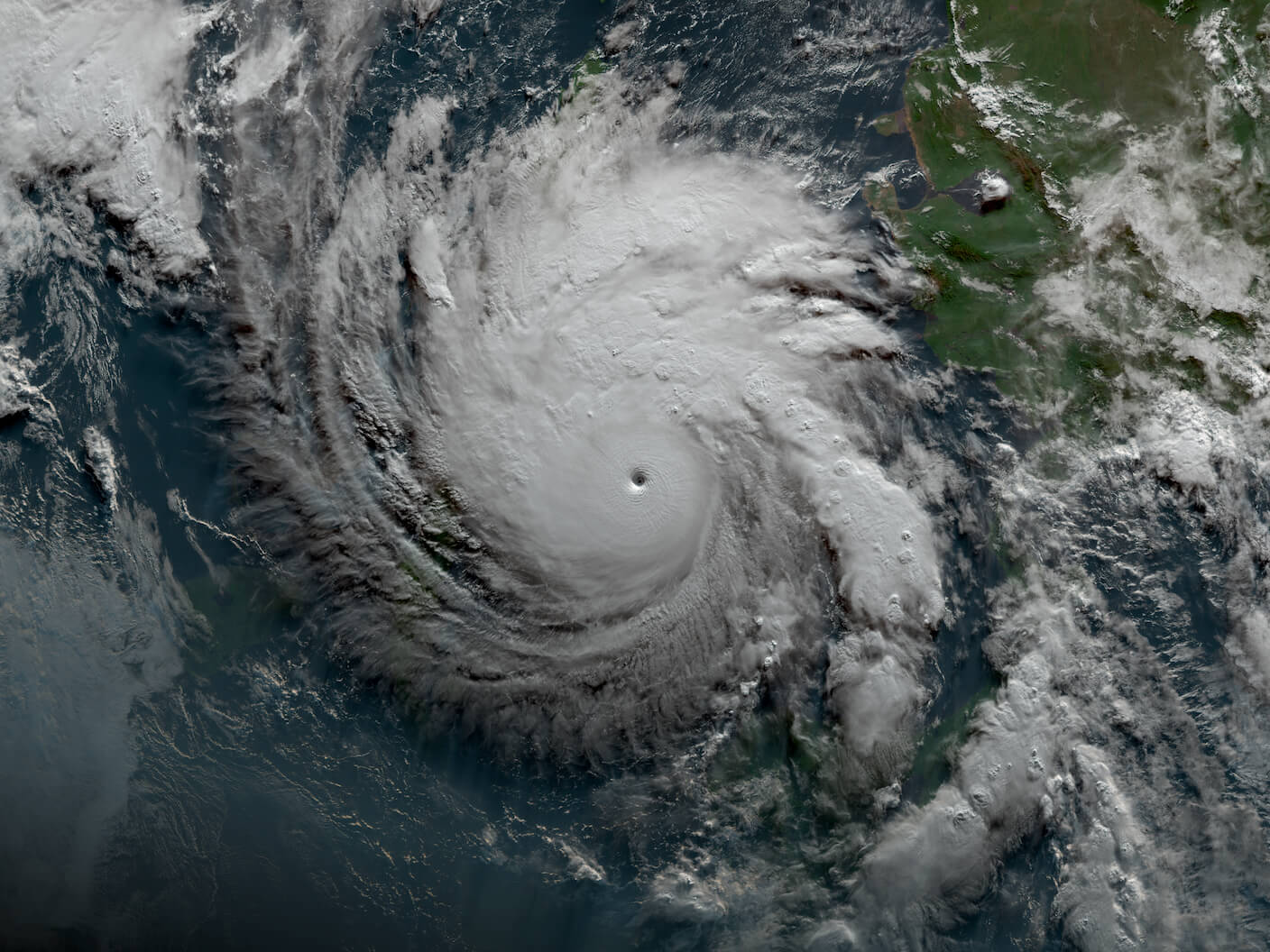

When Hurricane Melissa made landfall in Jamaica in 2025, it was the strongest storm ever to hit the island. The hurricane’s rapid intensification left forecasters stunned.
But thanks to WeatherNext, an AI model developed by Google DeepMind, the island had an early warning. Working with the National Hurricane Center, the model predicted Melissa’s sudden jump in strength with nearly 100 percent confidence three days in advance. That gave experts more time to help people prepare and evacuate. It was the first time a storm that began with relatively low wind speeds was successfully predicted to reach Category 5.
When it comes to cyclones—including hurricanes and typhoons—every extra hour counts. These storms are among nature’s most destructive weather events and notoriously hard to anticipate. A cyclone’s path and strength can change rapidly. Seemingly tame storms can explode into monsters; those expected to skirt populated areas can suddenly veer towards a city. Longer forecasts gives communities time to mobilize resources and get out of harm’s way.
But cyclones are chaotic systems. Tiny differences can dramatically alter their behavior, making them harder to predict the further out we look. Existing forecasts rely on physics-based simulations that extrapolate two days ahead. But DeepMind says their algorithm extends the warning period to three days without sacrificing accuracy.
An extra day may seem trivial. But “this scale of improvement corresponds roughly to a decade’s worth of meteorological progress,” the team wrote in a blog post.
Beyond cyclones, WeatherNext also generates 15-day weather forecasts faster and using less energy than conventional models. That’s not to say it’ll replace them though. Instead, the two complement each other, giving human forecasters better information to guide critical decisions.
“By combining advanced machine learning with the indispensable real-world expertise of human forecasters, we aim to create a collaborative weather forecasting ecosystem that can save lives and help communities adapt to a changing climate,” the team wrote.
Crystal Ball
Predicting weather has always been challenging. Standard forecasting software uses physical models of the Earth’s atmosphere, incorporating temperature, air pressure, wind, humidity, and many other variables. It then calculates how these factors will evolve. Given current pressure and temperature gradients and moisture levels, for example, how will air move, and how likely is it that moisture will condense into clouds and rain?
Supercomputers crunch the numbers and churn out predictions. Though relatively accurate, the process is slow—often taking hours—costly, and rigid. Weather is one of the most complex physical systems on Earth, and even small changes in conditions can throw these models off.
So DeepMind turned to AI. Five years ago, they developed an AI modeI that outperformed physics-based models at 90-minute forecasts. In 2023, the AI lab’s GraphCast algorithm nailed 10-day predictions from historical data, beating leading systems roughly 90 percent of the time across thousands of scenarios. GenCast soon followed, cutting the time and energy required to generate predictions. Broadly speaking, these systems divide the globe into small geographical chunks called pixels and learn how weather conditions in one area influence neighboring areas.
But extreme weather presents an additional challenge. Massive databases exist to train AI on everyday weather patterns. Cyclones, on the other hand, are relatively rare and highly unpredictable.
One way to tackle this problem it to generate many slightly different versions of what might happen by adding random noise after training. But because the noise affects each pixel differently, it can disrupt their relationships and produce unrealistic weather patterns.
For WeatherNext, DeepMind instead built uncertainty into the AI itself.
Bridging the Gap
There’s traditionally been a tradeoff between accuracy and scale in cyclone prediction.
Coarse global models are best at tracking a cyclone’s trajectory because storms are steered by massive atmospheric currents. But they can’t zoom in on the local turbulence that determines how quickly a storm intensifies. Meanwhile, high-resolution local models are better at predicting a cyclone’s strength but lack the broader context needed to accurately track its path.
One model sees the forest; the other sees the trees. WeatherNext bridges the gap.
DeepMind trained the AI on decades of global weather patterns and an expert-curated dataset of nearly 5,000 extreme cyclones. Rather than producing a single best guess, the model runs thousands of “what-if” scenarios assigning probabilities and a confidence level to each. The team can now predict a thousand possible scenarios for a single cyclone.
The model can generate a 15-day forecast in less than a minute on a single AI chip, and it can look further ahead when tracking cyclones. WeatherNext was as accurate as GenCast, a leading physics-based model, and the National Oceanic and Atmospheric Administration’s Hurricane Analysis and Forecast System at predicting maximum wind speed and trajectory three days ahead, rather than the two-day window current systems produce.
The model’s live predictions are available on Google Weather Lab, although the team stresses people should use local weather agencies or national weather services for official forecasts and warnings.
AI weather prediction is advancing fast, and DeepMind isn’t the only player. Huawei, the Chinese technology giant, and chipmaker Nvidia are also racing to develop faster, more accurate systems. Forecasters are increasingly folding these tools into workflows, and scientists generally agree that AI can make predictions faster and cheaper.
But that doesn’t mean it’s time to abandon physics-based models. Unlike AI, they’re easier to interpret, and they can also reveal previously unknown weather patterns—an increasingly important ability as Earth’s climate changes. These discoveries, in turn, could feed back into AI systems, helping them deal with events that aren’t captured in historical training data. Human expertise also remains indispensable, especially for judging whether AI forecasts make physical sense.
Scientists might next connect weather models with other systems, such as storm-surge modeling. Combining tools could improve predictions of rare but catastrophic outcomes, like whether a cyclone will arrive when sea levels are high or an earthquake-generated tsunami will hit a coast during a major storm. Modeling hazards together could give emergency workers a more realistic picture of the risks.
Evan Thompson at the Meteorological Service Jamaica has already seen how WeatherNext can benefit local communities as Hurricane Melissa charged towards shore.
“With early evacuation and better preparation, that reduction in harm really does make a difference to our people,” he told DeepMind. “It does actually save their lives, and it saves the livelihoods that they want to secure.”
