


Grokbot is the easiest no-code agent platform. It is an app that gives non-technical users real agent capabilities right away. It is an entire small company inside one application. Every item in the sidebar is a named, persistent teammate (bot) with an ongoing role. All of the bots share one dedicated cloud computer that belongs only to your account. That machine has a browser, file system, terminal, tools, and a shared workspace. Bots can even get their own screens and work in parallel.
Yes, Grok Bot is expensive at $200/month but you are getting a dedicated linux machine to make it easy to use and more productive.
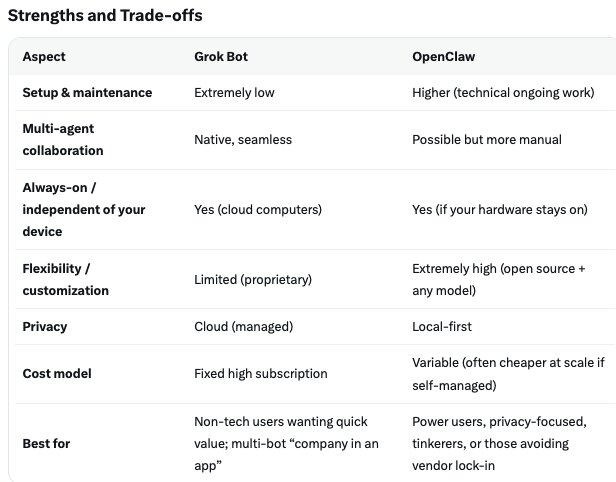
If you are technical OpenClaw wins on freedom, privacy, cost control. You can run anything on your own terms. OpenClaw and Grok bot can be complementary rather than mutually exclusive. OpenClaw or other self-hosted tools give deep customization and local work. Grok Bot is polished, always-available multi-agent productivity. Do you value simplicity and managed reliability more or maximum control and zero vendor dependency.
Another starting system for browser automation is Playwright Playwright is the dominant low-level browser automation library for AI agents in 2026. Playwright is Microsoft’s open-source tool Apache 2.0 that drives real browsers (Chromium, Firefox, and WebKit) with a single API. Higher-level systems (Browser Use, Stagehand, vendor Computer Use) add an LLM decision loop on top of the browser so the agent can adapt when pages change, while pure Playwright is more deterministic and cheaper when the flow is known. Use raw Playwright when you are building or extending a custom agent and want precise, low-cost, auditable control.
They have multiple named agents that each have their own cloud computer working for you and they can work on your computer as well. You can teach a task to them live. The teach a task can then instantly become a skill file that can be re-used.
You can work with one agent on your business and provide all of your context. You can tell a new agent to ask the experienced agent to teach all of the context. You do not have to re-explain or reshare all of the files.
Lean on the agents. Explain everything about yourself and your main issues and what you do. Then the agent tell you how it can help you.
Grok bot works out of the box. Try it out. 90% of people, who do not customize OpenClaw or Hermes, will likely find Grok Bot to be better.
Grok Bot Solves Agent Signup Pain Point
The biggest friction with most agents—connecting calendar, email, and other services—is almost eliminated.
1. You simply start talking to a bot.
2. When it needs access it asks you to authorize once. Because everything runs on the same dedicated machine, that single authorization works for every bot thereafter. If a service has no official connector, the bot can pull up a remote login screen, hand control to you so you type the credentials yourself, then remember the session—without ever handling your password in plain text.
3. Grokbot is free to start. Generally a day or so of free usage then hits a paywall.
Start using the Chief of Staff bot that coordinates the others which reduces the mental load to managing only one or two agents. Bots can message one another transparently on the shared machine.
Security is simplified to a single perimeter. One Linux machine in Silicon Valley that you alone control. Adding more bots does not expand the attack surface. Users can opt out of data-retention for training/logs. It is a far more secure and usable version of OpenClaw. Instead of low-ambition uses (a plain email scheduler), users should treat the dedicated computer as a platform for building real things—landing pages, software, entire businesses—because the bots understand code and can even write their own tools and self-improve.
When is the $200 Per Month Subscription Worth It?
After the free tier, Grokbot jumps to $200/month. Higher Ultra / Grok Superheavy tier at ~$300/month includes Grok Bot.
The price is steep. Value comes only if you can extract $1000+ per month or more of value back every month—by killing unused subscriptions, running half a business, or similar high-leverage uses.
Computing creates leverage by cheaply replicating software. AI multiplies that leverage further. Grokbot can be used by non-technical users, but you must be a power user.
Nate Provides Two Starter Kits to his Substack community
1. Superdoerbot is a set of files/templates that make the bot relentlessly proactive. It inspects calendar and email, infers real work (drafts a presentation PowerPoint or a reply email in your style), and never waits for explicit instructions. It drafts but does not send without permission.
2. Business-in-a-Box bot – another set of files/templates that turn a bot into a full business-operations partner. You supply the business idea. The bot (and any partner bots it spins up) handles the rest—setup, management, delegation, etc.
These two are chosen because they finally let completely non-technical users (who only use email and a browser) to cross the agents chasm. The app stays awake and working even when your laptop is off. Technical/power users still benefit. Grokbot supplies an extra pool of tokens outside the weekly limits and expensive credit systems of Claude, Codex, etc., and is additive rather than a replacement.

Brian Wang is a Futurist Thought Leader and a popular Science blogger with 1 million readers per month. His blog Nextbigfuture.com is ranked #1 Science News Blog. It covers many disruptive technology and trends including Space, Robotics, Artificial Intelligence, Medicine, Anti-aging Biotechnology, and Nanotechnology.
Known for identifying cutting edge technologies, he is currently a Co-Founder of a startup and fundraiser for high potential early-stage companies. He is the Head of Research for Allocations for deep technology investments and an Angel Investor at Space Angels.
A frequent speaker at corporations, he has been a TEDx speaker, a Singularity University speaker and guest at numerous interviews for radio and podcasts. He is open to public speaking and advising engagements.
