

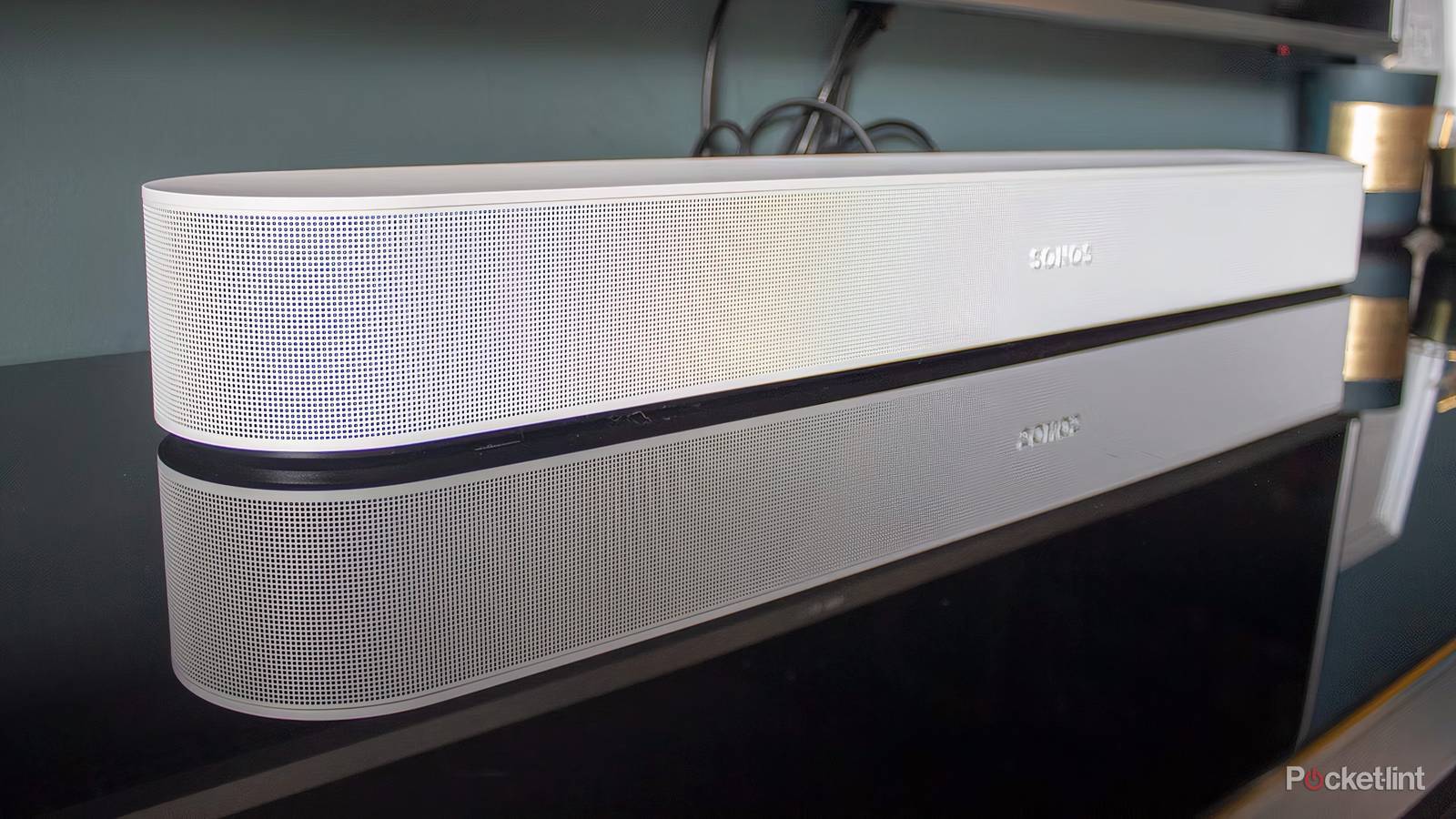

Sonos remains one of the most popular choices for soundbars, despite cheaper alternatives and some very public app problems that were only recently sorted out. It makes more sense when you actually get one in your home. Even the entry-level Ray sounds amazing, being an owner myself, and that app integration is killer now that it works as planned. If you’re rolling deep, you can expand to a wireless multi-speaker Atmos system with relative ease, adding more units as you see fit.
There can of course be problems with Sonos products that have nothing to do with the redesigned app. Some of them are relatively straightforward to deal with, while others might require putting in some elbow grease to reconfigure your Wi-Fi and other equipment. I’m optimistic that most issues can be solved in a few minutes.
 Quiz
QuizTV speakers and soundbars
Trivia challenge
From built-in tweeters to Dolby Atmos monsters — how much do you really know about TV audio?
SoundbarsTechnologyBrandsFormatsHistory
What does the term ‘Dolby Atmos’ refer to in home audio?
Correct! Dolby Atmos is an object-based audio format that places sounds in a three-dimensional space, including overhead height channels. It was originally developed for cinema in 2012 before making its way into home theatres and soundbars.
Not quite. Dolby Atmos is an object-based surround sound format that adds height channels to create a three-dimensional listening experience. It debuted in cinemas in 2012 and later arrived in home audio products including soundbars.
What does a soundbar’s ‘2.1’ configuration refer to?
Correct! In speaker configurations, the first number represents full-range or satellite speakers, and the ‘.1’ refers to a dedicated subwoofer channel. A 2.1 soundbar therefore has two speakers plus a subwoofer for bass reproduction.
Not quite. Speaker configuration numbers follow a simple convention: the first digit is the number of full-range speakers and the ‘.1’ denotes a dedicated subwoofer. So a 2.1 soundbar has two speakers and one subwoofer.
Which company developed the Acoustic Research bookshelf speaker and is widely credited with popularising the hi-fi speaker market in the 1950s?
Correct! Acoustic Research, founded by Edgar Villchur in 1952, revolutionised speaker design with the acoustic suspension (sealed box) woofer. This innovation dramatically improved bass response from compact enclosures and helped launch the modern hi-fi industry.
Not quite. The answer is Acoustic Research, founded by Edgar Villchur in 1952. His acoustic suspension speaker design transformed the industry by delivering deep bass from a compact sealed cabinet, setting the stage for the hi-fi revolution.
What is the primary purpose of an HDMI eARC connection on a TV?
Correct! HDMI eARC (Enhanced Audio Return Channel) allows a TV to send high-quality audio — including lossless formats like Dolby TrueHD and DTS-HD Master Audio — downstream to a soundbar or AV receiver. It improved on the original ARC standard, which was limited to compressed audio.
Not quite. HDMI eARC stands for Enhanced Audio Return Channel, and its job is to send audio from the TV to an external speaker system such as a soundbar. Unlike original ARC, eARC supports lossless audio formats including Dolby TrueHD.
In what decade did the first commercially available soundbar products begin to appear on the consumer market?
Correct! Soundbars began appearing as commercial consumer products in the early 2000s, driven by the rise of flat-panel TVs whose slim profiles left little room for decent built-in speakers. Brands like Yamaha were among the early pioneers of the format.
Not quite. Soundbars emerged as a consumer product category in the early 2000s. The shift to thin flat-panel televisions created a need for a compact audio solution, and companies like Yamaha helped popularise the soundbar as an accessible alternative to full surround sound systems.
What technology do upward-firing drivers in a soundbar primarily aim to simulate?
Correct! Upward-firing drivers are designed to bounce sound off the ceiling and back to the listener, simulating the overhead height channels used in object-based formats like Dolby Atmos and DTS:X. They allow a soundbar to approximate a full overhead speaker setup without ceiling-mounted speakers.
Not quite. Upward-firing drivers bounce audio off the ceiling to simulate overhead height channels, which are a key part of object-based formats like Dolby Atmos. It’s a clever workaround that avoids the need to physically mount speakers in the ceiling.
Sonos launched its first wireless home speaker system in which year?
Correct! Sonos launched its first product, the Sonos Digital Music System, in 2004. It was a groundbreaking multi-room audio system that allowed users to stream music wirelessly throughout the home, well before smart speakers became mainstream.
Not quite. Sonos actually launched its first wireless multi-room audio system in 2004, making it a very early pioneer in the wireless speaker space. The company helped define the category years before smart speakers like Amazon Echo became common household names.
What does ‘passive radiator’ mean in the context of a TV speaker or soundbar design?
Correct! A passive radiator is a diaphragm with no voice coil or magnet — it moves purely in response to changes in air pressure inside the cabinet caused by an active woofer. This allows manufacturers to extend bass response without using a bass reflex port, which is useful in slim soundbar designs.
Not quite. A passive radiator is an unpowered driver — essentially a cone or diaphragm with no voice coil — that vibrates sympathetically with the air pressure generated by an active woofer. It’s a common technique in compact soundbars to boost bass without adding a port or increasing size.
Your Score
/ 8
Thanks for playing!
The soundbar is regularly dropping out of the Sonos app
Multiple causes may be at play

This is actually an ongoing concern for me. My Ray will remain usable with my TV, but disappear from the Sonos app without warning, preventing me from changing settings or using any direct music control. The only way to get things back on course is to re-pair the soundbar, although I don’t have to go through the complete setup process each time, thankfully.
The culprit seems to be my Eero Wi-Fi routers. Disconnections always seem to coincide with an Eero firmware update, which requires a reboot, and the Ray seems to have trouble re-establishing a link on its own. There was a long stretch when I didn’t have to deal with this, so it may be that a future Eero release will squash the glitch for good.
Mesh routers can create havoc with Sonos systems, because they rely on unified SSIDs that merge your 2.4, 5, and/or 6GHz bands.
Mesh routers in general can create havoc with Sonos systems. That’s because they rely on unified SSIDs, which merge your 2.4, 5, and/or 6GHz bands. Ordinarily this is a good thing, enabling seamless roaming between routers. Sonos speakers can’t always cope with this hopping, however. If it’s at all possible with your router, you should assign separate SSIDs for each band, and force all of your Sonos devices onto one of them. The 2.4GHz band is probably the safest, since while it has less bandwidth than 5 or 6GHz, it also offers the most range.
Other factors could be involved. You should, for instance, ensure that your soundbar isn’t dealing with interference, which may be likely if it’s tucked inside a cabinet, or has other significant obstacles in the way of a Wi-Fi signal. In a house with a lot of devices, a particular Wi-Fi band might become too congested, forcing your router to kick some devices off. That’s unlikely unless you’re still using Wi-Fi 5, but it’s not impossible. The brute-force way around Wi-Fi issues is to wire your soundbar to Ethernet — but that may not be practical unless your router is in the same room anyway.
The soundbar isn’t powering on with the TV and/or responding to the remote
The joys of CEC

If you’re connecting a Beam or Arc for the first time, make sure that CEC is enabled in your TV’s settings, and that the bar is plugged into your TV’s ARC or eARC port. Not all HDMI ports are created the same — if you plug a soundbar into one that isn’t marked for ARC or eARC, you won’t get any sound, since most HDMI connections are designed to receive audio data one-way.
Assuming this isn’t your first rodeo, there could be a CEC handshake error. CEC allows control input to be passed over HDMI, and if a handshake fails, input won’t go through. You may be able to resolve this by unplugging the HDMI cable on both ends, unplugging your TV and soundbar for at least 30 seconds, then reconnecting everything in reverse order. I’ve seen a suggestion that you might want to wait longer if errors persist, but there’s likely no benefit to waiting more than a minute or two.
If you’ve got a Ray, you’re in a different boat. Being an optical speaker, it simply can’t power on with your TV, since CEC isn’t available. For the same reason, you can’t automatically use your TV remote to control its power and volume. You’ll have to use the Sonos app to “train” the speaker on your remote’s IR blasts. Remember also that you may need to disable your TV’s Bluetooth connection (if one exists) to prevent your remote from adjusting soundbar and internal speaker volume at the same time. You’ll hear an unpleasant echo if both speakers are playing simultaneously.
Audio is interrupted or generating loud pops
Format support raises his ugly head

In a multi-speaker setup, one source of interruptions may be your Wi-Fi network. You should try to eliminate any range, congestion, or interference issues, and keep all your speakers on the same frequency band (2.4, 5, or 6GHz) if your router allows for multiple SSIDs. If you’re using a router that’s stuck on Wi-Fi 5, it’s time to upgrade. That technology just can’t handle enough simultaneous connections in a modern home. Even Wi-Fi 6 will be a massive improvement, and Wi-Fi 7 is increasingly commonplace.
With or without additional speakers, another cause of interruptions may be format support, or rather the lack thereof. Your TV may not be processing a given format properly, especially if it’s something as complex as Dolby Atmos. If the source of audio data is something like a media streamer, Blu-ray player, or game console, try changing your TV’s settings to enable audio passthrough. This will pass the raw data along to your soundbar, which will probably do a better job of decoding it. One way you can test whether formats are at fault is by switching your TV to Stereo/PCM — if that suddenly fixes things, the cause is obvious.
Your TV may not be processing a given format properly, especially if it’s something as complex as Dolby Atmos.
A problem unique to Sonos devices (to my knowledge) is the so-called “pop of death.” It’s not actually fatal to anything, but you might (potentially) be hearing loud pops whenever you change inputs or audio formats. The issue lies with Dolby MAT, which delivers Atmos metadata alongside uncompressed audio. Until an update a few years ago, Beam and Arc soundbars weren’t filtering out any corrupt data, resulting in the same sort of popping you might hear from a damaged music CD. The solution, then, is to trigger a firmware update for your speaker(s) using the latest version of the Sonos app. Remember, you can’t treat a smart soundbar like one of your parents’ old analog speakers — it’s essentially a computer, so software bugs can have an outsized impact.
In the same vein, it’s worth checking for firmware updates to your TV and any other devices that make use of your speaker. While you can’t add a format to a device that doesn’t already support it, there’s the off chance that you’ll fix a compatibility issue you weren’t aware of.


5/5
