

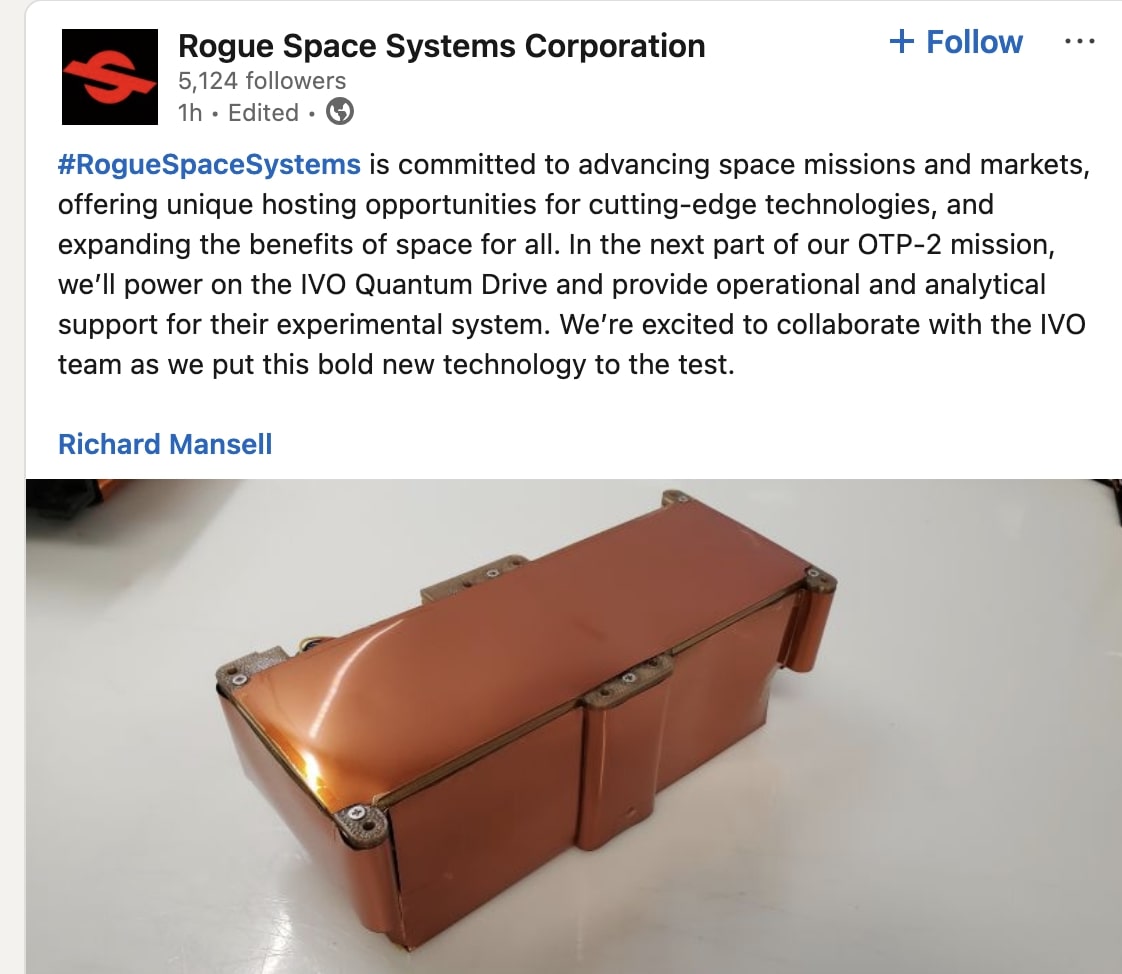

30 Jan 2026 blog post from Dr Mike McCulloch, he compared the IVO Quantum drive based on Quantized inertia theory, satellite’s orbit to a nearly identical twin control satellite. From late September to late December 2025 (90 days), the IVO sat fell ~600 meters less than the control (IVO: 4,880 m decay; control: 5,480 m decay). This relative rise of ~6.6 meters per day is roughly consistent with the expected thrust (1.75 mN) if the drive was firing intermittently (every other day for ~1 minute on average, limited by engineering/glitches). He calls the data plausible and encouraging but not conclusive, noting a possible alternative explanation (Lorentz force from interaction with Earth’s magnetic field, though his rough calculation says it’s too small). He stresses they had hoped for stronger, unambiguous thrust to rule out confounds and says a detailed press release from IVO would help. He concludes that a good ground-based levitation test is now the best next step.
Earlier X post (7 Jan 2026): McCulloch noted the observed ~6.6 m/day relative upward effect matched what he expected from IVO’s known thrust capability.
Given what I know about the extent to which IVO could thrust, they should have been able to push up by a few metres per day. Over the past 3 months I estimate they’ve thrust up relative to a control sat by 6.6m per day. All the same, a ground levitation test is the best way now.
— Mike McCulloch (@memcculloch) January 7, 2026
IVO’s own website (ivolimited.us) has quietly updated its description to say the Quantum Drive has been tested and validated to Low Earth Orbit environments.
McCulloch has shifted emphasis toward unambiguous ground-based thrust tests.
In early April 2026 he held meetings with the UK’s National Physical Laboratory (NPL) — one of the world’s top metrology labs — to design a high-precision QI thrust experiment. He described the costing as higher than hoped and is now pursuing a single “world-class” test instead of multiple parallel ones. He is hopeful that UK funding body ARIA will support it. Once demonstrated at NPL, he believes this would open the door to propellantless propulsion, cheap energy, and levitation applications. He continues to publish and discuss new astrophysical evidence supporting QI.
Experimental Observation of Acceleration-Induced Thermality (Arxiv, 2019)
Published papers on Quantized Inertia
Testing quantized inertia on Proxima Centauri (2024, Monthly Notices of the Royal Astronomical Society)
The Alpha Centauri system has two close stars Alpha and Beta (A & B) and one much further away: Proxima Centauri. All three stars are co-moving with similar chemistry, which implies they are bound, but the fast orbit of Proxima implies it is gravitationally unbound given the visible mass of A and B. This problem cannot be fixed with the addition of dark matter, which must be uniform on such scales, or adding mass to A and B (their mass is well constrained) or by Modified Newtonian Dynamics. A new model for inertia called Quantized Inertia (QI) has been proposed that solves the galaxy rotation problem by reducing the inertia of low-acceleration stars at the galaxies’ edge in a new way, thus keeping them bound without the need for dark matter. It is shown here that if QI is applied to Proxima Centauri in the same way, it predicts the observed orbital velocity, within the bounds of observational uncertainty, and binds Proxima, without the need for extra mass.
NBF: It would only take ~$1 million to do another test in orbit. IVO can analyze what happened and try to improve things on the ground and in lab work before trying again.
Brian Wang is a Futurist Thought Leader and a popular Science blogger with 1 million readers per month. His blog Nextbigfuture.com is ranked #1 Science News Blog. It covers many disruptive technology and trends including Space, Robotics, Artificial Intelligence, Medicine, Anti-aging Biotechnology, and Nanotechnology.
Known for identifying cutting edge technologies, he is currently a Co-Founder of a startup and fundraiser for high potential early-stage companies. He is the Head of Research for Allocations for deep technology investments and an Angel Investor at Space Angels.
A frequent speaker at corporations, he has been a TEDx speaker, a Singularity University speaker and guest at numerous interviews for radio and podcasts. He is open to public speaking and advising engagements.
