

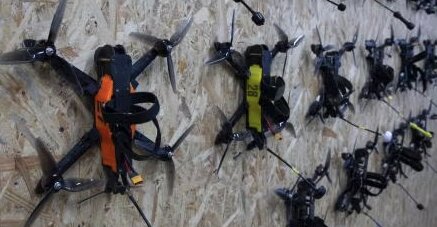

Drone walls and layered short/medium/long-range droning have effectively recreated a modern version of trench attrition warfare, where large-scale land capture is extremely difficult and costly for near-peer adversaries. Only small, incremental gains have been seen in Ukraine. Countries that cannot match drone quantity and integration at scale risks failure or stalemate.
Drone Walls and Layered Droning Explained
A drone wall refers to a dense, multi-layered defensive network using.
Short-range FPV kamikaze drones, small quadcopters with grenades, and loitering munitions (Lancet, Switchblade drones) for immediate frontline defense.
Medium-range are Larger strike drones and reconnaissance assets that create kill zones 10–25 km deep.
Long-range Strategic drones, swarm-capable systems, and integration with artillery/EW for deeper interdiction.
This creates a highly transparent, lethal kill zone where any visible movement (vehicles, troops, logistics) is rapidly detected and targeted. Ukraine has pioneered concepts like this on the defensive, and both sides now operate in a pointillist battlefield of intermixed strongpoints rather than clear front lines.
Defense is strongly favored, maneuver is restricted, and attrition dominates.
What It Means for Near-Peer Wars
If you cannot match millions of drones then your country will struggle to conduct or sustain offensives. Your forces get attritted in the kill zone before achieving breakthroughs. Logistics and massing become nearly impossible without air superiority or overwhelming drone suppression.
Deadlock is likely when both sides have comparable drone capabilities + defensive preparations. Neither can achieve operational breakthroughs without enormous cost.
Offense requires drone overmatch (numerical + qualitative superiority) plus integration with other domains (EW, airpower, long-range strikes). Pure mass without drones fails. Pure high-end tech without mass also struggles against cheap swarms.
Drones have not eliminated maneuver entirely (integration with doctrine, EW countermeasures, and air superiority can still enable it), but they have raised the threshold dramatically.
Taiwan vs. China Scenario
High probability of deadlock or very limited gains, especially if Taiwan prepares properly.
China’s advantages are Massive industrial base (civilian manufacturers could theoretically retool for enormous drone volumes — reports cite potential for hundreds of millions to billions annually in wartime). They can flood the battlespace with cheap drones + missiles.
Taiwan’s advantages/defenses
Investing heavily ($6.7B+ drone and unmanned vessel plans).
Extremely difficult amphibious assault across the strait.
Strait forces only long-range ~100 mile action until large beach heads are secured.
Mountainous/urban terrain favors Taiwan defenders.
Layered drone walls + anti-ship/anti-air systems create kill zones that make beachheads and follow-on forces unsustainable.
Traditional 3:1 Rule in the Drone Era
In classic military analysis, attackers historically needed roughly 3:1 local superiority in troops, firepower, or combat power to achieve a breakthrough against a prepared defender. This accounts for friction, defensive advantages, and the need to overcome prepared positions.
Drones have amplified the defender’s advantage (via drone walls, kill zones, and persistent ISR/strike), making large-scale advances extremely costly without overmatch. However, they have not eliminated the 3:1 principle — they’ve layered an additional requirement on top of it. You still need local superiority for ground forces to exploit breakthroughs.
But you now also need drone superiority (like air superiority) to enable that superiority (or to create breakthroughs via standoff attrition).
In Ukraine, modest local/tactical drone edges (sometimes as low as 1.3:1 in strike drones in specific sectors, or short-term surges of hundreds of drones) have enabled limited gains when combined with suppression of enemy drone networks and other effects.
Rule of thumb emerging from Ukraine/Russia
Local/tactical drone overmatch of ~2–4:1 (or strong surges) in a sector, sustained over days/weeks, can enable offensive gains or defensive dominance when paired with effective electronic warfare (EW) or kinetic suppression of enemy drone operators/C2.
Strikes on production/launch infrastructure to degrade regeneration.
Integration with artillery, airpower, or ground maneuver.
Global numerical parity or even slight inferiority can still produce results if you create local overmatch and attrit the opponent’s ability to sustain drone operations.
US vs. Iran: What Numerical + Tech Edge Is Needed?
Iran is not a peer. It has strong asymmetric drone capabilities (cheap Shahed-style one-way attack drones, dispersed production, volume tactics) but far smaller overall scale, industrial base, and technological sophistication than the US or even Russia/Ukraine in high-end systems. Recent conflicts have shown Iran can launch hundreds-to-thousands in barrages and exploit cost asymmetry ($20k drone vs. millions in interceptors), but US/coalition forces have achieved high interception rates and significantly degraded Iranian drone production/launch capacity through strikes on infrastructure.
Key thresholds for US to overwhelm Iran (assuming willingness to destroy more drone-related infrastructure than in prior limited operations).
Numerical drone edge does not a blanket 10:1 globally. A local/tactical surge to 3–5:1 or higher in attritable/autonomous drones in key operational areas.
US surge potential (Anduril’s new facilities for low-cost autonomous drones and high-speed systems like FURY, plus Replicator-style initiatives) can rapidly close gaps in mass while leveraging superior quality.
Technology edge (often more decisive than raw numbers)
AI/autonomy is US advantage in autonomous swarming, target recognition, and loyal wingman concepts allows fewer US drones to achieve disproportionate effects (persistent ISR, coordinated strikes, counter-drone).
Counter-drone systems likeDirected energy (lasers), advanced EW, cheap kinetic interceptors, and AI-driven detection — these neutralize Iran’s cheap swarms at much lower cost per intercept than Patriots or similar.
Integration with Superior C4ISR, space assets, and networked operations multiply effectiveness.
Infrastructure destruction multiplier
This is critical and already proven effective. Strikes that damaged 2/3 to 85% of Iran’s drone production/launch capacity in past operations drastically reduced output and launch rates (sometimes over 90% drop). Greater willingness to target factories, storage, engines/sensors production, and dispersed sites would further degrade Iran’s regeneration ability, effectively lowering the numerical ratio the US needs to sustain.

Brian Wang is a Futurist Thought Leader and a popular Science blogger with 1 million readers per month. His blog Nextbigfuture.com is ranked #1 Science News Blog. It covers many disruptive technology and trends including Space, Robotics, Artificial Intelligence, Medicine, Anti-aging Biotechnology, and Nanotechnology.
Known for identifying cutting edge technologies, he is currently a Co-Founder of a startup and fundraiser for high potential early-stage companies. He is the Head of Research for Allocations for deep technology investments and an Angel Investor at Space Angels.
A frequent speaker at corporations, he has been a TEDx speaker, a Singularity University speaker and guest at numerous interviews for radio and podcasts. He is open to public speaking and advising engagements.
