

Close Menu

    Subscribe to Updates

    Get the latest Tech news from SynapseFlow

    What's Hot

    Surprise! Meta Says Now You Have to Pay a Monthly Subscription to Use Key Features of Your Already Expensive Smart Glasses

    July 4, 2026

    TCL PlayCube portable projector review

    July 4, 2026

    Windows 11 screen turns off when set to ‘Never’

    July 4, 2026
    Facebook X (Twitter) Instagram
    • Homepage
    • About Us
    • Contact Us
    • Privacy Policy
    Facebook X (Twitter) Instagram YouTube
    synapseflow.co.uksynapseflow.co.uk
    • AI News & Updates
    • Cybersecurity
    • Future Tech
    • Reviews
    • Software & Apps
    • Tech Gadgets
    synapseflow.co.uksynapseflow.co.uk
    Home»Future Tech»NASA’s Hubble Captures Crimson Cloud Sparkling with White, Blue Stars
    NASA’s Hubble Captures Crimson Cloud Sparkling with White, Blue Stars
    Future Tech

    NASA’s Hubble Captures Crimson Cloud Sparkling with White, Blue Stars

    The Tech GuyBy The Tech GuyJuly 4, 2026No Comments3 Mins Read0 Views
    Share
    Facebook Twitter LinkedIn Pinterest Email
    Advertisement


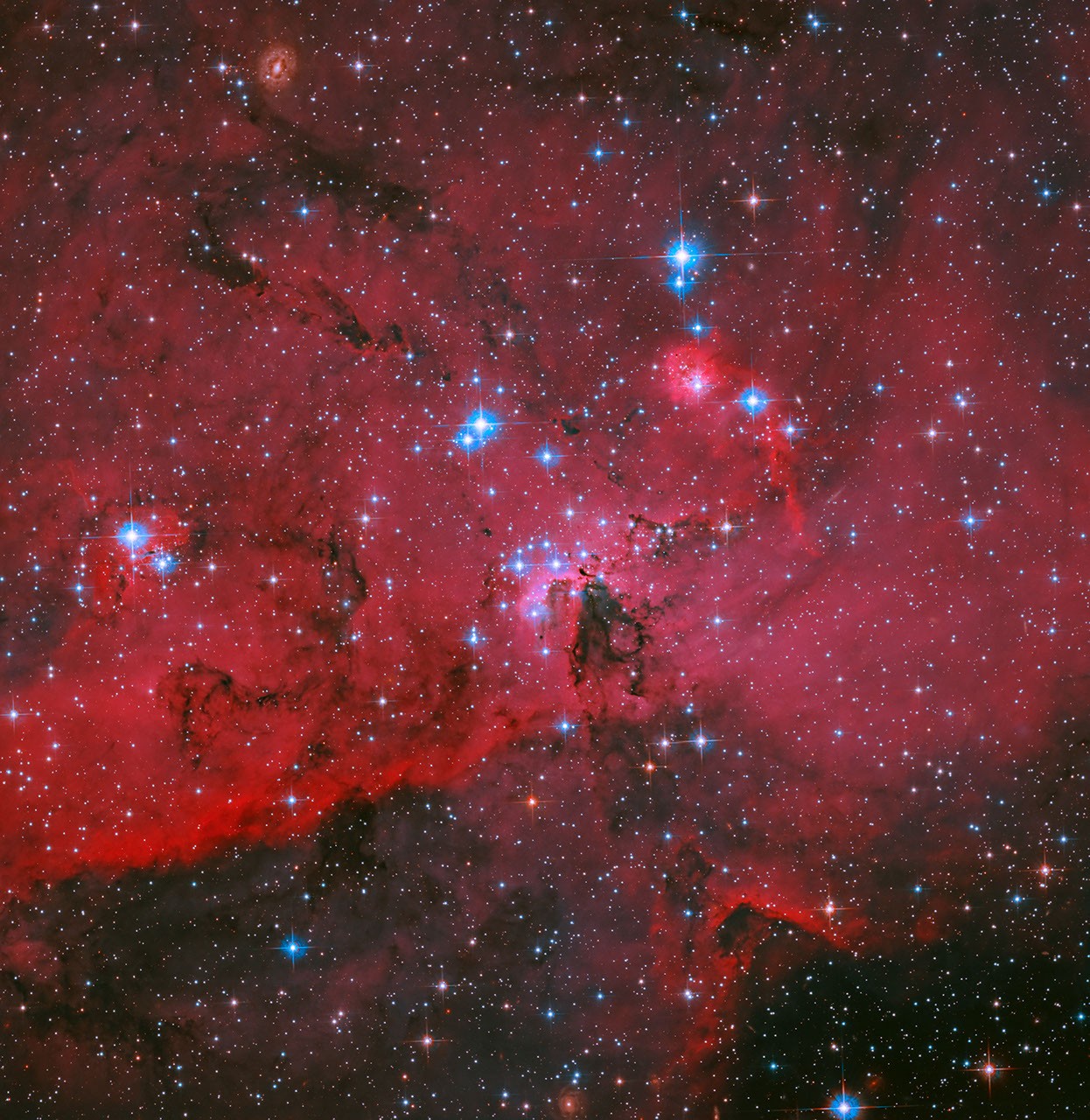
    Like fresh fireworks launched against a background of dissipating smoke, blue and white stars shine brilliantly against a crimson background of glowing gas in this image of stellar nursery LH 95 from NASA’s Hubble Space Telescope.

    Advertisement

    LH 95 is a region in the Large Magellanic Cloud, a dwarf galaxy that orbits the Milky Way. Low-mass infant stars live alongside massive blue giant stars in what is known as a stellar association, one of many in the Large Magellanic Cloud.

    The LH 95 region’s most massive stars, possessing at least three times the mass of the Sun and visible here as the largest and brightest blue stars, expel ultraviolet radiation and stellar winds that both heat and shape the surrounding hydrogen gas. Dark filaments stand out in sharp contrast against the glowing hydrogen where denser dust lanes resist erosion.

    In this image, blue indicates the shorter wavelengths that are visible light, while red depicts the longer wavelengths of visible light, as well as some near-infrared light. Colors in Hubble images are chosen based on standard image processing techniques to best represent the wavelengths of light that pass through the filters used in the observation. The gas of the nebula glows crimson due to hydrogen-alpha emissions.

    Hydrogen-alpha is an excellent indicator of star formation, allowing astronomers to identify very young stars embedded in this glowing gas. Researchers found developing stars still gathering material from the disks of gas and dust around them. In fact, LH 95 is home to an extraordinary 2,500 stars that have accumulated almost all of their critical mass but have not yet “turned on” by beginning fusion reactions. These stars, called “pre-main-sequence stars,” have formed from collapsing clouds of gas and are still contracting. They will soon begin burning hydrogen in their cores to become full stars.

    By studying these forming stars, researchers confirmed that the stars’ accretion rate ― the rate at which they accumulate matter ― decreased with age, as expected. However, they also learned that accretion can persist for several million years, longer than sometimes assumed. This information helps refine our understanding of how young stars keep growing and how their disks evolve.

    Researchers noted that distinct generations of stars in LH 95 exist side-by-side, indicating that rather than forming stars in a single event, the region produces multiple stellar generations over an extended period.

    The most massive star in LH 95 (above center, slightly left) has about 60-70 times the mass of the Sun and is about a million years younger than the rest of stars in the system, which appear to be around 4 million years old. Massive stars like these burn through their fuel quickly and die in supernova explosions.

    With its rich stellar population, LH 95 is valued by astronomers for providing a way to observe forming stars at relatively close range in an environment with less obscuring dust than similar regions of the Milky Way.

    As one of NASA’s flagship observatories, Hubble has produced a wealth of scientific discoveries over more than 30 years in orbit. Its observations are expanded upon and enhanced by observations with other NASA missions, including the infrared-detecting Webb Space Telescope and the upcoming Nancy Grace Roman Space Telescope, which is scheduled to launch in late summer.

    Explore More

    Media Contact:

    Claire Andreoli
    NASA’s Goddard Space Flight Center, Greenbelt, MD
    claire.andreoli@nasa.gov

    Advertisement
    Share. Facebook Twitter Pinterest LinkedIn Tumblr Email
    The Tech Guy
    • Website

    Related Posts

    Surprise! Meta Says Now You Have to Pay a Monthly Subscription to Use Key Features of Your Already Expensive Smart Glasses

    July 4, 2026

    Pro-growth, pro-family, pro-entrepreneur tax plan- Keep Your Check and Broad AI Participation for a Sustainable Boom

    July 4, 2026

    The Milky Way Was Rewired by a Cataclysmic Collision Billions of Years Ago. Now It Is on Course for Another.

    July 3, 2026

    Does Someone on Polymarket Know That Putin Is Going Down?

    July 3, 2026

    TESLA Growth is Back and GLOBAL AI Energy Empire No One’s Talking Will Be HUGE

    July 3, 2026

    The Birthplace of the United States

    July 3, 2026
    Leave A Reply Cancel Reply

    Advertisement
    Top Posts

    You don’t need a NAS to self-host — I proved it with hardware from my closet

    June 7, 2026169 Views

    Spotify is giving one of its best playlists a big visual upgrade to give subscribers ‘a closer connection’ to its New Music Friday curators — and I think it could be the update it’s always needed

    June 12, 202690 Views

    The iPad Air brand makes no sense – it needs a rethink

    October 12, 202516 Views
    Stay In Touch
    • Facebook
    • YouTube
    • TikTok
    • WhatsApp
    • Twitter
    • Instagram
    Advertisement
    About Us
    About Us

    SynapseFlow brings you the latest updates in Technology, AI, and Gadgets from innovations and reviews to future trends. Stay smart, stay updated with the tech world every day!

    Our Picks

    Surprise! Meta Says Now You Have to Pay a Monthly Subscription to Use Key Features of Your Already Expensive Smart Glasses

    July 4, 2026

    TCL PlayCube portable projector review

    July 4, 2026

    Windows 11 screen turns off when set to ‘Never’

    July 4, 2026
    categories
    • AI News & Updates
    • Cybersecurity
    • Future Tech
    • Reviews
    • Software & Apps
    • Tech Gadgets
    Facebook X (Twitter) Instagram Pinterest YouTube Dribbble
    • Homepage
    • About Us
    • Contact Us
    • Privacy Policy
    © 2026 SynapseFlow All Rights Reserved.

    Type above and press Enter to search. Press Esc to cancel.

    Ad Blocker Enabled!
    Ad Blocker Enabled!
    Our website is made possible by displaying online advertisements to our visitors. Please support us by disabling your Ad Blocker.