


NASA’s Nancy Grace Roman Space Telescope will create enormous cosmic panoramas, which astronomers will use to explore everything from dark energy and dark matter to distant planets and black holes. The first observations will start in early 2027. It is launched and is moving to position.
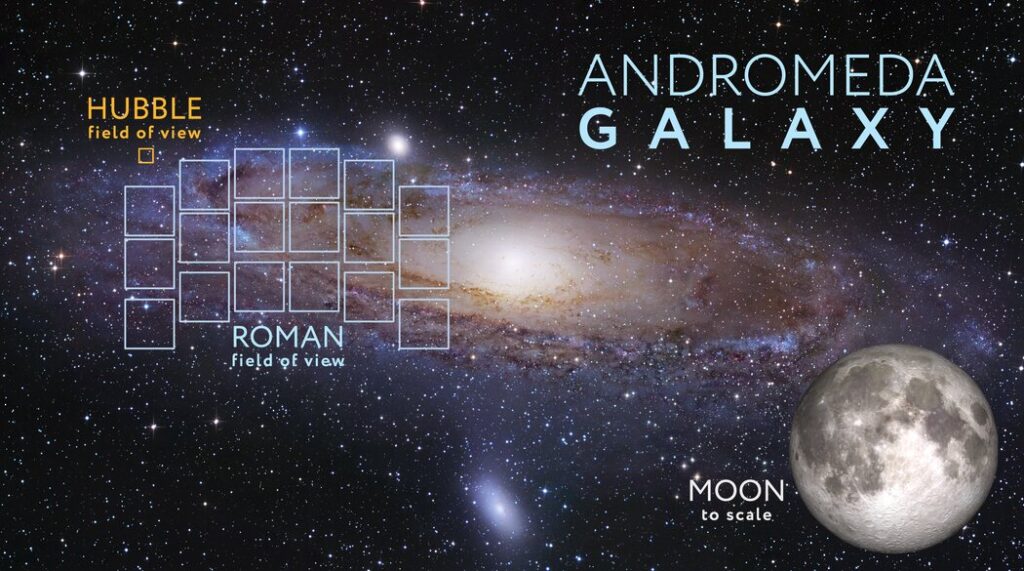
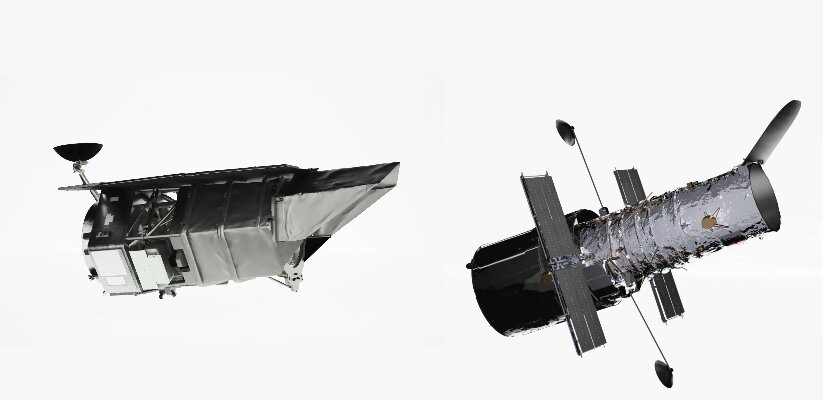
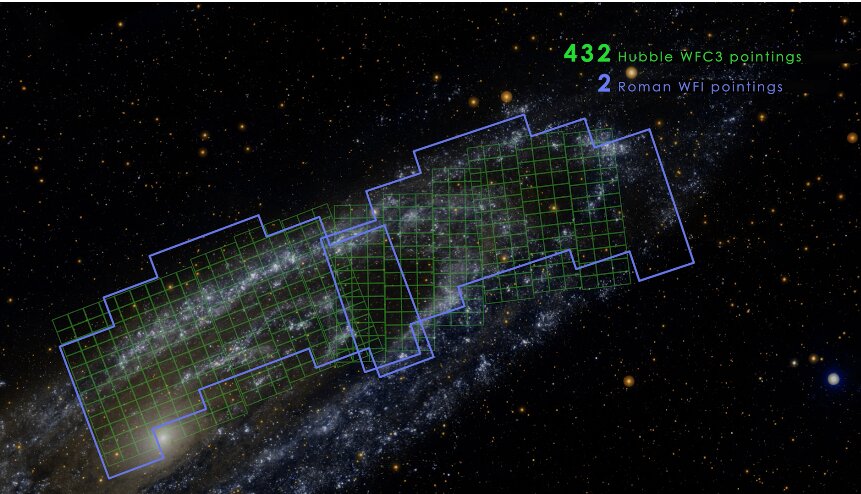
Roman will collect light from far across the universe using a primary mirror that’s 7.9 feet (2.4 meters) wide — the same size as Hubble’s primary mirror. Roman’s images will have the same crisp resolution as Hubble’s, but each one will capture a patch of the sky at least 100 times larger. Over the first five years of observations, Roman will image more than 50 times as much sky as Hubble covered in 30 years.
It will either give better measurements of dark energy or it could disprove it. Dark energy / cosmology observation. High-Latitude Time-Domain Survey will find tens of thousands of Type Ia supernovae out to z ~ 2.5—more than doubling the measured expansion timeline. High-Latitude Wide-Area Survey (~4,900 deg², ~12% of the sky) will do weak lensing, galaxy clustering, BAO, and redshift-space distortions on hundreds of millions of galaxies. Combined probes should sharply test whether dark energy is constant or evolving. Strongly lensed supernovae (dozens expected) give an independent H₀ route.
“Dark energy” is a name for a measured effect. It is late-time cosmic acceleration. The evidence is Type Ia supernovae are fainter at a given redshift than a coasting or decelerating universe predicts.
BAO plus the CMB acoustic scale give a geometric expansion history that also requires acceleration.
The age of the universe, the integrated Sachs–Wolfe effect, and the growth of large-scale structure are consistent with that picture.
Roman will add better supernovae, better weak lensing, better clustering, and an independent lensed-supernova route to H0H_0H_0. If those datasets still show acceleration — which they almost certainly will — the phenomenon itself stays. A single new telescope does not erase 25 years of multi-probe consistency.
They will try to differentiate between causes like a constant vacuum energy, a evolving field, or a change in gravity?
Quantized inertia proposes that inertial mass comes from Unruh radiation, cut off by horizons. At very low accelerations the cosmic horizon suppresses those waves, so inertia drops. That drop is supposed to:explain flat galaxy rotation curves from visible matter only (no dark matter)
produce a minimum acceleration of order. Mike McCulloch identifies with the acceleration usually attributed to dark energy. He predicts that the galaxy-rotation anomaly should get stronger at higher redshift, because the universe (the cosmic cavity) was smaller then. Those papers exist and are specific enough to be tested.
Eric Weinstein has a Geometric Unity theory. In 2025 Weinstein stated that GU predicted that there’s no cosmological constant replacing Einstein’s Lambda with a geometric field that can vary and still respect the theory’s symmetries. He predicts Lamda should not be a rigid constant. There are dozens of other dynamical-dark-energy and modified-gravity models.
Observing billions of cosmic objects will help astronomers explore exciting science topics that require such huge numbers, like exoplanet demographics and dark energy.
Hubble is tuned to see the universe in ultraviolet, visible, and near-infrared wavelengths (spanning 0.2-1.7 microns), while Roman is tuned to see visible light and further into the infrared (0.5-2.3 microns). Both observatories will perform spectroscopy, which involves splitting light into individual colors to study patterns that reveal detailed information. But Roman’s spectral studies will have lower resolution over a large area, while Hubble’s has higher resolution over a small area.
Roman will conduct rapid surveys of broad swaths of the universe to reveal large, deep regions of space.
Next 12 months (Sep 2026 – Sep 2027)
Expect engineering first, then the opening of the survey program—not a flood of finished exoplanet catalogs.
Now through ~Nov/Dec 2026 cruise + commissioning (alignments, focus, calibrations).
Early 2027 first public “glamor” images and start of science.
First high-cadence Galactic Bulge season is planned as soon as the bulge is visible after commissioning—likely spring 2027. That is when microlensing and transit monitoring of ~100 million stars every ~12 minutes begins.
HLTDS pilot (template images and early supernova-rate check) and HLWAS Deep tier also start early.
Coronagraph 3 months of allocated time in the first 18 months, starting with known nearby systems to prove contrast and take the first reflected-light snapshots of mature giant planets.
Exoplanet findings to expect
Roman uses three complementary methods.
1. Transits (Galactic Bulge Time-Domain Survey)
Simulations give ~60,000–200,000 transit candidates, commonly cited around 100,000. Most will be close-in giants. Several thousand should be smaller than 4 Earth radii. This is an order-of-magnitude jump over the current ~6,000 confirmed exoplanets, but many will remain candidates until follow-up. Roman can also measure secondary eclipses and phase curves for some of the brighter systems, giving crude temperatures and heat-redistribution constraints at scale.
2. Microlensing (same bulge survey)
This is the unique science. Forecasts are ~1,400–2,500 bound planets, including Earth- and Mars-mass worlds at wide orbits (Venus to beyond Pluto), planets in habitable zones of bulge stars, and hundreds of free-floating / rogue planets down to roughly Mars mass. These are the planets transit and radial-velocity surveys miss. Multi-planet systems and even a first microlensing exomoon are possible but rare (order-unity expected).
3. Direct imaging (Coronagraph)
Quality over quantity. A handful of nearby, mature Jupiter- and Saturn-analogs in reflected light—possibly the first image of a ringed exoplanet—plus spectra (low resolution) and debris-disk / exozodi images. Contrast of ~10⁻⁸–10⁻⁹ at 0.15–1.5″ separations. This is a pathfinder, not a census.
Bonus Solar System science from the same wide-field data potentially hundreds to ~1,000 new irregular moons of Jupiter, Saturn, Uranus, and Neptune, plus distant small bodies.

Brian Wang is a Futurist Thought Leader and a popular Science blogger with 1 million readers per month. His blog Nextbigfuture.com is ranked #1 Science News Blog. It covers many disruptive technology and trends including Space, Robotics, Artificial Intelligence, Medicine, Anti-aging Biotechnology, and Nanotechnology.
Known for identifying cutting edge technologies, he is currently a Co-Founder of a startup and fundraiser for high potential early-stage companies. He is the Head of Research for Allocations for deep technology investments and an Angel Investor at Space Angels.
A frequent speaker at corporations, he has been a TEDx speaker, a Singularity University speaker and guest at numerous interviews for radio and podcasts. He is open to public speaking and advising engagements.
