

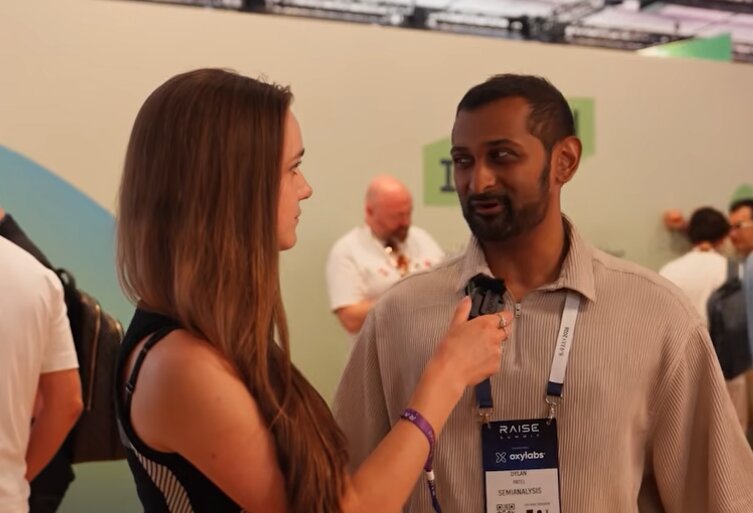

Here are the 12 hottest takes from RAISE Summit Day 2.
1. Qasar Younis (Applied Intuition)
There will be a pullback. The current level of spending on models, employees, and general opulence in AI companies is unsustainable. We’re in the “opulence phase” of the bubble, and cycles move faster than people think. He referenced the collapse of LTCM as a possible analogy for what could happen in AI.
SpaceX is better positioned than most because it already has real revenue from leasing (Anthropic ~$1.25B/month + Google ~$920M/month). This creates a natural hedge against a pullback. Colossus 2’s rapid monetization of excess capacity turns what could be a capex-heavy risk into a cash-flowing asset.
2. Dylan Patel (SemiAnalysis)
Most companies are building the wrong infrastructure. They’re optimizing data centers based on what models looked like 6–12 months ago instead of building for flexibility and general-purpose use. A lot of this infra will end up being suboptimal or wasted in 2–3 years.
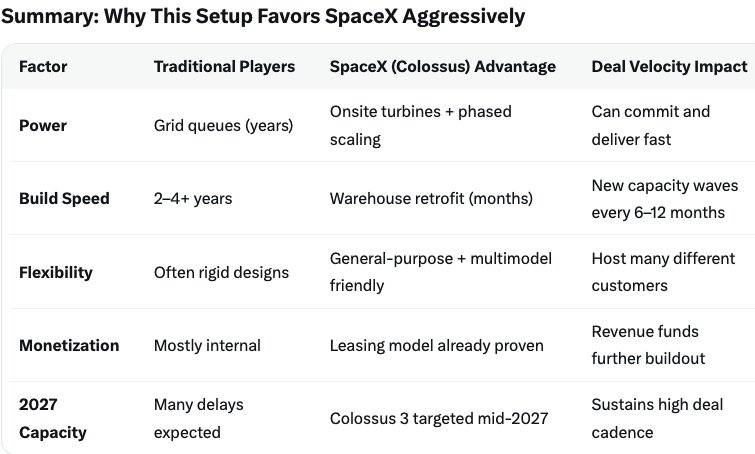
Traditional hyperscalers and many neoclouds are locking into rigid designs based on today’s Blackwell/GB200 needs. SpaceX’s approach (warehouse retrofits + onsite/mobile gas turbines + phased power) is inherently more flexible.
3. Marc Boroditsky (Nebius)
The real game is long-term enterprise adoption, not just AI-native companies. The industry needs to stop getting distracted by capex, power, and stock prices and focus on actually transforming real enterprises with AI.
4. Arvind Jain (Glean)
Open-source models will dominate inference within the next 2 years. We’ll go from almost no open-source usage to almost all inference running on open-source models.
This is bullish for leasing volume. Open-source inference tends to be more price-sensitive and higher volume. SpaceX can offer large blocks of capacity at competitive rates while still making strong margins because of its power and build speed advantages.
5. Apoorv Agrawal (Altimeter)
There are “Four Seasons of AI” — OpenAI, Anthropic, Grok/SpaceX, and Google. CIOs and CEOs should stop betting on one season and instead plan for the climate (multimodel routing, evals, and post-training custom models).
SpaceX doesn’t need to pick winners — it can host workloads from multiple labs simultaneously on the same physical infrastructure. Colossus 2 is already doing this (Anthropic + Google + Reflection + internal Grok).
6. Nikhil Benesch (TurboPuffer)
Search is still way too expensive. Bringing search costs down by another order of magnitude will unlock entirely new products and business models that currently can’t exist.
7. Barak Kaufman (Wonderful)
Geographies will matter more than verticals in AI. Country-level expansion and go-to-market strategies will be more important than vertical specialization for the biggest winners.
8. Max Junestrand (Legora)
European startups complain too much instead of locking in and competing globally. There’s a bit of laziness — if you want to build world-class companies, you have to work as hard as the Americans and Chinese (and skip the long European summers).
9. Gil Feig (Merge)
Token maxing doesn’t work. Just using more tokens isn’t producing meaningfully better results anymore. The real productivity gains come from using AI to dramatically shorten cycle times and iterate faster, not from raw token consumption.
10. Ariel Cohen (Navan)
Bullish on humans. In complex, high-stakes domains like travel, AI agents will still need heavy human oversight because hallucinations are too costly. The future is AI + humans, not AI replacing humans entirely.
11. CJ Desai (MongoDB)
Data is back and is the unsung hero of AI. You cannot build a good AI application without a strong data layer. The quality of your AI is only as good as your data.
12. Dylan Patel (SemiAnalysis) – Bonus Take
Open source is dying quickly for frontier models. Multiple Chinese labs are already telling inference providers that their next models will be closed and licensed instead of open-sourced. Demand for available working capacity remains extremely high.
Dylan Patel is making the main SpaceX bull case. Hyperscalers (Google, Microsoft, etc.) have massive signed demand but are power- and timeline-constrained. SpaceX can deliver monetizable capacity in months, not years.
Brian Wang is a Futurist Thought Leader and a popular Science blogger with 1 million readers per month. His blog Nextbigfuture.com is ranked #1 Science News Blog. It covers many disruptive technology and trends including Space, Robotics, Artificial Intelligence, Medicine, Anti-aging Biotechnology, and Nanotechnology.
Known for identifying cutting edge technologies, he is currently a Co-Founder of a startup and fundraiser for high potential early-stage companies. He is the Head of Research for Allocations for deep technology investments and an Angel Investor at Space Angels.
A frequent speaker at corporations, he has been a TEDx speaker, a Singularity University speaker and guest at numerous interviews for radio and podcasts. He is open to public speaking and advising engagements.
