

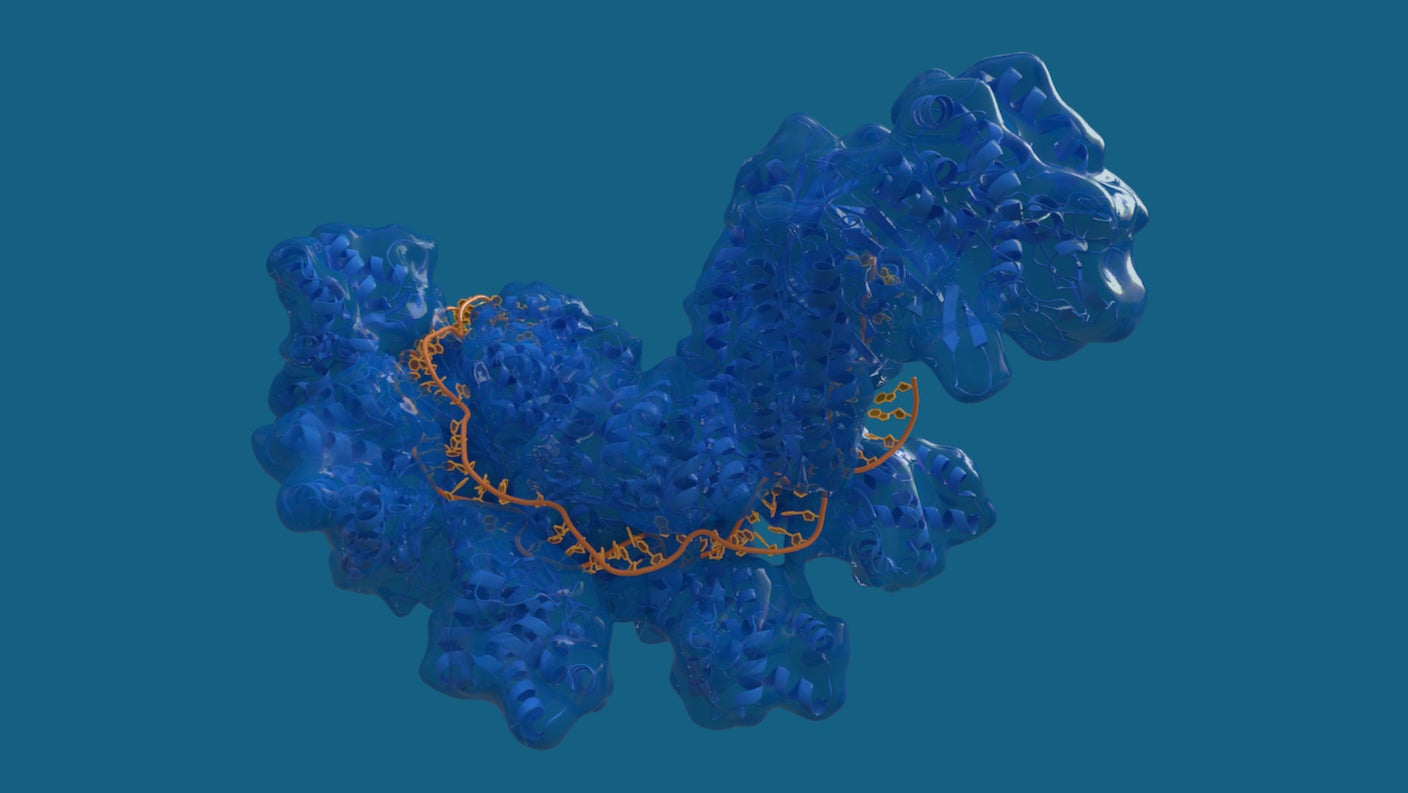

Gene editing is like a molecular meet cute. When protein “scissors” dock onto the intended gene, even a tiny slip—no more than the width of a hydrogen atom—can ruin the connection, and the protein may latch onto similar DNA sequences nearby. In a rom-com, a missed connection means heartbreak; in gene therapy, it can trigger dangerous off-target effects.
Now, AI is playing matchmaker.
In one recent study, researchers used AI to engineer more faithful gene-editing scissors with higher fidelity than previous versions. In another, AI designed the scissors from scratch. Although the synthetic proteins are markedly different than their natural counterparts, they successfully edited genes in cells from multiple species.
The studies expand protein design. “The ability to customize the molecular geometry of genome editors will drive progress towards safer and more efficient therapies,” wrote Hoi Yee Chu and Alan Wong at the University of Hong Kong, who were not involved in either study.
Scientists still need to test the new molecular scissors inside the body. Meanwhile, they’ll continue searching for natural gene editors they can both employ and use to train AI.
Long Road to Precision
There’s no doubt CRISPR has transformed biology.
From blood disorders to inherited blindness and high cholesterol, the gene editor has gone from academic curiosity to a therapeutic powerhouse in just over a decade. Researchers and doctors are also using it to engineer immune cells that recognize and attack once untreatable cancers.
But it’s not all roses: CRISPR doesn’t always edit the right gene.
The gene editor’s protein scissors, called nucleases, are steered to a DNA sequence by a fragment of guide RNA. Once the arrive, the scissors cut the DNA and change the genome.
CRISPR was first used to inactivate target genes. A more sophisticated version, called base editing, can handle single DNA letter swaps. Yet precision is still a hurdle. Early CRISPR was even branded “genetic vandalism” for straying away from its intended target and making unpredictable genome-wide changes. Another problem is called bystander editing. This is when the tool alters neighboring DNA letters that weren’t supposed to be changed. Even a handful of unintended edits could undermine treatment.
Making CRISPR more precise is something of a holy grail. But nucleases are intricate molecular machines, and even small changes to a few critical building blocks can cripple them. To improve the proteins, studies have subtly altered existing nucleases and screened variants to surface versions that have better specificity without sacrificing activity, a tradeoff that has long plagued the field.
Both approaches are tedious and slow. And because they begin with natural enzymes, they explore only a tiny fraction of the protein designs that might actually work.
“What remains unclear is which amino-acid residues [protein building blocks] in Cas9 can be further engineered to maximize fidelity—that is, to ensure that the enzyme cleaves the genome at the correct site and makes the intended edit,” wrote Chu and Wong.
AI Intuition
A Chinese team turned to Google DeepMind’s AlphaFold 3 to open the black box. AlphaFold predicts not only protein shapes but also how proteins interact with DNA, drugs, and other biomolecules.
Most researchers use AlphaFold to CRISPR and its target DNA, revealing potential hotspots for engineering. This team took a different approach. Rather than focusing on a single protein-DNA structure, they used the AI to calculate the likelihood that specific parts of of CRISPRs protein scissors would interact with various DNA sequences.
They first mapped changes to the genome after base editing in human kidney cells and then compared thousands of off-target and on-target changes. To make sense of the data, they developed ContactSeek, an AI that pinpointed protein areas more often associated with mistaken targeting. These would be prime candidates for redesign.
They then used ContactSeek to improve a base editor that switches the DNA letter A to G. With only two changes, the new editor outperformed several existing high-fidelity editors. They also generated more selective CRISPR variants—those that used a different pair of protein scissors—without sacrificing editing efficiency.
Traditional methods often rely on individual trial-and-error experiments. But ContactSeek extracts patterns from thousands of predicted interactions, revealing contact regions that might be hard to detect from single tests. But like other AI models, ContactSeek’s predictions are only as good as the data used to train it. The tool could be further improved with more data and by adding complementary AI tools, such as RoseTTAFoldNA.
In a separate study, CRISPR pioneer Jennifer Doudna and colleagues asked AI to dream up entirely new nucleases. They focused on compact proteins that gave rise to Cas12, the proteins scissors often used in base editing. Instead of tweaking existing proteins, however, they fed an AI model the proteins’ 3D structure, and asked it to redesign them. The AI spooled out thousands of synthetic candidates.
But it didn’t give any hints about which might work, and testing each would be impractical.
Instead, the team trained a second AI on which parts of the proteins interact with each other and which with DNA. Eventually, the second model learned what sections could be changed and homed in on a handful of promising designs. They differed from their natural counterpart sequences by roughly 30 percent, far more than previous AI-designed CRISPR nucleases.
Despite being somewhat alien, several edited genes in bacterial, plant, and human cells. A few even outperformed their natural counterparts in terms of efficiency. Like ContactSeek’s designs, the synthetic nucleases must next prove themselves in the body. Researchers want to make sure they don’t trigger an immune attack and can edit enough cells to treat disease.
Neither study directly addressed bystander editing, another headache in the field. But the tools can work with each other. One fine-tunes nature’s gene editors; the other creates brand new designs. It’s early, but AI is beginning to help design the next generation of gene editing tools.
