


Startup Substrate is building next-generation semiconductor fabs using advanced X-ray lithography. This goes beyond extreme ultraviolet 13.5 nanometer wavelengths down to 0.01 nanometers.
At the core of Substrate’s technology is a custom particle accelerator which propels electrons (produced by an unknown emitter) to near the speed of light using radio-frequency cavities. As these electrons pass through sporadic magnetic fields, they gain kinetic energy, accelerating to speeds very close to the speed of light (a relativistic speed), which allows them to produce special types of light when manipulated. These fast-moving electrons fly through a series of magnets that flip back and forth, wiggling the electrons and causing them to release their energy and produce coherent bursts of intense X-ray light (or radiation). Substrate is starting with soft X-rays (wavelengths of 1-10 nm, lower energy) rather than hard X-rays (wavelengths of 0.1-1nm, higher energy).
Substrate, Inversion Semiconductor and xLight and researchers at Johns Hopkins University have revealed that they are working on lithography systems harnessing particle accelerators over the past 12 months. Chinese scientists and Japanese researchers are also testing particle accelerators for semiconductor production.
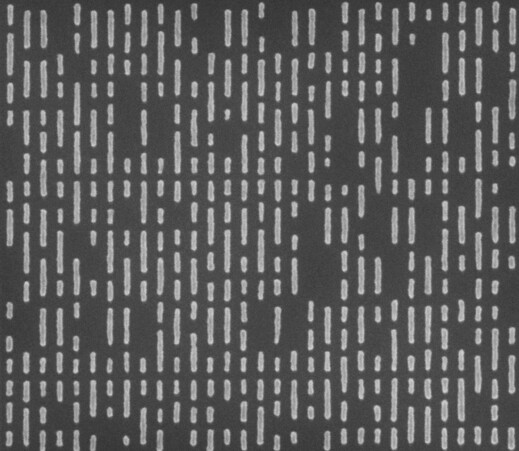
They have already printed 12 nanometer features. They can use single patterning instead of the complex multi-step processes and multilayer processes that are needed today.
They have consistent feature sizes across the entire wafer down to 0.25 nanometer accuracy tolerances. The tool costs $15 million and not $500 million.
They want to build the entire process and fab around the x-ray lithography. They need to build the resists and the masks.
They need to increase throughput.
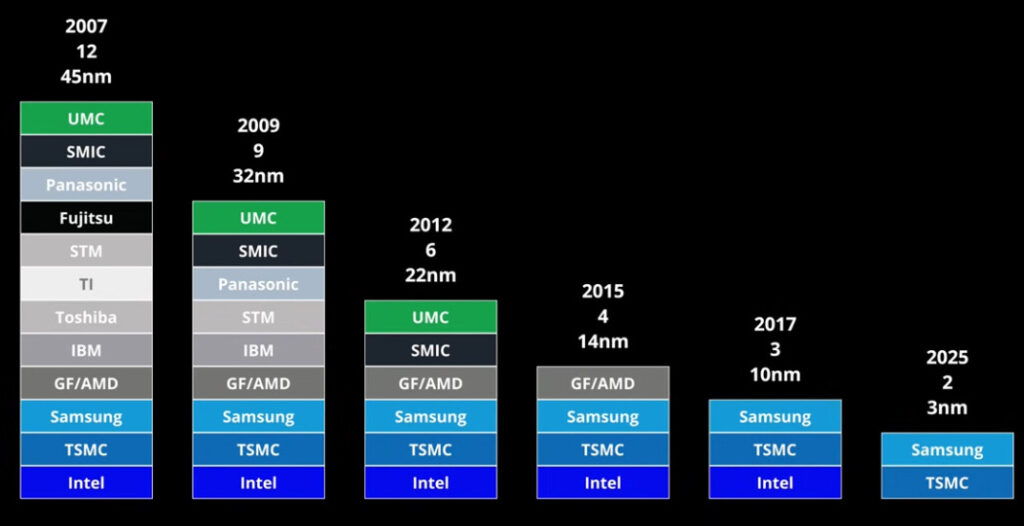
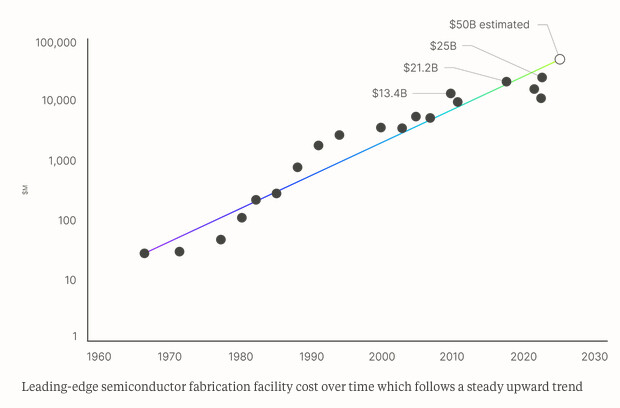
Substrate has designed a new type of vertically integrated foundry that harnesses particle accelerators to produce the world’s brightest beams, enabling a new method of advanced X-ray lithography. The compact accelerator create and power beams that generate light billions of times brighter than the sun, directly into our lithography tools, each using a completely new optical and high-speed mechanical system to produce the smallest of features needed for advanced semiconductor chips.
While current approaches are reaching their limits, leading to increasing costs and complexity, Substrate inventions are designed to work together to extend Moore’s Law for years to come.
The light source begins with radio-frequency cavities accelerating pulses of electrons using powerful electric fields. The electrons ride each successive wave, gaining energy and increasing their velocity to near the speed of light. To produce light, these charged, highly energetic electrons traverse a gauntlet of strong alternating magnetic fields, which force them to release their energy as bursts of brilliant, intense light. These bright pulses of light are transported and shaped by a succession of perfectly polished optics all the way to the silicon wafer.
They completed the first in-house production-quality 300 mm wafer lithography tool, which operates at the extreme G-forces required to meet the throughput of a leading-edge fab.
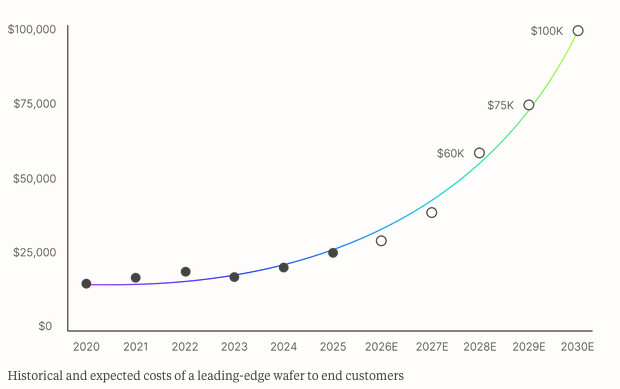
Substrate has a pathway to reduce the cost of leading-edge silicon by an order of magnitude compared to the current cost-scaling path. By the end of the decade, Substrate will produce wafers closer to $10,000, not $100,000.
AI models already assist chip designers in creating custom silicon, and in the near future, they will surpass humans at this task. The cost of design and verification will plummet to near-zero, and designing complex silicon will become something almost any company can afford. Once this happens, the bottleneck will become the fabrication and manufacturing of these chips.
Substrate understands the power of AI in accelerating innovation in manufacturing. From day one, they have leveraged GPUs and TPUs to accelerate solving problems previously thought to be intractable. By building end-to-end simulations of the physics governing our machines, the transistors they will create, and the final designs they will power, they have compressed problems that would have previously taken years to solve into days.

It will take at least 5 years to get to the first production fab.
Inversion Semiconductor is developing the next-generation chip fabrication machine, to create the most powerful chips 15x faster. Their vision is to reshore advanced chip fabrication capabilities in the West.
Using an xray light source they will double transistor density for a given numerical aperture and 3x throughput.
ASML produces 13.5 nm “EUV” light by blasting tin droplets and directing the light on to a wafer using mirrors. However, advanced chips constantly demand finer circuit features. To improve resolution, ASML enlarges its mirrors, a trade-off that significantly increases system complexity and cost.
Over the next decade ASML targets 1 kW of EUV light out, with 1 MW of power in. Inversion Semiconductor aims to achieve 10 kW of even shorter-wavelength light. This will also enable the light source to power multiple lithography machines, unlocking billions in annual revenue gains for fabs.
Currently
They aim to generate the required high power light using “tabletop” particle accelerators capable of accelerating electrons to extremely high energies over centimeters, rather than the kilometers needed for large accelerators at CERN and SLAC. They will do this using plasma waves (wakefields) driven by a high power laser.
So far they have:
Set-up a mini laser lab in the basement of the YC office, to test our novel laser stability algorithms
Developed initial LWFA prototypes to generate small-wavelength light.
Brian Wang is a Futurist Thought Leader and a popular Science blogger with 1 million readers per month. His blog Nextbigfuture.com is ranked #1 Science News Blog. It covers many disruptive technology and trends including Space, Robotics, Artificial Intelligence, Medicine, Anti-aging Biotechnology, and Nanotechnology.
Known for identifying cutting edge technologies, he is currently a Co-Founder of a startup and fundraiser for high potential early-stage companies. He is the Head of Research for Allocations for deep technology investments and an Angel Investor at Space Angels.
A frequent speaker at corporations, he has been a TEDx speaker, a Singularity University speaker and guest at numerous interviews for radio and podcasts. He is open to public speaking and advising engagements.
