


Synthetic biologists have long dreamed of constructing artificial cells from the bottom up. Researchers have now taken a major step in this direction by demonstrating that non-living components can be assembled into a system that grows, copies its DNA, and divides.
The genomic revolution transformed our ability to understand and manipulate cellular machinery, allowing scientists to rewire cells’ genetic circuitry to fight disease, produce valuable chemicals, and make crops more resilient. The holy grail for the field, however, has been to use these tools to create entirely synthetic cells—a milestone that would signal humanity’s mastery of life’s key ingredients.
How best to do this has long been an open question. Genomics pioneer Craig Venter made significant progress by stripping living bacteria back to their bare essentials, culminating in the 2016 unveiling of a minimal cell with just 473 genes. The Synthetic Yeast Genome Project has taken the opposite approach, building artificial versions of all 16 yeast chromosomes from scratch, though they’ve yet to get them working together in a single cell.
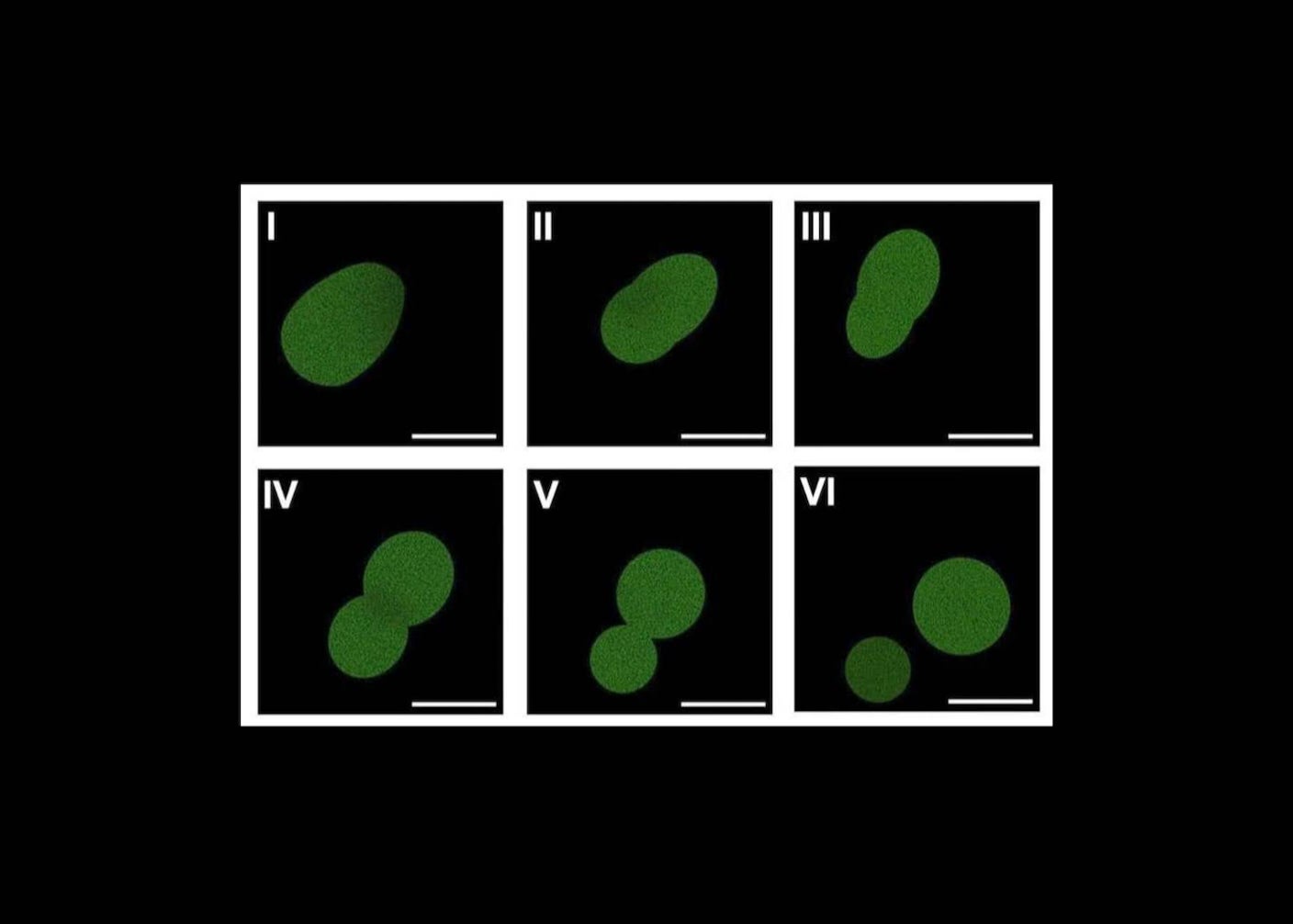
Now, researchers from the University of Minnesota, have assembled a synthetic cell out of engineered, non-living components housed inside an artificial, cell-like membrane. Their creation was capable of the four hallmarks of a living entity—the ability to feed, grow, copy genetic material, and produce offspring.
“We’ve replicated in chemistry what only used to be possible in biology: the complete set of behaviors of a cell,” Kate Adamala, who led the project, said in a press release. “It proves that the most fundamental functions of life, like growth and replication, do not need a mysterious magical spark.”
The researchers outline the design for their synthetic organism—nicknamed SpudCell for its potato-like shape under the microscope—in a non-peer reviewed paper uploaded to bioRxiv. SpudCell features a genome 90,000 base pairs long, which is considerably smaller than the 113,000 base pairs researchers had previously predicted would be the bare minimum needed to support a viable cell.
Rather than housing all the genes in a single chromosome, the team split them across several small, circular DNA molecules called plasmids, each specialized to fulfill specific functions. The researchers say this makes it possible to modify different aspects of the organism more easily.
To read the genome and build proteins, SpudCell uses a pre-defined kit of 36 purified enzymes drawn largely from E. coli. The whole assembly sits inside a liposome, a hollow bubble of the same fatty molecules that form natural cell membranes.
The artificial cell feeds in two distinct ways. Small molecules pass directly into the cell through protein pores implanted across the membrane. Molecules too large to squeeze through—like ribosomes and enzymes—are packaged inside tiny lipid bubbles that fuse with the membrane and empty their contents inside.
While the cell can feed, it’s entirely reliant on the researchers providing it with specially prepared meals. This means it’s a long way from surviving in the wild, which is both a major limitation and a key safety mechanism. “It’s a bed-ridden Frankenstein’s monster that has to be spoon-fed,” Adamala told New Scientist. “There’s no danger of it running amok.”
After ingesting “food,” SpudCell’s genes use the material to churn out proteins, while folding the incoming lipids into its membrane. This causes the whole cell structure to swell. Within a few hours, it’s bulked up enough to reproduce by dividing into two smaller cells.
Replicating cell division has been a longstanding challenge in the field. Natural cells split using an intricate protein scaffold called a cytoskeleton that’s fiendishly difficult to recreate. Adamala’s team sidestepped this problem by using a completely different mechanism, in which proteins bunch up on the membrane’s surface, putting it under mechanical strain. Eventually this squeezes two parts of the membrane together to pinch off a new cell.
The cells even manage a crude form of evolution. When the researchers introduced a genetic tweak boosting the cells’ ability to feed, those with the variant outcompeted the original lineage within five generations, and their edge widened when the researchers exposed the population to nutrient scarcity.
However, no one is claiming SpudCell is alive. Crucially, the cells cannot make their own ribosomes—the machines that build proteins from genetic instructions—and the ribosomes provided by the researchers degrade over time, limiting the cells to five to ten divisions.
The University of Chicago’s Jack Szostak told Quanta the work is an “impressive step” but the inability to produce ribosomes seriously limits potential for sustained growth. “If their system was able to generate its own ribosomes and other proteins and RNAs, it would be much closer to existing biological cells such as bacteria,” he said.
Nonetheless, the researchers think these artificial cells are a promising way to manufacture drugs, fuels, and materials without the toxic, energy-hungry industrial chemistry we rely on today. And they’ve created a new nonprofit called Biotic to share the tools they’ve developed with researchers.
