


I installed my furnace filter the wrong way while not paying attention once in our old house. I have a mechanical engineering degree, and I worked 12 years in the HVAC industry, so even I wasn’t immune to putting the filter in backward.
Most furnace filters have an arrow on them that is easy to miss, but it determines how effectively the filter will perform for the next 3–6 months. That would normally span your whole heating season if you change your filter in the fall.
The arrow on your filter points toward the furnace
Follow the air, not the label
The furnace filter has an arrow indicating which way the air flows through the filter. The air is sucked into the return ducts from the rooms of your home and is pulled through the filter and into the furnace blower. The arrow on the filter should be pointing away from the return duct and towards the furnace.
In our house, the media cabinet is in the basement, adjacent to the furnace. Regardless of where your media cabinet or furnace is, the rule still holds true. If you aren’t sure which way the air is flowing, locate the large return duct from your house. The air is flowing out of that duct, so the arrow should be pointing away from it.
Good HVAC companies will draw an arrow near your filter housing showing you which way to install the filter when they install a new system. In that case, you just have to match the arrow on your filter to the guide your HVAC installer left for you.
Filters are built to load from one side
Graded media only works in one direction
Furnace filters are not the same on both sides. The media used for pleated filters has layers with increasing density as you approach the downstream side of the filter. A wire mesh is typically on the downstream side to support the pleats against the suction force from the blower motor. The media also has coarse fibers that trap larger particles first, so that the finer media can be reserved for the smaller particles.
If you install the filter backward, the fine layer of the filter will be subject to all of the lint and dust being pulled into the furnace. This will cause the filter to load up more quickly and prevent it from trapping the particles that the filter is designed for. If you have a thin 1-inch filter installed, it could also collapse or cave in on the blower side without the support of the mesh on the correct side of the filter.
A backward filter shows up on your heating bill
Less airflow means longer runs and limit trips

A filter that loads up too quickly will restrict the return air flow into the furnace. When the furnace is restricted for airflow, heat builds up around the heat exchanger and eventually trips the high-limit switch that turns the burners off. This will cause the furnace to short-cycle, resulting in uneven heating of your home. Repeated thermal stress can also crack the heat exchanger, which can allow carbon monoxide to leak into the house.
There’s no reliable data out there on what a backward filter costs, and I wouldn’t trust any website that has a number. The U.S. Department of Energy estimates that simply changing a dirty filter could reduce an air conditioner’s energy consumption by 5–15%. That’s air conditioning, of course, but it’s the same fan pulling the same air through the same filter in January, too.
My 4-inch filter forgives more, but not everything
Deep media resists collapse, not bad loading

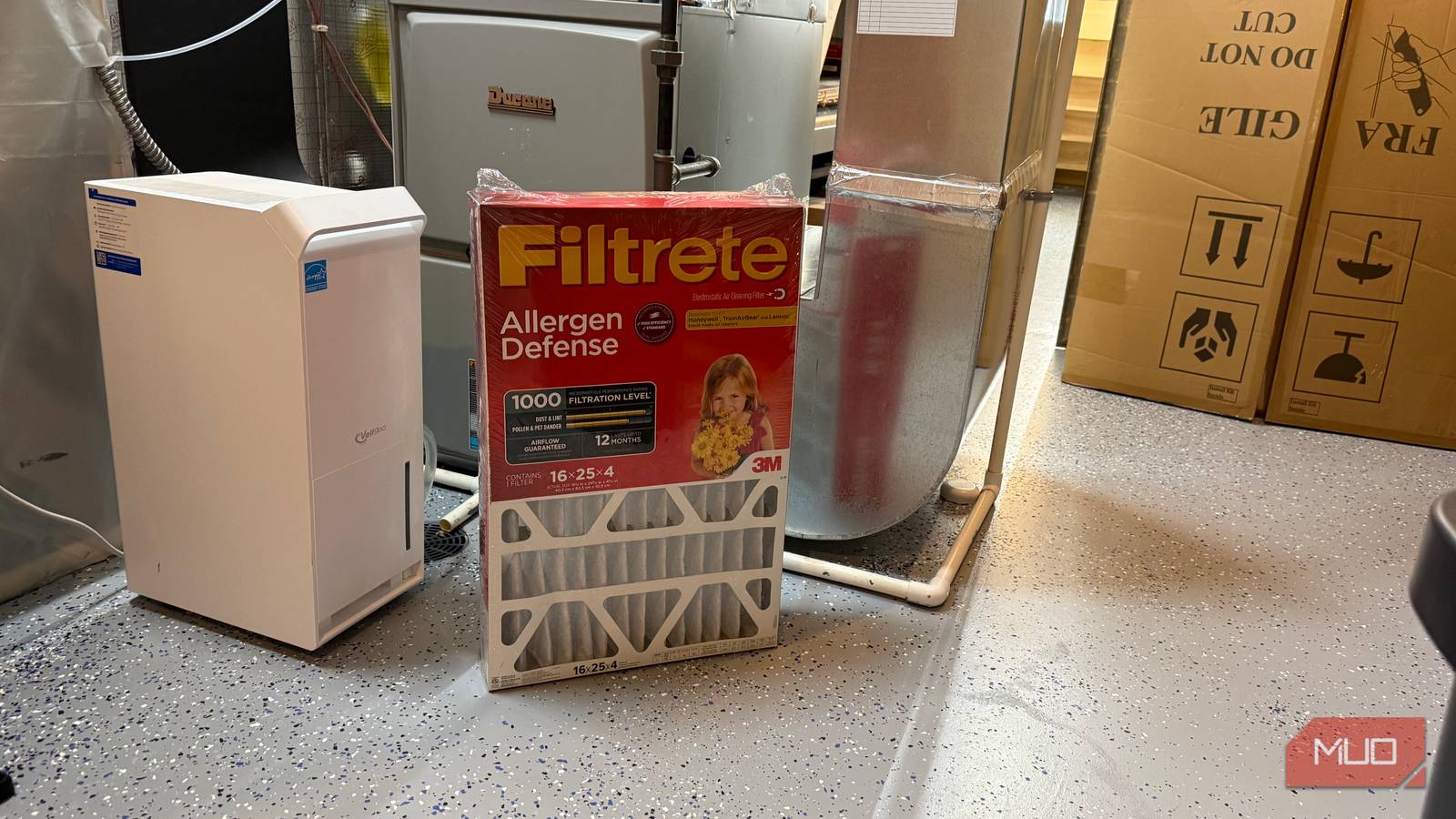
Both of our homes have used a 4-inch media filter cabinet. I’m currently using Filtrete 16x25x4, MERV 11. These filters have an MPR rating of 1000. They have deep pleats and a rigid frame, so they should not collapse even if you install them backward.
However, the loading issue still holds. The MERV 11 filter is fine enough that it matters which side faces the incoming air. A deep filter that loads up early just takes longer to show it.
My routine keeps the arrow pointed the right way
A phone reminder and a monthly look

Filtrete recommends changing my filter at least every 12 months. I rarely get that close. I have a reminder set on my iPhone to check my filter at the end of each month, and change it if it looks dirty. In most cases, this means I change it every 3–6 months.
I changed it monthly during our basement finish in late 2024 and early 2025 (due to construction dust), and more often than usual when smoke from the Canadian wildfires drifted our way. If you run your fan on the Circulate setting, you’ll run more air through your filter, so you should check it more often. Also, if you run your fan more to solve cold spots, you should check your filter more often.
Check the arrow before you close the cabinet
It takes 2 minutes to change a furnace filter. Just spend an additional 2 seconds to ensure that the arrow is pointing in the right direction (toward the furnace), close the filter cabinet, and set your next reminder. There will be no warning with a backward filter; it will just work harder and be less effective until you pull it out, sometimes months later.
