


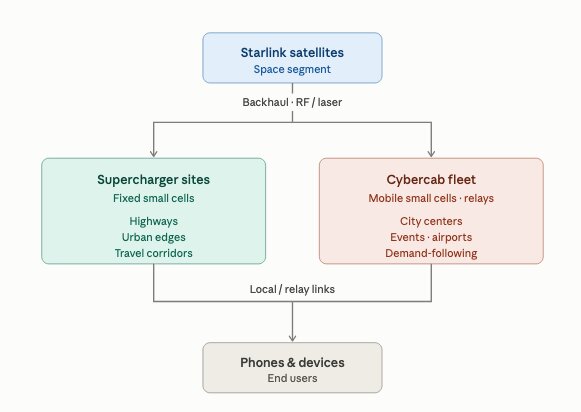
SpaceX’s Direct-to-Cell service delivers wide-area coverage from orbit, but it still runs into the classic satellite limits: capacity and densification in crowded areas. The most elegant fix is already sitting in Tesla’s network — Supercharger stations and the coming Cybercab fleet.
Turn Superchargers into fixed small cells and Cybercabs into mobile densifiers, backhaul the whole thing over Starlink, and you get a hybrid network that’s far cheaper and faster to scale than anything a traditional carrier can build.
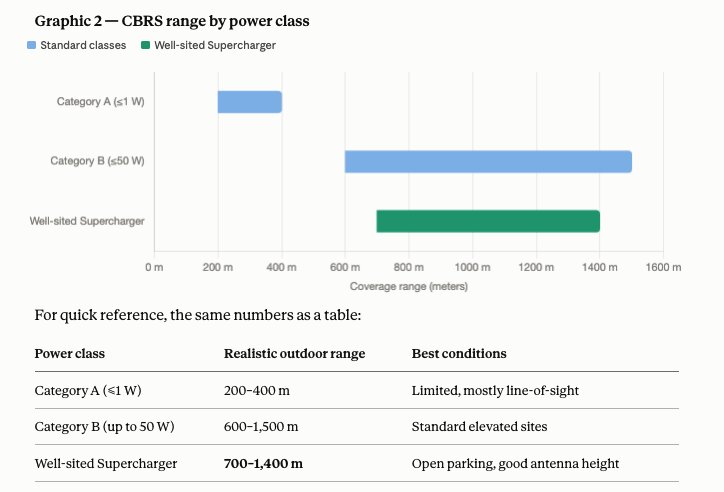
Realistic small-cell range with CBRS
Outdoor small cells typically cover 200–2,000 meters. On CBRS spectrum, real-world performance depends mostly on transmit power, antenna height, and clear line of sight. Supercharger sites are unusually favorable — many already sit in open lots with good mounting height.
The lower 200-400 meter range use 1 watt of power while the longer range go up to 50 watts.
Covering Cities
The strategic power isn’t any single cell’s reach but getting complete coverage. Fixed Supercharger nodes hold the corridors, mobile Cybercabs follow demand into dense areas, and Powerwall-hosted nodes fill in neighborhoods.
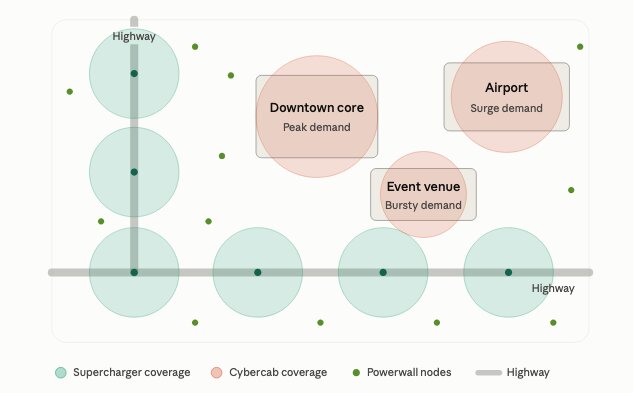
Roughly 6,000 Supercharger locations already anchor corridor and suburban coverage. Tens of thousands of Cybercabs would add mobile capacity exactly where people concentrate, and Powerwall-hosted nodes extend a resilient residential layer. The result follows traffic and population instead of leaning on static towers.
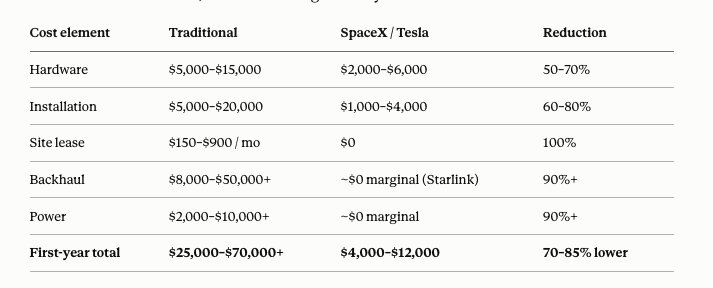
The real advantage is cost
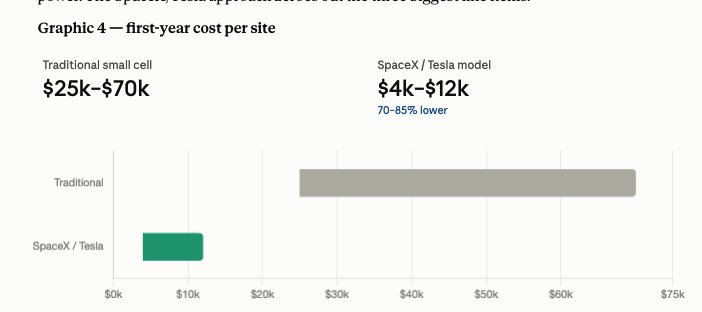
This is where the model breaks from the traditional playbook. A conventional outdoor small cell runs roughly $25,000–$70,000 in its first year once you add fiber backhaul, site lease, and power. The SpaceX/Tesla approach zeroes out the three biggest line items. Mass production and integrating the systems into the products will remove duplicate installation and get costs to around $1000-2000 for superchargers, powerwalls and megapods. The low power car systems will be $100-250.
Brian Wang is a Futurist Thought Leader and a popular Science blogger with 1 million readers per month. His blog Nextbigfuture.com is ranked #1 Science News Blog. It covers many disruptive technology and trends including Space, Robotics, Artificial Intelligence, Medicine, Anti-aging Biotechnology, and Nanotechnology.
Known for identifying cutting edge technologies, he is currently a Co-Founder of a startup and fundraiser for high potential early-stage companies. He is the Head of Research for Allocations for deep technology investments and an Angel Investor at Space Angels.
A frequent speaker at corporations, he has been a TEDx speaker, a Singularity University speaker and guest at numerous interviews for radio and podcasts. He is open to public speaking and advising engagements.
