

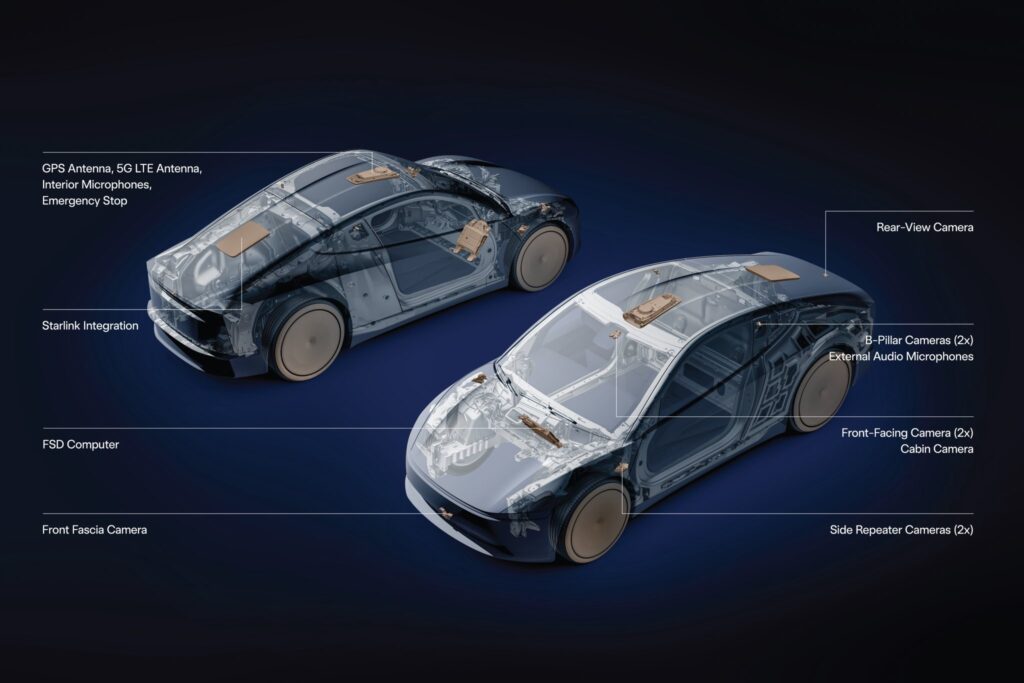

SpaceX Starlink V5 satellite terminal directly integrated into the Cybercab’s roof structure (alongside the GPS antenna, 5G LTE antenna, FSD computer, and various cameras). This is a clean, factory-integrated design rather than the external Starlink Mini dishes spotted on earlier prototypes/testing vehicles (often mounted on the trunk lid).
Starlink V5 directly integrated in Cybercab pic.twitter.com/FxzTtzjB6I
— Tesla (@Tesla) July 20, 2026
Higher-Resolution/Dual GPS
The Cybercab includes a dedicated dual GPS (or dual-frequency GPS) system for significantly higher positioning accuracy and redundancy compared to standard consumer Tesla vehicles. This supports SAE Level 4 autonomy requirements (full self-driving in defined conditions without constant human oversight). Dual GPS helps with instantaneous heading determination (two separated antennas give direction without needing vehicle movement).
Better performance in challenging environments (urban canyons, parking structures).
Overall telemetry reliability is improved for a driverless vehicle.
The Starlink V5 terminal sits alongside the GPS antennas in the roof (per the Tesla diagram), so they are co-located and complementary. Starlink terminals themselves include GNSS receivers for satellite acquisition/pointing, and broader research explores using Starlink signals as a GPS backup or augmentation for positioning, navigation, and timing (PNT). However, the primary “higher-resolution GPS” upgrade in the Cybercab is the vehicle’s dedicated dual GPS hardware.
Research (primarily from Ohio State University’s ASPIN lab, led by Zak Kassas, with results featured in GPS World and ION papers) demonstrates strong opportunistic use of Starlink’s Ku-band downlink signals (OFDM beacons). With an average of ~3 simultaneously visible Starlink satellites, ~2-meter 3D positioning accuracy is achievable in ~20 seconds (from a poor initial guess, using Doppler observables from the full OFDM beacon after advanced signal processing). Earlier work (2021–2025) was 8–10 meters with 6 satellites over longer periods and improved to meter-level with IMU (inertial measurement unit) aiding and ephemeris/timing corrections.
Expected PNT accuracy improvements by 2028. Standalone Starlink PNT will likely have routine sub-meter to low single-digit meter accuracy, with faster convergence (seconds instead of tens of seconds), higher availability, and better performance in challenging environments. Denser constellation + V3 signals (stronger, better processed) will improve Doppler/pseudorange quality and geometry. With DTC and hybrid systems, Starlink GPS could potentially exceed standard GNSS robustness, with meter-level or better accuracy in many scenarios. Multi-frequency or differential techniques could push toward sub-meter.
Long-term vision with ~1,000× more satellites eventually, Starlink PNT could be far more robust than GPS (over 10×-100X visible satellites and much stronger signals). Centimeter-level (or better) positional accuracy with Starlink PNT by 2029–2030 is plausible under SpaceX’s long-term vision of massive constellation growth, especially if they evolve from today’s opportunistic use of communication signals toward a dedicated or hybrid PNT service. Broadcast of precise ephemeris/clock corrections, support for carrier-phase tracking, or a network-assisted/PPP service. Research shows that providing real-time corrections turns performance from limited to near-GPS or better
Data Transfer for Fleet Learning
This is one of the biggest practical benefits. Starlink provides high-bandwidth, low-latency bidirectional connectivity (far superior to cellular in coverage and uplink speed in many scenarios). For Tesla’s end-to-end neural net training approach (vision-only, fleet-scale learning). Vehicles can upload massive amounts of camera/sensor data, video clips, telemetry, and edge cases much faster.
This accelerates the “fleet learning” loop. More data → faster model improvements → quicker iteration toward reliable unsupervised operation.
It also enables reliable over-the-air (OTA) software/FSD updates and real-time fleet monitoring/telemetry, even in remote or cellular-dead-zone areas.
Earlier prototype testing with Starlink explicitly highlighted faster data uploads as a way to speed up development.
Benefits for Unsupervised Robotaxi
For a purpose-built, no-steering-wheel/no-pedals robotaxi fleet aiming for unsupervised (Level 4+) operation at scale.
Redundancy and reliability — Cellular coverage has gaps (rural roads, tunnels, dense urban areas, disasters). Starlink provides an independent satellite link, ensuring the vehicle stays connected for safety, remote support (if ever needed), and operations. Waymos have stopped operation in San Francisco when they lost cellular communication.
Faster AI improvement — High-speed uplink directly speeds up the data pipeline that trains Tesla’s FSD models. Tesla’s core advantage has always been fleet-scale data. Starlink removes a major bottleneck.
Operational scalability — Supports wider geographic deployment, 24/7 uptime, and global expansion without depending solely on terrestrial networks.
Passenger experience — Bonus high-speed Wi-Fi (potentially a differentiator for robotaxi service).
Future-proofing — Aligns with Tesla’s vision of always-connected physical AI systems.
Write-Ups, Technical Papers, and Related Research
Tesla’s own patent (US 2025/0368267, filed ~2024, published Dec 2025). Details an RF-transparent roof assembly using polymer materials (polycarbonate, ASA) to embed satellite antennas (and other electronics) directly into the roof without signal blockage. This is the foundational technology enabling the clean Starlink V5 integration shown today. It explicitly mentions facilitating communication with satellites.
IEEE paper (2023) Improving the safety of autonomous driving by using Direct-to-Satellite connectivity. The case of Iridium and Starlink satellite constellations. It presents real-world measurements of vehicular data transfer via Starlink (and Iridium), latency analysis, and concludes that satellite links can improve road safety through better situational awareness sharing.
Broader Trend: Physical AI + Starlink + IoT Integration ==> Global Internet of Things
This fits a clear, accelerating trend. All Tesla’s physical AI (Cybercab robotaxis, Optimus humanoid robots, FSD) gains a global, high-performance connectivity backbone via Starlink.
Enables edge devices (vehicles, robots, sensors) to reliably upload training data to centralized AI systems, receive updates, and operate in remote/IoT-scarce environments.
There will be a seamless global internet of physical things where autonomous systems, robotics, and infrastructure stay continuously linked for collective intelligence and scalability.

Brian Wang is a Futurist Thought Leader and a popular Science blogger with 1 million readers per month. His blog Nextbigfuture.com is ranked #1 Science News Blog. It covers many disruptive technology and trends including Space, Robotics, Artificial Intelligence, Medicine, Anti-aging Biotechnology, and Nanotechnology.
Known for identifying cutting edge technologies, he is currently a Co-Founder of a startup and fundraiser for high potential early-stage companies. He is the Head of Research for Allocations for deep technology investments and an Angel Investor at Space Angels.
A frequent speaker at corporations, he has been a TEDx speaker, a Singularity University speaker and guest at numerous interviews for radio and podcasts. He is open to public speaking and advising engagements.
